

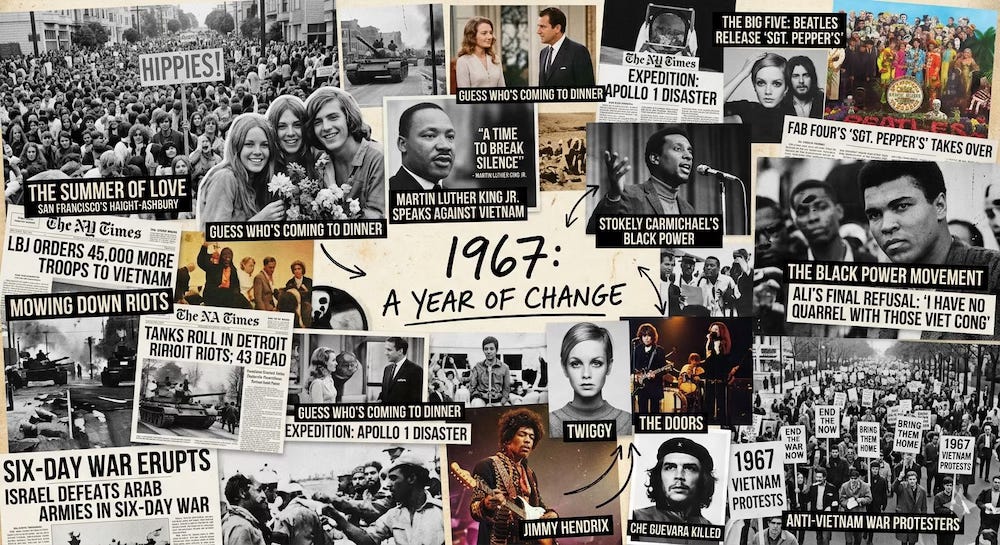
I recently rewatched The Trip on TCM. Roger Corman’s 1967 film, script by Jack Nicholson, Peter Fonda tripping through its Technicolor dreamscape, isn’t great cinema by any serious measure. But that’s almost beside the point. What it is, exactly, is a document of a very particular moment in American life: the summer the center stopped pretending to hold. Watching it again, I felt something give way inside me, and suddenly I was back there.
1967 arrives in memory not as a single year but as a series of vivid exposures, each one overlit, the colors slightly off, the way photographs look when the film has been pushed too hard in the developing.
My drift toward the counterculture had actually begun five years earlier, when I got serious about jazz. The catalyst, oddly enough, was a television character: Maynard G. Krebs on The Many Loves of Dobie Gillis, bongos, poetry, Thelonious Monk, a hip vernacular that felt like a private language someone had carelessly left within reach. I started subscribing to the Village Voice, buying Lenny Bruce records, working my way through Kerouac and Ginsberg, making notes in margins with a seriousness I now find touching. Day-long pilgrimages to Greenwich Village. The round trip train from Hartford to Grand Central was $6.12.
Then came the first Kennedy assassination, the Beatles, and American culture began moving fast enough that you could feel the wind of it on your face. I was an early Baby Boomer, a generation that felt genuinely discontinuous from our parents, a mutation rather than a continuation. My father was a pianist, so he got the jazz. But the rest of it, the protests, the Civil Rights movement, the psychedelic fashions, arrived on him like dispatches from a country he’d never been issued a visa for.
By April of 1967, I went to New York for the first Be-In which took place at the Sheep Meadow in Central Park where thousands of us arranged on the grass like a vast, unruly orchestra without a conductor. Sgt. Pepper dropped that June, a few weeks before my high school graduation. I remember the needle going down, the hiss before “A Little Help from My Friends” came surging through the speakers, and the sense that something had irreversibly shifted. I turned eighteen on August 1st, already deeply curious about LSD and marijuana though I hadn’t tried either yet, paying close attention to how the media was framing all of it, the way a man watches an oncoming wave, half in terror, half in longing.
I had one friend who’d actually been there: a barber, ten or fifteen years older than me, with a small apartment above his shop that smelled of clove cigarettes and patchouli. Country Joe and the Fish murmuring from a transistor radio on the windowsill. I watched him smoke weed, though I declined when he held the joint out to me. He spoke about acid the way people do when something has genuinely rearranged them, quietly, without drama, as though describing a place you could visit if you knew how to read the maps.
Timothy Leary was everywhere that year. Talk show after talk show, those pale eyes radiating calm authority, making his case for LSD with the measured cadences of the Harvard professor he’d once been, arguing that the drug could liberate people from the invisible architecture culture had quietly erected around them, the ceilings they didn’t know were ceilings, the walls they’d mistaken for open sky. That argument landed on an eighteen-year-old like a summons.
By that summer I was on the verge of leaving suburban West Hartford for New York. I’d been watching foreign films obsessively, Godard, Antonioni, Bergman, Fellini, and had decided I wanted to make films. The moment that crystallized it was a film forum where a young Francis Ford Coppola appeared, just after writing the screenplay for Patton. He spoke about cinema the way my barber friend spoke about acid, as though it were a technology for dismantling and rebuilding consciousness, frame by frame.
Two events that year foretold everything that followed.
The June before graduation, my senior class held a Class Night talent show for which I had made a short film. For the soundtrack, I included “A Day in the Life” from Sgt. Pepper. When I screened it for the principals beforehand, they were horrified, insisting the song glorified drug use and demanding I cut it. I agreed. Then ignored them completely.
After introducing the film at the event, I slipped into the projection booth and locked the door behind me. The moment those opening piano notes hit, the principals came running, pounding on the door, frantic to shut it down. They didn’t get in. The song played through.
The next day the Vice Principal of Discipline called me in. He gave me a detention, but he also phoned my father with a warning that carried more weight than the punishment itself: he was concerned, he said, that I appeared to be developing into someone who would defy authority by any means necessary. Probably become one of those protestors.
He wasn’t wrong.
That October, I learned that Francis Ford Coppola was shooting a film out on Long Island. I had written to him the previous year asking about the path to becoming a filmmaker, and he had written back with a genuinely encouraging letter. So I reached out again, bold enough to ask if I could meet him for breakfast at the Garden City Hotel where he was headquartered. He said yes.
We spent an hour together one morning, and then he took me outside and showed me something he was building: a truck that housed everything needed to shoot a film, a fully mobile production unit, long before portable filmmaking was even a concept. Standing beside it was the young man constructing it for him. Coppola introduced us. His name was George Lucas.
This was five years before The Godfather. Nearly a decade before Star Wars. I was eighteen years old, standing in a parking lot on Long Island, and I had absolutely no idea what I was looking at.
I should have asked to stay. An unpaid internship, a grunt job, anything, just to be on that set. I would have learned more about filmmaking in a few months than I ever did at NYU Film School. But I was eighteen, short on confidence, terrified of what my parents would say. And so I shook hands and went back to school.
I’ve thought about that morning many times. Not with bitterness exactly, more the way you think about a door you watched close. What’s on the other side remains unknowable, and eventually you stop trying to imagine it. I found my way to filmmaking anyway, just by a much longer, more circuitous route.
That year, the war in Vietnam stopped being something distant. By 1967 I could no longer just read the headlines and turn the page. When I got to New York, I went to my first real demonstration, part of a crowd that stretched farther than I could see, all of us moving together with a sense of purpose I had never felt before.
Then the mood shifted. The police moved in, and I turned to find a mounted officer bearing down on me, the horse enormous in the middle of the street. I ran. He chased me for what felt like a long block, hooves hammering the pavement right behind me, the officer yielding a billy club, until I managed to cut between parked cars and lose him. I was shaking. I was angry. And I was more certain than ever that I had landed on the right side of this.
Looking back across everything that followed, the films, the cities, the collaborations, the marriages, the failures and the occasional luminous successes, 1967 stands apart from every other year. It was the year the current I’d felt moving beneath still water finally reached the surface and began, unmistakably, to run.
Listening - Soul Perfection Remix - Marvin Gaye’s Mercy Mercy Me
Soul Purrection is a YouTube channel that remixes popular music to expose what’s already there, pulling key elements out of the original recording and giving them room to breathe.
When Marvin Gaye brought “What’s Going On” to Motown in the early seventies, Berry Gordy rejected it. Too jazzy. Not commercial. Gaye was certain the music mattered, and maneuvered a single into the hands of radio DJs anyway. It became an immediate hit, and Gordy reversed course, ordering an album built around it. What Gaye delivered was a suite, not a collection of songs. Tracks flowed into each other. Politics, ecology, spirituality, all of it wrapped in orchestration that Motown had never attempted. “Mercy Mercy Me” sat in the middle of that album like a wound, Gaye’s voice riding above strings and rhythm in a lament about a planet being destroyed by the people living on it.
Soul Purrection strips that recording back and lets you hear what Gaye and arranger David Van DePitte buried in the mix. What you thought was background turns out to be the whole argument.
Watching: Dynasty: The Murdochs and the Empire That Ate Itself
There’s a line early in Liz Garbus’s four-part Netflix documentary that lands like a verdict: “He wasn’t raising children. He was raising possible successors.” Everything that follows in Dynasty: The Murdochs is the consequence of that sentence playing out across half a century of money, media, and managed cruelty.
The series follows the story from Rupert’s earliest empire-building to the final reckoning: a court battle and a $3.3 billion settlement paid to the three children who lost when Lachlan Murdoch was handed control of Fox. Dynasty: The Murdoch exists because the family drama played out on the world’s stage, and Fox News’ impact on our political and social fabric has stakes for all of us.
The family declined to be interviewed, which turns out not to matter much. Thousands of pages of documents, emails and text messages never before seen paint a portrait of a ruthless patriarch who raised his four eldest children less as a family than as gladiators, pitting them against each other for his affection and his empire.
“Rupert got everything he wanted, but it ripped his family apart.” Four episodes. Worth your time.
Next Tuesday The Country That Optimized Away It’s Soul
The United States doesn't have a community problem. It has a marketplace problem. Every social interaction has been quietly converted into an economic transaction, every citizen into a walking brand. Mexico, corrupt and chaotic as it is, never made that trade. Next week I'll explain why living in Guanajuato made that impossible to unsee.
Being 3 years younger than you Bret, I had the opportunity to learn a lot from you... jazz, Lenny Bruce... and I guess I can finally admit this now... at least on one occasion, copying your act (but not your courage... as I never got caught). Last day of Jr. High School, school assembly in the auditorium, and as a member of the AV "Club" a few of us were working the lights and mics... and right before the principal was to make his final comments - we put "We Gotta Get Out of this Place" on a continuous loop, left the projection room, and locked the door behind us... and then just melted into the audience of 14 year olds trying to figure out the changing world of 1967.
Takes me back to the old 'hood. Walking in many of the same places you did, literally. But we all take different routes to get where we eventually settle. I'll guess that your enthusiasm for music and the arts was assisted by your exposure to this at a young age. I remember sitting at our grandfather's house, listening to a national radio broadcast from overseas where we all gathered to hear the military band, with your father as band conductor. A proud moment for all of us. The apple doesn't fall far from the tree.