

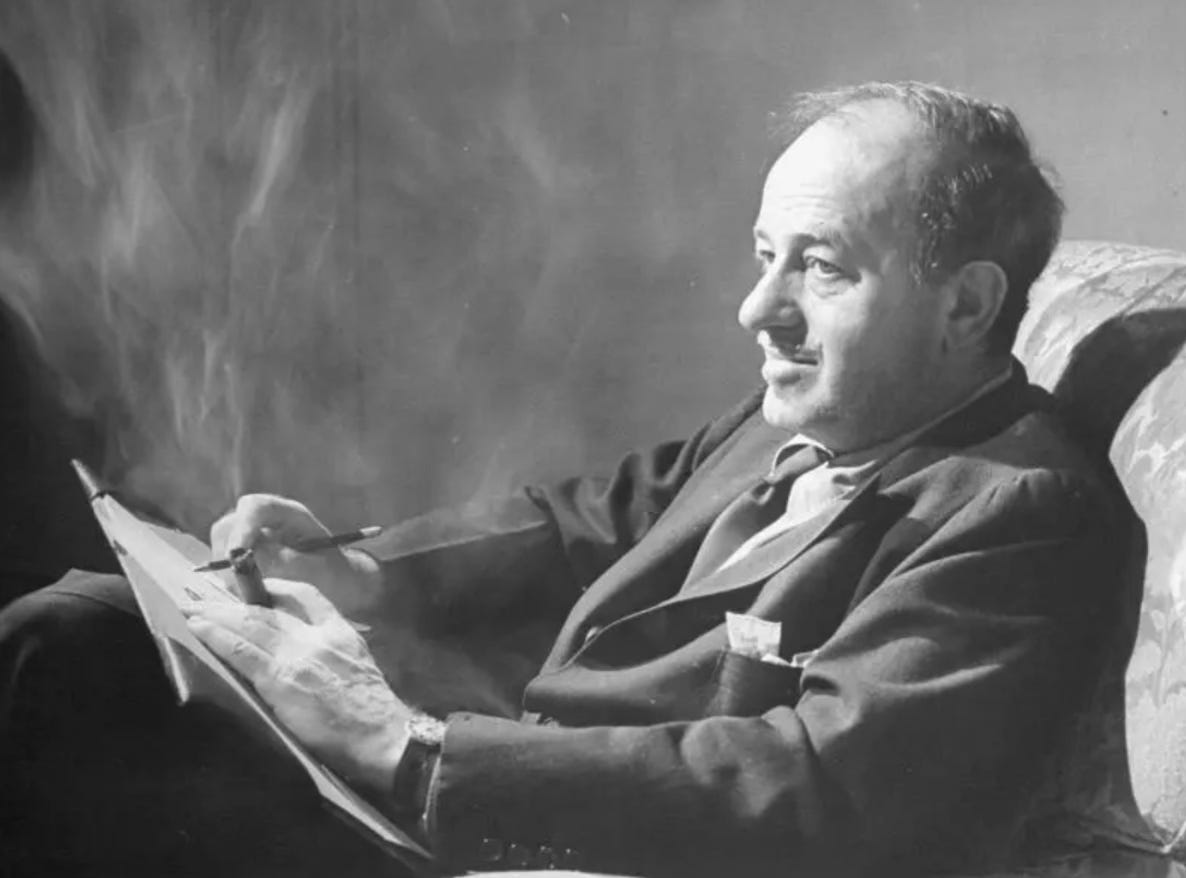
I’ve always been drawn to individuals unafraid to express or create what they know to be true, even at personal risk. Such courageous voices are increasingly rare, especially now in the age of growing self-censorship.
It requires immense courage to pursue actions others might find unsettling. It’s far simpler to avoid confrontation than to face opposition directly. Many prefer to “go with the flow,” reasoning that life is challenging enough without inviting additional conflict.
However, some of us feel compelled to take a different path—not for attention, but because we must. We speak, write, or create because it’s an intrinsic part of who we are. Suppressing this drive leaves us incomplete as writers, artists, and individuals.
As James A. Baldwin observed, “It is only because the world looks on his talent with such a frightening indifference that the artist is compelled to make his talent important.”
Embracing this calling demands resilience and a willingness to face potential adversity, but it’s essential for personal fulfillment and authenticity. Sometimes it produces memorable art and sometimes, it can kill us.
Ben Hecht, the writer, John Coltrane, the musician, and Lenny Bruce, the comedian/satirist, are compelling examples. All three are personal heroes. Today I’ll discuss Ben and the follow up posts will focus on Trane and Lenny at a later date.
Ben Hecht was a prolific writer, journalist, and screenwriter whose sharp wit, unfiltered voice, and relentless activism made him one of Hollywood’s greatest storytellers, and, a fierce advocate for justice.
As a teen, Ben Hecht started out as a Chicago newspaperman before rising to prominence in the city’s 1920s fabled literary scene. His 1922 novel, Fantazius Mallare, sparked an obscenity case. While Hecht avoided major penalties by not contesting the charge, the case reflected a wider crackdown on so-called indecent literature of the era.
In the late 1920s, Hecht was lured to Hollywood by a now-famous telegram from screenwriter Herman J. Mankiewicz, the screenwriter for Citizen Kane: “Millions are to be grabbed out here and your only competition is idiots. Don’t let this get around.”
Mankiewicz, already established in the film industry, knew Hecht’s sharp wit and storytelling skills would thrive in Hollywood. Hecht took the bait and quickly made his mark, winning his first Academy Award for Underworld in 1929, which invented the crime genre. By the time the Depression was in full swing, he was wildly successful in Hollywood.
Hollywood success then and now isn’t just about talent—it’s about playing the game. Navigating egos, power struggles, and industry politics require diplomacy. Staying in the good graces of the studio system means knowing when to stay quiet and when to play along.
That wasn’t Ben Hecht’s style. By the late 1930s, he had strong opinions about the Nazis’ rise to power and little interest in keeping this to himself. As a result, he was at odds with Hollywood’s power players—the studio moguls, many of whom, like Hecht himself, were Jewish.
At the time, what was happening to the Jews in Europe wasn’t front-page news. Most people remained unaware of the full extent of Nazi atrocities. But Hecht knew, thanks to refugees who had escaped Hitler’s reign of terror and somehow managed to get their stories out.
Ben Hecht couldn’t simply carry on with business as usual. He felt compelled to write and speak out, driven by a deep sense of responsibility to use his voice to expose the truth—and perhaps even alter the course of history.
In the 1930s, anti-Semitism was prevalent across the globe. In Hollywood, Jewish success often required a degree of assimilation. For instance, many actors and filmmakers altered their names—Bernie Schwartz became Tony Curtis, Issur Danielovitch became Kirk Douglas, and Betty Joan Perske became Lauren Bacall—in an effort to blend in and avoid discrimination. During that time, few were willing to openly acknowledge their ethnic heritage.
With the industry’s remarkable success, the Hollywood studio heads, in particular, were careful not to stir controversy. They supported the U.S. war effort, but they also avoided anything that might draw government scrutiny. This led to a culture of self-censorship. During World War Two and even after it was over, for decades, there was scant mention of the Holocaust on the silver screen.
As Hecht split his time between Hollywood and New York, he became one of the few voices in America speaking on behalf of Europe’s Jews. His wife, Rose, understanding his urgency to wake up the American public—especially American Jews—to the Nazi threat, helped him secure a position as a columnist for the liberal New York newspaper P.M. Hecht began writing a column, publishing stories and essays exposing the horrors unfolding overseas. His powerful Reader’s Digest article, “Remember Us” was the first national call to action.
It also signaled his growing troubles in Hollywood. His friends repeatedly told him to stay away from politics, because his involvement could jeopardize his screenwriting career. Hecht didn’t listen, and he got involved with a group of Palestinian Jews, the Emergency Committee to save the Jewish People of Europe, becoming their in-house propagandist. His newspaper ads, the first to use the medium for political purposes, outraged many, including President Roosevelt.
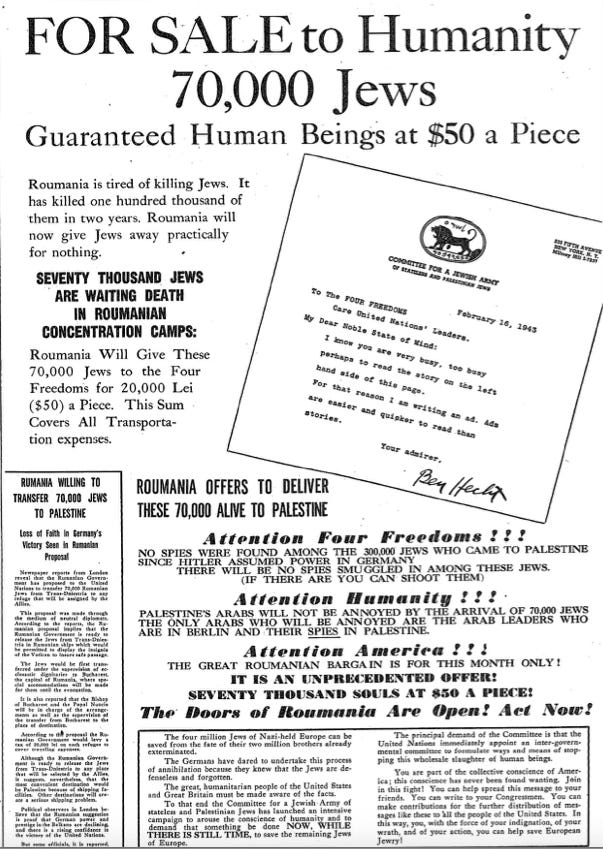
Ben Hecht’s support for the militant Zionist group Irgun in the late 40s severely damaged his career. His fundraising and newspaper ads for their fight against British rule in Palestine led to a UK blacklist from 1947 to 1949. After his 1947 New York Post article praising Irgun’s tactics, Britain banned his films, removed his credits, and shunned his work. His reputation in the UK suffered for years before recovering.
However, Hecht was already a well-established figure in the U.S., and the British blacklist did not carry the same weight as the Hollywood blacklist tied to McCarthyism. Hecht continued to work in Hollywood, though often uncredited or as a script doctor. Despite the British boycott, he contributed to numerous films either openly or as a ghostwriter including Hitchcock’s “Rope,” Howard Hawks’ screwball comedy with Cary Grant and Marilyn Monroe, “Monkey Business,” and his adaption of Hemingway’s “A Farewell to Arms.”
Hecht was known as Hollywood’s greatest script doctor, and he was frequently brought in to rewrite screenplays. His ghostwriting involved sharpening dialogue, restructuring narratives, or adding a touch of his signature wit and cynicism. His ability to shape films from behind the scenes ensured his continued relevance long after the controversy surrounding his political views had faded.
Ben Hecht died in 1954.
Twenty five years later, I caught up with his autobiography, Child of the Century. I was fascinated by his stories, his amazingly well crafted prose, and the remarkable life he led. What prompted further investigation was the chapter, “The Committee,” about his work as a propagandist for the dying Jews of Europe, and then, on behalf of the Irgun in Palestine, who fought the British in the battle to establish a Jewish state.
I was well aware of the Holocaust. But I didn’t realize the extent of anti-Semitism in the United States—or how President Roosevelt, despite knowing what was happening in Nazi Germany, did so little to stop the genocide. He wasn’t alone in his inaction. The Pope and Winston Churchill were also complicit, turning away from the moral imperative to intervene.
In the mid-1980s, PBS aired the documentary We Will Never Die, offering a true picture of America’s silence while the Holocaust was taking place. I discovered that one member of the Committee, Yitzhak Ben-Ami, was still alive and living on the Upper West Side of Manhattan—just blocks from where I then resided.
I sought out Ben-Ami, who welcomed me into his apartment one spring day. As he vividly recounted the Committee’s efforts in the 1940s, his passion made the history feel more immediate than any book ever could. Over time, we became friends, and I helped him gain publicity for his memoir, Years of Wrath, Days of Glory.
Ben-Ami held tremendous respect for Ben Hecht, who had sacrificed everything for their cause. He shared copies of the full-page ads Hecht had placed in The New York Times and other newspapers, as well as materials from two theater productions Hecht had written.
One night, as I walked across 23rd Street with Ben-Ami after booking him on The Bob Grant Show, he suddenly turned to me and said, “Ben Hecht is looking down at you from heaven, and he’s smiling.” Those words stayed with me.
Then, in 1993, on a visit to Chicago, I decided to explore some of Ben Hecht’s old haunts—if any still remained. A trip to the Chicago Historical Society led me to the Newberry Library, just a few blocks away, where Hecht’s archives were housed. Suddenly, I was deep in his world, lost in letters, scripts, and personal papers. I had a thought I couldn’t shake: this is a play that needs to be written.
Back in New York, I found the two other surviving members of The Committee, Peter Bergson and Samuel Merlin. I’ve met any number of famous and unique people in my life, but few can hold a candle to these Herbraic revolutionaries. These men smuggled Jews in boats down the Rhine river, as the Nazis were approaching. When they came to the United States in 1943 with direct knowledge of the ongoing European massacre, few would heed their call. At the behest of the King of The Jews, Rabbi Steven Wise, the US government even threatened them with jail and expulsion. And then, they became the Irgun fighting alongside Menachim Begin, against the British to give birth to the state of Israel.
Peter Bergson was their leader. Born Hillel Kook in Palestine, he changed his name because he was the nephew of an important Jerusalem rabbi. During WWII, his mission was to mobilize American public opinion and government action to rescue Jews from the Holocaust. But sadly, his work was instrumental in exposing the U.S. government’s inaction regarding the Nazi genocide and pressuring officials to respond.
Bergson was a controversial figure—revered by those who saw him as a relentless advocate for Jewish lives, but criticized by mainstream Jewish organizations for his aggressive tactics. His work laid the groundwork for later humanitarian lobbying efforts and highlighted the moral failures of governments that ignored genocide. Though not widely credited in history books, his activism played a crucial role in both Holocaust rescue efforts and the eventual establishment of Israel.
When we met, Bergson was in the early stages of Parkinson’s, but despite his physical decline, he spoke with the same passion and conviction that had driven him 44 years earlier. He was deeply supportive of my idea to write about The Committee. “That’s why you are here,” he told me. “It is your Irgun mission.”
I did write that play, “The Pariah,” which was produced at small theatre in Westchester, New York in 1995. But somehow, I felt the mission was incomplete.
This story has haunted me for decades. Even now, I keep asking myself—why not a screenplay? Given today’s political climate, producing a film about Jews trying to save other Jews would likely be impossible. But if I live long enough, perhaps in another era, it could finally become a reality.
Today, anti-Semitism is once again on the rise. Critics argue that former President Donald Trump has leveraged concerns about antisemitism to advance political objectives, particularly targeting institutions and individuals perceived as adversaries. This approach has been characterized by some as a form of political retribution rather than a genuine effort to combat antisemitism.
And if that wasn’t bad enough, Trump’s buddy Benjamin “Bibi” Netanyahu stands at the center of international outrage, clearly guilty—morally, if not yet legally—of crimes against humanity for his brutal and prolonged treatment of the Palestinian people. Under his leadership, entire neighborhoods in Gaza have been reduced to rubble, civilian casualties have reached staggering levels, and the basic tenets of international law—protection of noncombatants, proportionality, and human dignity—have been trampled underfoot.
Those who cannot remember the past are condemned to repeat it.”
George Santayana
_ _ _
Until we meet again, let your conscience be your guide.
A great bio on someone I had no knowledge of. A hard post to read also in view of the current Jewish, Hebrew, Zionist dilemma and Netanyahu’s inhumanity. Last week I stumbled upon Eli Wiesel’s account of his experience of the Holocaust, re-read it and had to think what would he say now about this time?
All can pay tribute. Visit Ben. He's underground in Nyack, NY.
If you can't make it there you can read "Child Of The Century," in print and widely available.