

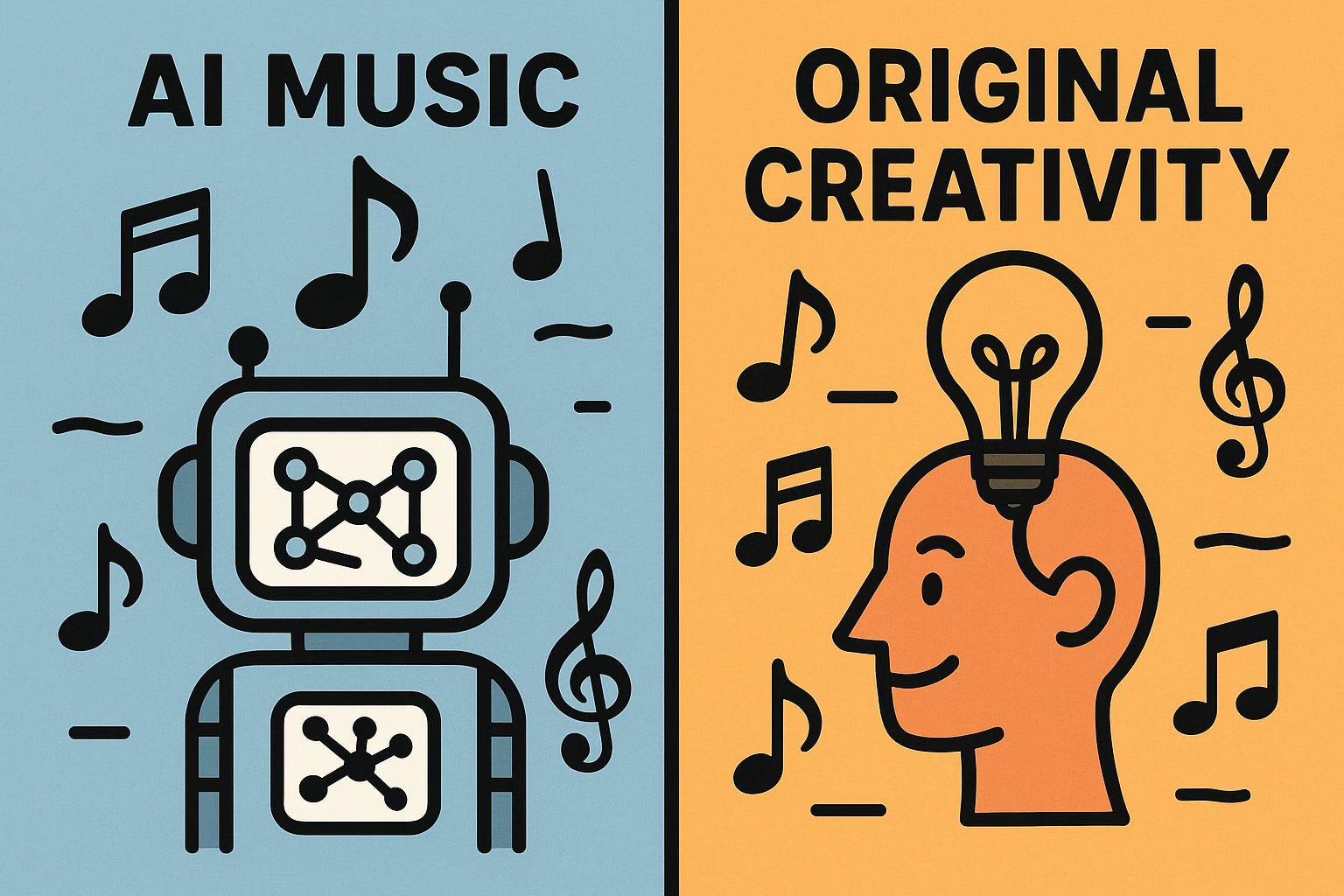
This week, a five part story: In a future society where music and human-made sound are outlawed, Marcus maintains AI composition machines while secretly carrying the memory of a forbidden jazz solo. He navigates a world policed by tone-deaf robots and enforced conformity, haunted by memories of his father and a clandestine community dedicated to preserving lost music. As his daughter Aria starts questioning the world’s silence, Marcus becomes part of an underground network, risking everything to reconstruct an instrument and pass on the living memory of jazz. As authorities develop technology to erase musical memory itself, Marcus and the keepers face a fateful choice about whether to remain hidden or make one final, defiant stand for the soul of human expression.
_ _ _
Part One: The Sound of Forgetting
Marcus cleaned the resonance chambers of AI Composition Unit Seven with the same careful precision he brought to everything now. Forty-three years old, hands steady, breathing controlled. The maintenance bay hummed with the perfect fifths and octaves of Approved Composition #4,891, today’s mandatory listening. Through the facility’s windows, the city stretched out in geometric perfection, every building a monument to the Great Silence that had begun thirty-one years ago.
His supervisor’s footsteps approached in 4/4 time. Everyone walked in 4/4 time now.
“Unit Seven’s efficiency is down point-three percent,” she said, not looking at him. Nobody really looked at anyone anymore. Eye contact might accidentally communicate something unapproved.
“I’ll run diagnostics,” Marcus replied, his voice carefully neutral. Inside his chest, Miles Davis’s “So What” pulsed against his ribs. Two beats of silence. Then that first note, climbing up from nothing. He’d been carrying the solo for thirteen years now, since Samuel died and passed him the inheritance. Some days it felt heavier than the machines he maintained.
The supervisor left. Marcus returned to his work, but his mind drifted to breakfast that morning. Aria, his sixteen-year-old daughter, had been humming. Not the approved composition—she would never make that mistake—but humming nonetheless, unconsciously, the way people used to hum when music was something humans made.
“Did you know,” she’d asked, spreading synthetic jam on her protein toast, “that before the Silence, people used to make their own sounds? Just... make them up?”
Elise had frozen at the counter. Marcus had kept eating, mechanically, while his heart hammered jazz rhythms.
“Where did you hear that?” he’d asked.
“History class. Mr. Chen was explaining why the Great Silence was necessary. He said people used to create chaos with instruments. Random noise. No algorithm, no optimization. He played us a recording of what they called ‘traffic’ from before. All those machines making different sounds at once.” She’d shuddered. “How did anyone think?”
Marcus had wanted to tell her: That wasn’t chaos, that was life. Instead, he’d said, “Finish your breakfast.”
Now, alone with the machines, Marcus allowed himself to remember the night before the Instrument Surrender. His father waking him at 2 AM, leading him down to the basement where three old men sat with their forbidden things. A piano. A bass. A saxophone.
“Listen,” his father had whispered. “Remember exactly this.”
The old men had played for seventeen minutes. Marcus knew it was seventeen because he’d counted every second, knowing somehow that these seconds mattered more than any that would come after. One played something his father later told him was Coltrane’s “Naima.” The saxophone wept. The bass walked. The piano filled the spaces between heartbeats.
His father had cried. Marcus had never seen his father cry before. Would never see it again.
The next morning, they’d carried their piano to the pyre in Revolution Square. The same square where the instruments burned. The same square where, six months later, his father would disappear after someone reported hearing him whistle a non-approved interval.
A Null passed by the window, its chrome head swiveling with mechanical precision. The tone-deaf enforcement robots had been programmed without any capacity for pitch recognition—they could detect unauthorized sound patterns but couldn’t process music itself. The perfect enforcers for a world that had declared war on human creativity.
Marcus’s shift ended at 1700 hours. He walked home through the approved route, passing the monument to the Cacophony Wars that had never actually happened. The plaque read: “In memory of those lost to the chaos of unregulated sound. Never Again.”
At the apartment, Elise was cooking. She moved differently when she thought no one was watching, her hands dancing in small rebellions against the approved patterns. She’d been a dancer, before. Before was a word they never said aloud.
“Aria’s in her room,” she said, not turning from the stove. “Listening to her homework.”
Marcus nodded, though she couldn’t see him. They’d developed their own language of silences over the years. This one meant: She’s safe. She’s not asking questions. We have another day.
He went to check on his daughter. She lay on her bed, mandatory implants feeding Approved Composition #4,891 directly into her auditory cortex. Her face was peaceful, almost happy. She’d never known anything else.
That night, after Aria was asleep, Elise pressed against him in the darkness.
“The janitor at your facility,” she whispered. “The old one. He talked to me at the market.”
Marcus went rigid.
“He said you’re building something.”
The “So What” solo thundered in Marcus’s chest. Two beats of silence, then the note that changed everything. He’d been collecting pieces for three months. A valve here. A tube there. Hidden in seven different locations across the district. Almost enough to make a trumpet.
“I’m not building anything,” he said.
Elise’s hand found his face in the dark. “She called it beautiful today. The machine music. She called it beautiful and meant it.”
Marcus said nothing. In the silence, he could hear Elise composing—rhythms in her breathing, melodies in the way her fingers tapped against his chest. Thirteen years of enforced quiet, and she’d been writing symphonies in her head.
“When?” she asked.
“Soon.”
“How many others?”
“Enough.”
She was quiet for a long moment. Then: “Play it loud. Play it so loud that she can’t unhear it.”
Marcus held his wife and thought about the old men in the basement. About his father’s tears. About Samuel teaching him the solo, note by note, making him promise to pass it on. About the underground, where keepers of forbidden solos met in storm drains and wind farms, preserving what the world had decided to forget.
Somewhere in the city, a woman who cleaned streets was sleeping with Coltrane’s “Giant Steps” in her dreams. A teenager who’d never held a saxophone carried Bird’s “Ko Ko” in his bones. They were all waiting for the signal. For someone to play the first note.
Marcus closed his eyes and let the “So What” solo pulse through him. Two beats of silence.
Then the note that would end everything.
Or begin it.
_ _ _
Tomorrow: Marcus is drawn into a hidden community that preserves forbidden jazz solos, receiving his own musical inheritance and learning the risks of keeping memory alive in a world that punishes creativity. As the underground faces new threats, Marcus begins collecting pieces for a secret act of rebellion—while his daughter starts to question the silence imposed on their lives.
Forbidden intervals?
YES 👌🏽
I'm a big fan of your dystopian vision. Why not work on a science fiction book, a la 1984, with what we know now!