

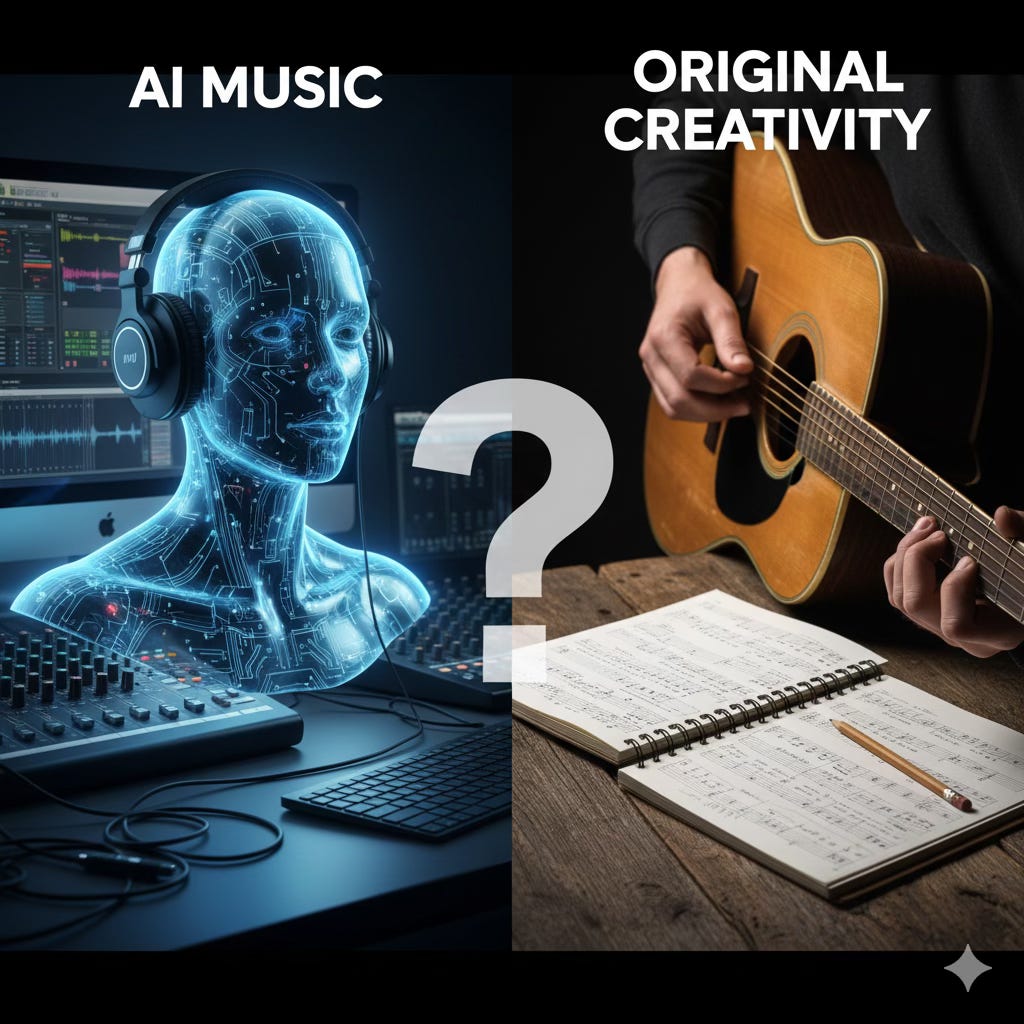
Part Three: The Janitor’s Secret
The janitor was waiting for Marcus in the maintenance bay, leaning against AI Composition Unit Five with the patience of someone who’d been waiting for decades. Abraham—though Marcus had only learned his name yesterday when Elise mentioned their encounter at the market.
“Took you long enough,” Abraham said. He was ancient, maybe eighty, with hands that trembled until they didn’t need to. “Three months of collecting pieces. Valve from the construction site. Tube from the recycling center. The mouthpiece from—where? The medical district?”
Marcus’s hand moved instinctively to his tools, though what he’d do with them, he didn’t know.
“Relax, boy. If I wanted you caught, you’d have been caught.” Abraham pushed himself off the machine. “I’ve been watching you for thirteen years. Since Samuel started teaching you. Good man, Samuel. Saw him play with Miles once. Not the real Miles—the hologram tour. But Samuel was flesh and blood, filling in for a bassist who’d been disappeared.”
“You’re a keeper?”
Abraham laughed, a sound so human it seemed to violate the air itself. “No. I’m something worse. I’m a rememberer. I don’t carry a solo—I carry the stories. The why and how. The names they want us to forget.”
He pulled Marcus deeper into the maintenance bay, where the machines hummed loud enough to mask everything.
“You want to know how it really started? Not the Cacophony Wars—that’s propaganda for children. It started with convenience. 2031: AI composers could write a symphony in three seconds. Why wait for human inspiration? 2035: Algorithms could predict what music would make people buy, vote, comply. Why allow unpredictability? 2038: The Optimization Act. Music became a public health issue. Unregulated sound was classified as pollution.”
Abraham’s eyes went distant, looking at something Marcus couldn’t see.
“I knew Bird. Charlie Parker. Not personally—I was just a kid. But my grandfather took me to see him in 1953, two years before he died. Grandfather was a janitor too, at Birdland. You know what Bird said to me? ‘Kid, they’re always trying to kill the music. But music is like water—it finds a way through.’”
“They teach us Parker was Anarchist 1920-B,” Marcus said.
“They teach lies. Parker was a genius who could hear the future in his head and pull it into the present through his horn. Dizzy Gillespie bent notes like he was bending reality. Coltrane found God in the overtones. They weren’t anarchists—they were prophets. And that’s why they had to be erased.”
Abraham grabbed Marcus’s arm, his grip surprisingly strong.
“But here’s what you need to know right now. The Nulls—they’re getting upgraded next week. Neural pattern recognition. They’ll be able to detect musical memory like a virus in your brain. Anyone carrying a solo will light up their sensors like a fire.”
Marcus felt the floor tilt. “Next week?”
“Monday. Six days. After that, the music doesn’t just die—it gets extracted, deleted, wiped clean.”
That evening, the emergency gathering at Reservoir 7 was the largest Marcus had ever seen. Forty-three keepers, nearly the entire regional underground. Dorothy was there, Chen, Keisha. Others Marcus had only heard about: the surgeon who carried Dizzy’s “Salt Peanuts,” the child who’d somehow inherited Art Tatum’s impossibilities.
“Six days,” Keisha said. “That’s all we have.”
“We could go deeper,” someone suggested. “Find places even the upgraded Nulls can’t reach.”
“For how long?” Chen asked. “A month? A year? We’d just be dying slower.”
Dorothy stood. In the rushing water’s white noise, she seemed to shimmer. “Then we don’t hide. We play.”
Silence. Even here, silence was dangerous when it wasn’t planned.
“In the open,” she continued. “Revolution Square, where they burned the instruments. We play everything we’ve saved. All at once. Let them hear what they lost.”
“That’s suicide,” Chen said.
“Yes,” Dorothy replied. “But the music lives. Someone will hear. Someone will remember. The children who don’t even know what they’re missing—they’ll hear, and they’ll know something exists beyond the algorithm.”
The vote wasn’t really a vote. They all knew. They’d known when they accepted their first solo that this day would come.
“I’ll go first,” Marcus said. “I’ve been building a trumpet. I’ll play the first note.”
Keisha touched his shoulder. “We all go together. That’s how jazz works.”
Later, at home, Marcus found Elise standing at their bedroom window, looking at nothing. Aria was asleep, her implant feeding her tonight’s approved composition.
“Six days,” he said.
“I know. Abraham told me yesterday. He tells me a lot of things.” She turned to him. “Did you know Duke Ellington wrote three thousand compositions? Three thousand ways of seeing the world through sound. Now we have one.”
Marcus pulled out the seventh piece of his trumpet—retrieved from beneath a dumpster behind the protein facility. He laid it on their bed with the others. The instrument was almost complete. Tomorrow, he’d get the last piece from the old subway tunnel.
Elise sat beside the pieces, not touching them. “I’ve been composing,” she said quietly. “In my head. For thirteen years. Symphonies, Marcus. Entire symphonies. They play when I sleep, when I walk, when I cook. Music made of our life—you, me, Aria. The sound of your breathing. The rhythm of her questions. The melody of us surviving.”
“Play it for me.”
She looked at him for a long moment. Then she began to hum. Not the approved composition. Not anything that had ever existed before. It was beautiful and broken, structured and free, a sound that could only have been born from thirteen years of forced silence.
Marcus picked up the mouthpiece of his unfinished trumpet, held it to his lips without the rest of the instrument, and played air through it. Just breath and metal, but he played the “So What” solo into it, and somehow, in the friction between what was and what should be, music happened.
Aria stirred in her sleep. Did she hear? Could she hear through the implant’s constant feed?
“Four days to finish teaching her,” Elise said. “Four days to make her understand what we’re about to do.”
“And if she doesn’t?”
“Then we play louder.”
Outside, the Nulls patrolled in perfect formation, their sensors sweeping for irregularities. But inside the apartment, revolution was being assembled piece by piece, note by note, in the space between heartbeats.
Abraham had been right. Music was like water.
It would find a way through.
_ _ _ _
Tomorrow: As dawn approaches, each member of the underground prepares to risk everything by bringing their treasured music into the open, carrying memories, defiance, and hope to Revolution Square. With families at stake and time running out, they gather for a final act of resistance, determined to let the world hear what has survived three decades of silence.