

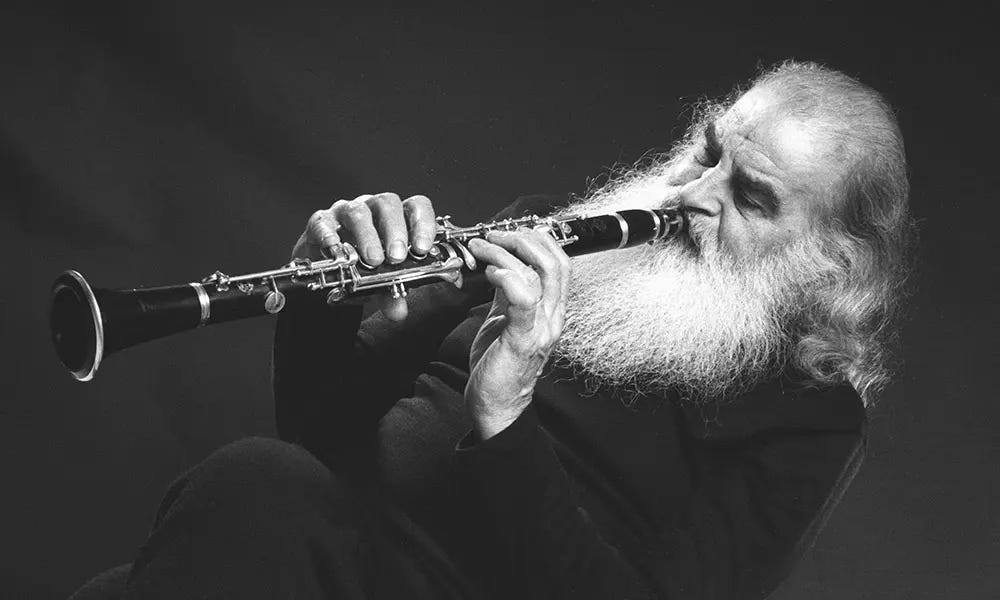
Tony Scott was one of jazz’s great originals and genuine outsiders, a figure who could have been famous but chose something richer: a life of perpetual musical discovery across cultures and continents.
Born Anthony Joseph Sciacca on June 17, 1921, in Morristown, New Jersey, to Sicilian immigrant parents, he trained at the Juilliard School from 1940 to 1942 and went on to become one of the very few clarinetists to fully commit to bebop. With Buddy DeFranco, Scott was considered one of the leading bebop clarinetists, and the two men were often described as the only major clarinetists to take on bebop, a style widely thought to be incompatible with the instrument’s soft, sweet sound. Scott’s approach, however, was distinctly his own: he was known for a cooler style than the more aggressive bebop playing of DeFranco.
His roll call of collaborators is staggering. Few jazz musicians can claim to have played with Billie Holiday, Thelonious Monk, Dizzy Gillespie, Charles Mingus, Ben Webster, Bill Evans, Charlie Parker, Clark Terry, and Sarah Vaughan. He also arranged Harry Belafonte’s massive hit “Day-O (The Banana Boat Song)” and won the DownBeat critics poll for clarinetist in 1955, 1957, 1958, and 1959.
His connection to Charlie Parker was deep and personal. Scott literally lived with Bird. He shared an apartment with Charlie Parker for a year, and when Parker died in 1955, Scott was devastated. While on a European tour in Yugoslavia, he spontaneously composed and performed what became his most celebrated piece. “It was a spur of the moment thing,” Scott told the New York Times. “The audience gave me a five-minute standing ovation. Musically, it was the high point of my life.” That piece, “Blues for Charlie Parker,” became his most requested composition and a genuine jazz standard in its way.
In 1959, fed up with a New York scene that was increasingly hostile to the clarinet and offering fewer and fewer gigs, Scott walked away from it all. He pursued a nomadic lifestyle for six years, following an insatiable curiosity for exploring new tonalities, asymmetrical phrasing, and improvisation beyond bebop. What he encountered in Asia transformed him. He traveled widely across Japan, the Philippines, Korea, Malaysia, Indonesia, and Thailand. He played in a Hindu temple in Hong Kong, explored the Balinese gamelan tradition, and sought out Javanese harp and flute players.
He was, as the critic Leonard Feather wrote, “the first modern American jazz musician to make extensive visits to these areas.” He also performed before the king of Thailand and appeared on Japanese television.
The album that came out of this journey, Music for Zen Meditation and Other Joys, recorded in 1964 and released by Verve in 1965, was unlike anything that had existed before. Scott convinced koto player Shinichi Yuize and bamboo flute player Hozan Yamamoto to improvise music based on classical Japanese scales. The challenge was immense: because there is no instrument in Japanese folk music comparable to the clarinet, Scott had to invent a voice for it by closely matching the tonal qualities and breath patterns of Yamamoto’s shakuhachi playing.
The album drew considerable attention for the minimalist beauty of songs with cosmic titles such as “The Murmuring Sound of the Mountain Stream,” “After the Snow, The Fragrance,” and “Sanzen (Moment of Truth).” The music was quiet and soothing, a salve in the midst of a world rife with war and cultural upheaval. Today it is widely regarded as the first New Age album ever recorded, predating the entire genre by more than a decade.
After returning briefly to New York, he continued his wandering. He toured Africa between 1968 and 1970, stopping in Egypt, Tanzania, Ghana, Morocco, and Senegal. He eventually settled in Rome in the 1970s, where he became a fixture of the Italian jazz scene, worked with pianist Franco D’Andrea, and formed an unlikely musical partnership with Romano Mussolini, the dictator’s son. He also acted in a film, playing a Sicilian-American Mafia boss. He spent his later years writing his autobiography, titled “Bird, Lady, and Me,” in honor of Parker and Holiday, and remained active into old age. He died in Rome on March 28, 2007, at the age of 85.
What made Scott memorable, beyond the music, was his uncompromising character. He kept an extraordinary archive of photographs of jazz legends and was known to carry them in a briefcase. When a fellow musician once reached for his photo of Billie Holiday, Scott snatched it back: “No!! Nobody touches this one!” And his philosophy was clear-eyed to the end. “I decided a long time ago I would rather be a jazz musician than rich and famous,” he said. “I had the chance to sell out, but I didn’t. I’ve never regretted that.”
He is one of those figures who fell through the cracks of jazz history precisely because he refused to stay still long enough to be marketed. That refusal is itself a kind of integrity that resonates particularly in our era of relentless personal branding.
Listen to “Misery” with Tony Scott on Clarinet, Scott LaFaro on bass, Paul Motian on drums and Bill Evans on piano, written for Billie Holiday.
Listen to Tony Scott’s “Blues for Charlie Parker.”
Watch Tony Scott play Satin Doll.
Listen to “Zazen (Moment of Truth” from Tony Scott’s “Music for Zen Meditation and Other Joys”
Next Tuesday - The Seat Was Available, but He Wasn’t
By the time I was twenty two, I had already spent quality time with three of my favorite filmmakers. I had a breakfast with Francis Ford Coppola at the Garden City Hotel in Long Island when I was a freshman in college. Martin Scorsese was my favorite teacher at NYU Film School. And, I spent two hours with Mel Brooks on the Long Island Railroad in 1972, on the way back from a weekend in Fire Island. Mel was in pre-production for one his classics, Blazing Saddles. When he told me about the film, he acted out scenes playing each character.
In June of 2003, I produced the “Legends of the Clarinet” performances at Iridium in New York, bringing together two bebop clarinet giants, Tony Scott and Buddy DeFranco, during the JVC Jazz Festival.
In his June 24 New York Times review, Ben Ratliff described Tony as the “man in black,” observing that he was dressed in black from head to toe, right down to his Yankees cap. It was a memorable image, especially alongside the impeccably dressed Buddy DeFranco.
As it happened, Tony was also in town for the 2003 Jazz Journalists Association Awards at B.B. King’s, where he had been invited to present the award for Clarinetist of the Year.
Tony apparently hadn’t forgotten Ratliff’s description. When he stepped up to present the award, he made a point of referring to his new “man in black” reputation. The punch line was his outfit: Tony had arrived wearing a white suit.
That was Tony Scott: a brilliant, unpredictable musician with a mischievous sense of humor—and impeccable comic timing.
Thanks Brett for this wonderful piece on my good friend,Tony.
We were very close and I stayed often with Tony in Rome. I have some wonderful stories I’d love to tell you. I miss him and his huge heart. I never met anyone like him.