

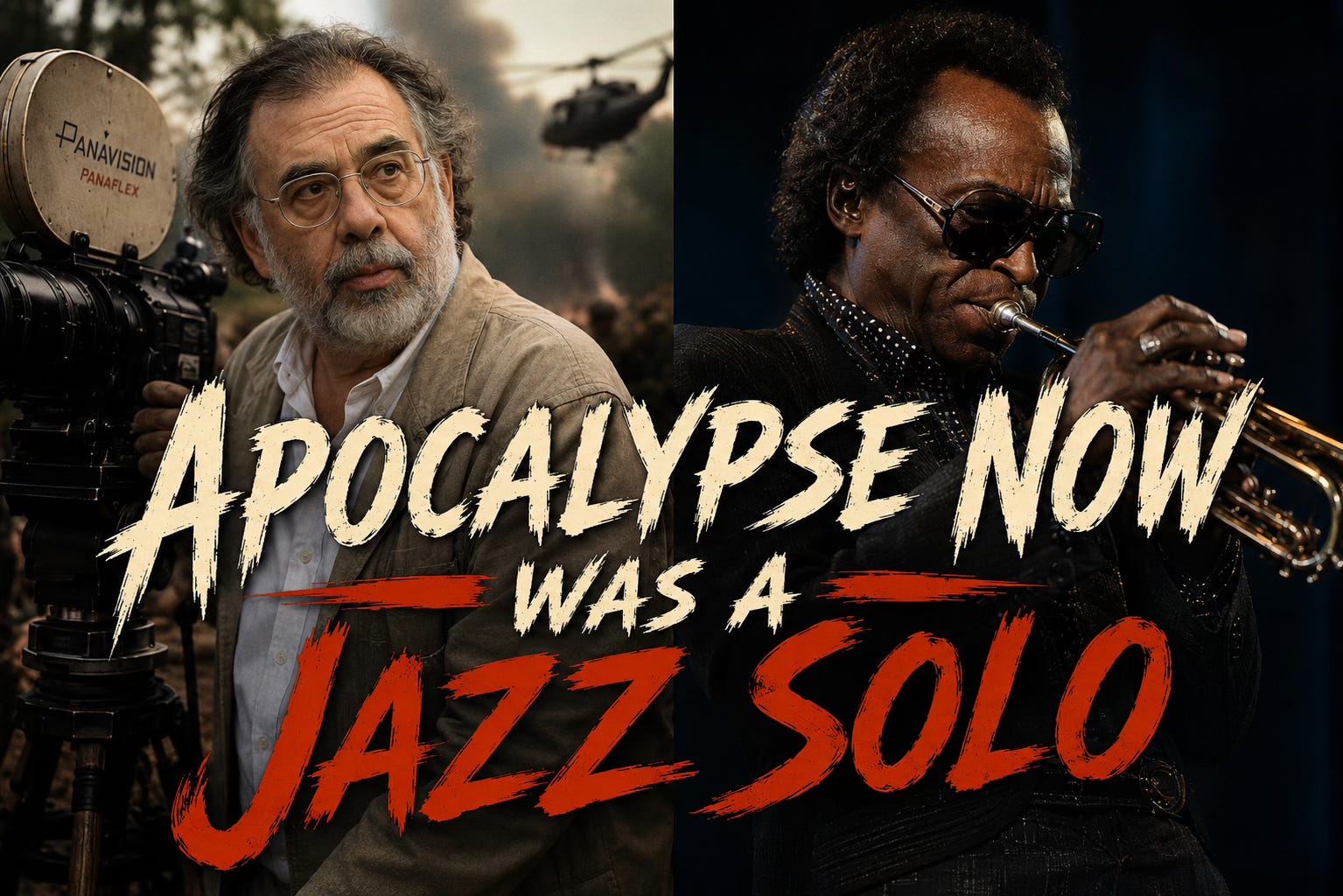
Coppola went into the Philippine jungle in the mid-1970s carrying enormous ambition, studio money, technical resources, and a cassette tape of Bitches Brew he could not stop playing.
That detail matters more than most film historians have allowed.
Most people understand Apocalypse Now as a Vietnam film. Others read it as psychological descent, Conrad transplanted to Southeast Asia, or cinematic derangement on an industrial scale. All of those readings are true. But underneath the helicopters, napalm, and nervous breakdowns, the film is doing something else entirely.
It is a jazz improvisation on celluloid. Specifically, it is a film structurally shaped by the late electric period of Miles Davis. Once you hear that, the entire architecture shifts.
Released in 1970, Bitches Brew abandoned conventional song forms for something more volatile: sprawling collective improvisation built around mood, repetition, texture, and gradual mutation. The music does not move linearly. Themes emerge, dissolve, reappear, collide, and reassemble. Time stretches. Momentum accumulates hypnotically. Musicians circle ideas instead of resolving them.
Listen to “Pharaoh’s Dance.” The opening riff surfaces, vanishes, resurfaces altered. Rhythm sections overlap without locking. Soloists drift in and out of the center. The piece accumulates psychic pressure through repetition rather than narrative arc, and nearly twelve minutes pass before anything resembling resolution appears, and even then it is provisional, unstable, temporary.
Now watch the river sequences in Apocalypse Now.
The patrol boat’s journey toward Kurtz is not structured as traditional Hollywood plot driven by escalating cause and effect. It functions as extended modal exploration. Each stop becomes its own improvisational movement: the helicopter attack, the Playboy bunnies, the bridge at Do Lung, the tiger in the jungle, the French plantation, the final approach to Kurtz. These sequences do not always advance the plot in any conventional sense. They deepen the vibration. Each one expands the psychic atmosphere while destabilizing normal reality further. The further upriver the boat travels, the less conventional time behaves. Logic dissolves. Military structure collapses into surrealism. Civilization loses coherence measure by measure.
This is jazz logic. Specifically the logic of electric Miles Davis, where repetition and improvisation create altered states through accumulation rather than dramatic escalation.
The production itself already resembled free jazz performed with explosives. Typhoons destroyed sets. Martin Sheen had a heart attack on location. Brando arrived overweight and apparently without having read Conrad. The script rewrote itself daily. The schedule collapsed. The budget detonated. Crew members drifted into psychological exhaustion that began to look not so much like burnout as theater.
“My film is not about Vietnam. It is Vietnam,” Coppola told his wife during production. It sounds insane until you watch Hearts of Darkness and realize he was probably underselling it.
And through all of it, the cassette kept playing.
This was not background mood music. This was structural influence. Coppola was using Bitches Brew the way Miles Davis used controlled chaos in the studio: deliberately assembling volatile elements and then refusing to over-manage the collisions.
Consider what editor Walter Murch actually built. Large portions of the film are constructed through associative sound flow rather than rigid visual continuity. Helicopter blades morph into the ceiling fan above Willard’s bed in Saigon. The Doors bleed into jungle ambience. Gunfire and music and river sounds braid together into a single hallucinatory pulse that refuses to let the ear settle.
Murch’s sound design is itself a jazz performance. He is not illustrating the images. He is improvising alongside them, creating a third thing that neither image nor sound produces alone. The film’s famous opening achieves its disorientation not through editing tricks but through layered acoustic texture, the sound of a mind coming apart at its seams rendered as pure rhythm and atmosphere.
Miles Davis and Teo Macero worked identically on Bitches Brew, splicing and layering tape to construct moods that no single performance captured. The method was the same. The intention was the same.
Then Brando arrives.
His performance barely resembles conventional screen acting. He enters the film the way a rogue improviser enters a session late, after the other musicians have already established a groove, and changes the harmonic center instantly. Everyone else has to reorient. The internal logic of the film shifts on its axis.
Consider what Brando was actually doing on set. He had arrived in the Philippines overweight, apparently without reading Conrad, carrying note cards with passages from T.S. Eliot and James Frazer’s The Golden Bough that he may or may not have intended to use. He moved through Coppola’s jungle compound in darkness, refusing conventional lighting, requesting to be shot in shadow and silhouette. He improvised speeches. He wandered. He muttered. He picked up a cat and held it. He shaved his head and became something that no longer fit inside a screenplay.
Coppola did not try to stop any of this. He filmed it all.
This is precisely what Miles Davis did with certain musicians in the electric period. When Keith Jarrett joined the band in 1970, Davis did not hand him charts or direct him toward a predetermined role. He told Jarrett to play electric organ, an instrument Jarrett reportedly despised, and then left him to find his own position inside the collective turbulence. The discomfort was the point. Productive instability was the compositional strategy.
Brando’s discomfort produced the same result.
His dialogue in the Kurtz compound sequences feels exploratory, fragmented, circling back on itself the way a soloist circles a modal center without ever fully resolving. He delivers lines about snails on a razor’s edge. He reads Eliot. He talks about his son. He describes the horror of watching children with inoculated arms hacked off, and the voice never rises, never performs conventional dramatic emotion, stays low and uninflected and all the more devastating for it.
The sequence where Willard sits in the darkness watching Kurtz materialize out of shadow operates entirely on rhythm and texture rather than dramatic exposition. Brando surfaces and submerges. Light catches a cheekbone, an eye, a massive shoulder. The scene has no conventional dramatic arc. It accumulates pressure through repetition and proximity the way “Pharaoh’s Dance” accumulates pressure through overlapping keyboards and percussion that never quite resolve into a single coherent pulse.
You are not watching a villain explained. You are watching a theme stated, submerged, and restated in a different register.
Jazz logic.
Kurtz is not the destination. He is the resolution the piece has been refusing to deliver for three hours, arriving finally in the wrong key, at the wrong tempo, in a form no one could have written down in advance.
The Do Lung bridge sequence demonstrates this most nakedly. No commanding officer. No clear objective. Explosions everywhere. Soldiers operating inside pure chaos illuminated by flares and collective insanity. The scene unfolds the way “Spanish Key” unfolds: rhythm and texture replacing exposition, dread accumulating without traditional release, the listener suspended inside an experience that refuses to resolve.
You are not understanding the war intellectually anymore. You are inside its psychological rhythm.
What Coppola ultimately discovered, intentionally or accidentally, was that Vietnam itself resisted classical narrative order. The war had already shattered America’s belief in coherent moral storytelling. There were no clean arcs. No stable ideological structure. No heroic symmetry left.
Only the river. Only the music. Only the next phrase emerging from the dark, unresolved, inevitable.
Listen to “Spanish Key” from Bitches Brew
Chaos at the Do Lung Bridge
Listen to “Pharoah’s Dance” from Bitches Brew:
Willard and the PBR arrive at Kurtz’s outpost/camp
Brando’s Horror Speech
What a great piece you just wrote! So interesting how you came up with this.. and yet it really rings true.. one of my favorite movies ever made.. BTW, Miles pointed Keith Jarrett in the direction of a Fender Rhodes to play.. he then saw the fender Organ there and set it up in a V with the Fender Rhodes and played each of them at the same time ,left on the Organ, right on the Fender Rhodes
Amazing comments and comparisons to Bitches Brew. Having seen the movie many times and listened to BB also many times and knowing someone from the movie and all about Vietnam and coming of age in that era mixes everything up and throws it all up into the air and it lands in the jungle and covers us all. It was all so messed up and confusing and ugly and deadly. And far more than just the music and the movie.