

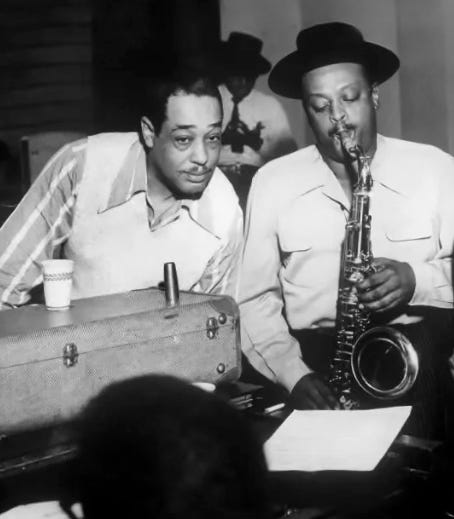
Ben Webster’s ballad playing is instantly recognizable.
His tone is the foundation. It’s one of the most personal sounds in jazz: warm, breathy, almost vocal in quality. That breathy articulation comes from how he voiced notes through the horn, creating an intimate, almost vulnerable sound that draws you in.
He had an unusual approach to time. Webster would play behind the beat in a way that created tension and release. He’d let notes breathe, stretch phrases out, then suddenly inject a bit of urgency. This gave his ballads a conversational quality, as if he were telling you a story he didn’t want to rush through.
His vibrato was distinctive: wide, expressive, sometimes almost aggressive even on tender material. It added emotional depth and made every sustained note feel alive.
Webster also had this ability to move from tenderness to roughness within the same phrase. He could caress a melody, then suddenly inject a gruff, almost growling tone that suggested pain or longing underneath the beauty.
He treated melodies with deep respect but personalized them completely. You always knew the song, but you were hearing Ben Webster’s version of it, filtered through his life experience and emotional sensibility.
All of this added up to ballad playing that felt deeply human, romantic without being sentimental, tough but tender. Nobody else sounded quite that way.
One of Duke Ellington’s most beautiful ballads, and there are many, is “The Single Petal of a Rose.” Duke wrote in 1958, for the Queen of England.
He was in London, invited to meet Queen Elizabeth II. The meeting lasted only minutes, but the impression stayed with him. He said she carried a calm presence. Not power. Not royalty. Calm. A quiet strength that filled the space around her.
Ellington went back to his hotel that night and began sketching a melody. Slow. Graceful. A line that rose and fell like a breath held too long. He built the harmony the same way. Soft chords. Gentle movement.
Nothing rushed. Nothing forced.
Later that year, he assembled a private recording for her. He called it The Queen’s Suite. Only one pressing was made. A single gold record. Hand-delivered to Buckingham Palace. Ellington paid for it himself. He never released it while he was alive.
The music was a gift, not a product. At the center of the suite sat “The Single Petal of a Rose.” A quiet moment in a noisy century.
A portrait painted with almost no paint. Just piano, space, and intention.
The melody felt like a memory unfolding in slow motion. Each phrase hovered. Each chord settled like dust in a still room.
Ellington rarely explained his work, but he called this piece one of his favorites. It held a dignity he didn’t want to disturb. It was personal. Private. Almost fragile.
Years passed.
The piece circulated among musicians who heard Ellington play it on stage or backstage. One of those musicians was Ben Webster.
By the early 1960s, Webster lived in Europe. He carried two things with him everywhere: his tenor sax, and a sense of longing he never shook.
His ballad playing had always been tender, but now it held more weight. More breath. More history.
In 1963 he went into the studio to record See You at the Fair. He chose “The Single Petal of a Rose.” Not to imitate Ellington. To answer him.
Webster didn’t change the form. He changed the feeling. Where Ellington offered poise, Webster offered warmth. Where Ellington suggested restraint, Webster suggested confession.
The piano opened the piece with Ellington’s chords. Then Webster entered, and the room shifted. His sound was soft but full. Air and tone held together by emotion.
He stretched the melody. He bent notes Ellington kept straight. He lingered on phrases as if speaking to someone who wasn’t there anymore.
Hank Jones supported him with clear harmony. Bassist Richard Davis added a heartbeat that the solo piano version never had. Drummer Osie Johnson touched the cymbals like he was afraid to wake something sleeping.
Webster turned Ellington’s private moment into a shared one. The music became less about royalty and more about remembrance. Less about grace and more about longing.
Two men. Two versions. Both telling the truth in different languages.
When you listen to the original, you enter Ellington’s quiet room. When you listen to Webster, you hear someone opening the window.
The same melody. Two lives behind it. One piece of music that refuses to age.
“The Single Petal of a Rose” remains one of the purest examples of what Ellington called “tone parallels”—stories told through sound instead of words.
Ellington wrote it for a queen. Webster played it for the world.
And each version reminds you how music holds memory long after people are gone.
Duke’s version
Ben’s version
.
I love Ben Webster. In the conversation about the founding of jazz tenor sax, Coleman Hawkins and Lester Young are always mentioned. Ben Webster is often overlooked. For me, he’s the one I go to first when I’m in the mood to go back to that era. Thanks for extolling him in this loving and descriptive way.
I first heard Ben’s version many decades ago, and it clung to me, as it did anyone who heard it. He was, of course, one of Ellington’s (and Strayhorn’s) great interpreters-Chelsea Bridge is another shimmering example..
Beautifully framed, Brett, the power of music to muse and to move..