

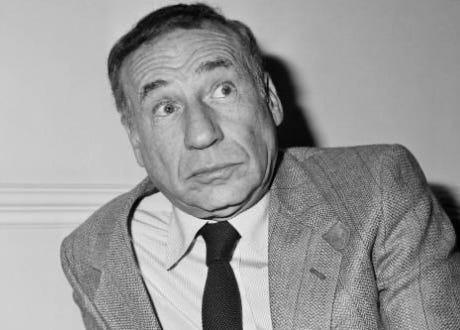
There are funny movies, and then there are films that sneak into your nervous system wearing a fake mustache and steal your wallet while you’re laughing.
Mel Brooks didn’t make a Western. He staged a laboratory experiment with horses, whiskey, dynamite, and the American id. He dumped racism into a controlled environment, shook the cage, and waited for the rats to eat each other.
The diagnosis was immediate.
Racism isn’t merely immoral. It isn’t merely cruel. It’s profoundly stupid. It lowers the collective IQ of everyone infected with it. Brooks understood this fifty years ago, long before cable news turned national idiocy into a subscription service.
The genius of Blazing Saddles is that Bart never defeats anyone through brute force. He wins because every racist in the film arrives already defeated. Their prejudice has done the work for him.
Take the hostage scene. One of the greatest comic moments ever filmed.
Bart points a gun at his own head.
“Nobody move or the Nigger gets it!”
The mob freezes.
Think about the insanity for a second. Hundreds of armed white citizens suddenly become helpless because one Black man has weaponized their own racist assumptions against them. They’re so trapped inside the prison of their own thinking that they fail to notice the gun is pointed at the only person holding it.
Brooks isn’t telling a joke. He’s demonstrating a theorem. Hatred makes people predictable. Predictable people become easy prey.
The lesson echoes through every frame, church bells ringing in a madhouse.
Lyle demands an old minstrel tune. Bart answers with Frank Sinatra. Within seconds the racist is performing the degrading minstrel routine himself while Black railroad workers watch in amusement.
The hunter has wandered into his own trap carrying the bait.
Nobody even bothers to explain the joke. Brooks trusts the audience to feel the universe briefly correcting itself.
Then comes Gabby Johnson, staggering into town speaking a language apparently developed during a concussion. Every syllable sounds like a drunk buffalo choking on gravel.
The townspeople applaud.
One solemn citizen declares the speech displayed “a courage little seen in this day and age.”
Nobody understood a damn word. Nobody cared. Confidence replaced meaning. Noise became wisdom.
Watching the scene today feels less like revisiting a comedy than accidentally switching on C-SPAN.
Then there’s Hedley Lamarr, intoxicated by his own vocabulary.
“My mind is aglow with whirling transient nodes of thought careening through a cosmic vapor of invention.”
Taggart’s response?
“Ditto.”
One word.
The balloon explodes.
Every pompous fraud in history dies a little death in that single exchange. Brooks understood something every con man eventually forgets. Grandiosity only works until somebody refuses to play along.
Governor Le Petomane, played hilariously by Brooks, might be the most terrifying character in the picture because he isn’t terrifying at all.
He’s cheerful. Distracted. Half asleep.
He signs documents without reading them. Conducts an affair behind a curtain while running the state. Throws racial slurs around like confetti, then politely adds, “No offense.”
That’s the machine. Bigotry doesn’t require snarling villains twirling waxed mustaches. Sometimes it wears a grin, shrugs its shoulders, and asks what’s for lunch.
Then there’s Boris the executioner.
Lamarr wants another hanging.
Sorry. They’re booked solid. Mass murder reduced to appointment scheduling.
Hannah Arendt spent years trying to explain the banality of evil after the Holocaust. Mel Brooks wrapped the same idea inside a punchline and somehow made it even more horrifying.
The bureaucrat doesn’t stop the execution because it’s wrong. He stops because Tuesday’s calendar is full.
And through all of this walks Bart. Not as a saint. Not as a victim. Not as a symbol.
As the smartest man in every room he enters. He speaks with elegance. He performs. He improvises.
He’s always three moves ahead, watching these self-appointed masters of civilization repeatedly trip over the same intellectual potholes they’ve dug for themselves.
Even while sinking in quicksand, he’s explaining quicksand. Even while surrounded, he’s directing the scene. The racists think they’re hunting him. Bart realizes he’s conducting them. That’s the difference.
Mel Brooks never believed racism made white people stronger. He believed it made them gullible. Clumsy. Easy to manipulate.
He understood that prejudice isn’t a weapon. It’s brain damage masquerading as confidence.
By the final act, Hedley Lamarr has assembled an army of thieves, killers, bikers, Nazis, Klansmen, and assorted American lunatics to destroy Rock Ridge.
It looks unstoppable. It collapses like a cheap carnival tent. Because hatred isn’t a foundation. It’s dry rot. Every structure built on it eventually caves in under its own weight.
People still call Blazing Saddles a satire. They’re underselling it. Satire exaggerates reality. Brooks barely exaggerated anything.
He simply pointed a camera at America’s oldest disease, poured gasoline on it, and invited us to laugh at the smell while the patient insisted he was perfectly healthy.
Fifty years later, the symptoms are still everywhere.
The diagnosis hasn’t changed.
Today is Mel Brooks’ 100th birthday.
I got to him early. Growing up in West Hartford, Connecticut in the late 50s and early 60s, I watched the 2000 Year Old Man on television more times than I can count. Carl Reiner would play straight man, and Mel would improvise a man who had personally witnessed the invention of God, language, and fear. It was the funniest thing I had ever seen, and I had no framework for why.
Then came the Tonight Show with Johnny Carson, and before that, a late-night hour with Steve Allen where Mel seemed to understand that television was a place you could get away with things. He used that knowledge every time. In 1968, he wrote and directed The Producers -- a film that belongs in the permanent record of American comedy.
What I didn’t understand then, but do now, is that Mel was teaching me something I couldn’t have named. He said it himself, years later: “I cut my finger. That’s tragedy. A man walks into an open sewer and dies. That’s comedy.” That’s not a joke about comedy. That’s a definition of how the universe is actually organized, and Mel was the only one honest enough to say it out loud. A joke either lands or it doesn’t, and the difference lives in one word, one beat, one held silence. There is no almost funny. Once I understood that, everything else I heard got measured against it.
A hundred years. He outlived the century he was born to satirize.
The writing room for Blazing Saddles was its own controlled experiment. Mel assembled a freewheeling group that included Richard Pryor, Norman Steinberg, Andrew Bergman, and Alan Uger -- a veteran of Sid Caesar’s Your Show of Shows running a room where the rules were that there were no rules. Pryor’s fearless humor and firsthand experience with racism shaped many of the film’s sharpest scenes and dialogue.
One of the most famous anecdotes from those sessions came from the late Norman Steinberg, who described the first day like this: Pryor arrived about two hours late. As everyone began discussing the story, he pulled out a vial of cocaine and started snorting it at the table. He then held the vial toward Brooks and asked, “Brother Mel?” Brooks looked at him and replied, “Me. Never before lunch.”
Everyone laughed, Brooks declined, and they got to work.
A year and a half before Blazing Saddles opened, fate intervened. Coming back from a weekend in Fire Island on the LIRR, I took the last empty seat, next to Mel Brooks. We spoke and he acknowledged my appreciation of his work, but said he had no time to talk because he had a briefcase full of work.
Fifteen minutes later he began to tell me the story, sometimes bringing a character to life with vocalizations. He was naturally funny storyteller and suddenly he had a performance opportunity. For some moments he was inches from my face, holding the scene until I broke. When I laughed he’d stop, stay in character, and wait. Not for the laugh to die down. For me to come back to him. Then he’d continue.
Forty-five minutes. The other passengers had no idea what they were watching. Judging by the looks we got as we left the train, they’d reached a unanimous verdict: Bellevue, both of them.
When Blazing Saddles opened, I was at the Beekman Theatre in New York for the first show of the first day. Sitting in the dark, certain lines came back to me before the actors delivered them. Certain bits arrived and I already knew the shape of them. I had seen this movie. On a commuter train, performed by one man in a polo shirt, to an audience of one.
That’s how I learned what Mel Brooks actually was. Not a comedian. A force of nature that happened to be wearing a person.
Blazing Saddles was considered shocking and unreleasable when it was made. Not until I read Mel’s autobiography a few years ago did I understand how he got it past the censors at his studio. At the preview they gave him notes on every objectionable scene they wanted taken out. Mel responded with, “I agree and don’t worry, it’s out!” After they left the room, he took all the notes and threw them in the trash can. That was the end of it. It’s a miracle the film was green lighted after that. As you illustrated in your essay, all Mel was doing was holding a mirror up to America, and though it was shocking to hear, he wasn’t amplifying or exaggerating. My other take away from Mel’s humor is that by making fun of every group, he is pointing out that we are all the same. No group of people is better than another. What a message for America in 2026. We clearly didn’t get the message 50 years hence.
I saw Blazing Saddles at a drive-in movie theater in Missoula, Montana. I had just moved there from Philly after my marriage broke up. My son was only two and sleeping in the back. I was lonely and depressed and I never laughed so hard in my life. Bret, you skipped Madeline Kahn doing her Marlena Dietrich imitation - I'm so tired - classic!