

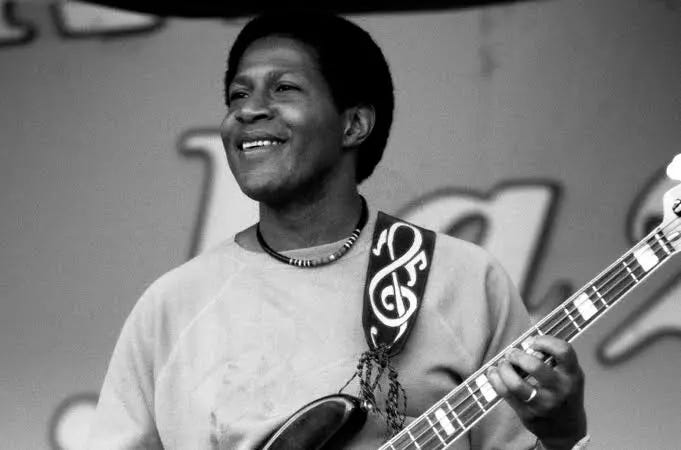
Bob Cranshaw was revered in the jazz world for both his musical mastery and his character. As a bassist, he possessed that rare quality of being absolutely dependable while maintaining deep musicality. His time feel was impeccable, his tone was warm and full, and he had an uncanny ability to support whatever music was happening around him without overplaying or calling attention to himself.
Born Melbourne Robert Cranshaw on December 3, 1932, in Evanston, Illinois, he came from a musical family of Madagascan and Native American heritage. His father, Stanley Irvine Cranshaw, was a jazz drummer from Kansas City who had moved to Evanston and worked as an electrician. Music ran through the family: his brother Stanley Jr. became a jazz pianist, and their adopted brother Emanuel took up the vibraphone. This early immersion in jazz culture shaped Cranshaw’s understanding of what it meant to be not just a musician, but a professional who could be counted on.
Young Bob showed prodigious musical gifts early. While studying piano as a boy, he found he could play back anything the teacher demonstrated. She thought he was reading music. “Once I heard it,” he recalled, “it was over.” Enrolled in a program for gifted children at Northwestern University when he was three or four years old, Cranshaw discovered he could master any instrument almost instantly. He wanted to play drums but imagined a classical trajectory for himself and learned all the orchestral percussion instruments before high school. Eventually, rather than compete with his father on drums, he switched to bass. He had practical reasons too: “If you played on the weekends, the girls were there.”
By high school at Evanston Township, he was playing in the acclaimed school orchestra and appearing regularly at local dances. But sheer talent could only take him so far. A pivotal moment came when the orchestra director asked each of eight bass players to perform a difficult passage solo. Most declined or struggled. Cranshaw, who had already absorbed the passage by listening, played it perfectly. The director moved him from eighth chair to third. “Now the challenge is on me,” Cranshaw remembered, “cause I’ve gotta be worthy of being in that third chair. I gotta produce.”
Finding His Voice in Chicago
After graduating, Cranshaw worked for the Department of Sanitation in Evanston while building his musical career. In the early 1950s, he met drummer Walter Perkins during basic training at Camp Roberts in California. By 1957, back in Chicago, they had formed MJT + 3, a quintet that included trumpeter Willie Thomas, alto saxophonist Frank Strozier, and the young pianist Muhal Richard Abrams. “We did a couple of albums in the early 1960s that were incredible,” Cranshaw remembered. “I was working in the clubs seven nights a week.”
His first trip to New York was brief and unsuccessful. Saxophonist Cannonball Adderley called him to come to the Big Apple, but Cranshaw didn’t connect with the city. “New York was so dirty,” he said, laughing. “In Chicago, we have alleys where we keep the garbage. So I came here and I saw all this garbage out on the street. And I said, ‘Thank you, no.’ I stayed for three days, then went back home.”
Eventually, Perkins and Cranshaw were hired to accompany vocalist Carmen McCrae, touring out of New York, and Bob gradually acclimated to city life. Near the end of his stint with McCrae, Perkins asked him to appear as part of a trio with Sonny Rollins at the 1959 Playboy Jazz Festival in Chicago. What happened next would change Cranshaw’s life. The festival featured 68,000 people and legends including Louis Armstrong, Count Basie, Miles Davis, Duke Ellington, Dizzy Gillespie, Coleman Hawkins, and Oscar Peterson. Cranshaw arrived hours early as instructed but hadn’t met Rollins yet. As group after group performed, Rollins remained absent, hiding backstage and checking out the competition. Finally, he appeared from the wings moments before showtime. They said hello, walked onstage with no set list, and tore it up. After the festival, Rollins asked Cranshaw if he wanted to join permanently. Cranshaw’s answer was brief: “I said, ‘I do.’”
A Discography That Reads as Jazz History
Cranshaw’s discography reads as a history of modern jazz itself. His work with Sonny Rollins produced some of the most memorable recorded performances in jazz. Albums such as “The Bridge” (1962), “Alfie” (1966), and “Easy Living” (1977) showcase Cranshaw’s ability to provide both rhythmic foundation and melodic counterpoint. His partnership with Rollins was so strong that the saxophonist kept returning to him for over fifty years. Rollins once said he could walk anywhere rhythmically because Bob was always there, a testament to the bassist’s unshakable time and presence.
With Lee Morgan, Cranshaw appeared on several Blue Note classics, contributing his distinctive bass work to sessions that helped define the hard bop era. He appeared on more Blue Note recordings than any other jazz bassist, working with leaders such as Horace Silver, Duke Pearson, Stanley Turrentine, Grant Green, Dexter Gordon, Bobby Hutcherson, and Jackie McLean. He was equally impressive on Grant Green sessions, appearing on albums such as “Idle Moments” (1963), where his acoustic bass work demonstrated his gift for creating space and allowing the music to breathe. That session remains a masterclass in restraint and taste, with Cranshaw providing just the right amount of movement without ever cluttering the sonic landscape.
Cranshaw’s work with Joe Henderson on albums such as “Mode for Joe” (1966) and “Inner Urge” (1964) showed his adaptability to more adventurous harmonic territory. He could handle the modal explorations and complex compositions that Henderson favored while maintaining that essential groove. His versatility extended across an astonishing range of artists: Wes Montgomery, Coleman Hawkins, Johnny Hodges, Horace Silver, McCoy Tyner, Thelonious Monk, Jimmy Heath, James Moody, Buddy Rich, George Shearing, Joe Williams, Ella Fitzgerald, and Oscar Peterson all benefited from his solid foundation.
Breaking Down Barriers with the Electric Bass
His electric bass work became particularly influential during the late 1960s and 1970s, appearing on countless soul-jazz and fusion sessions that bridged jazz with R&B and funk. At a time when electric bass was often looked down upon in straight-ahead jazz circles, Cranshaw normalized the instrument through his musical, tasteful, and unapologetic use of it. His electric work with Sonny Rollins during this period changed attitudes, opened doors for future jazz bassists, and proved the instrument could swing just as hard as the upright. This willingness to embrace new tools while maintaining traditional values of swing and groove marked Cranshaw as both a modernist and a keeper of the flame.
A Musical Chameleon
Cranshaw’s musical philosophy was unorthodox. He rarely asked for set lists or lead sheets. “When I’m playing a piece of music, I never ask the key,” he explained. “By the time you hit the first note, I know the key. When I’m playing things out, I don’t really think about what key it’s in. I hear it, I play it.”
This approach initially puzzled Joe Raposo, the enormously talented songwriter and musical director behind “Sesame Street” and “The Electric Company.” “The first time Joe and I played together,” said Cranshaw, “I knew he was thinking, ‘What the hell is this?’ But my philosophy was, I’m going to make it feel so good to him that he’s gonna put that left hand right in his pocket. And that’s what happened. Over the years at ‘Sesame Street,’ when Joe would write a lead sheet, he never wrote a bass part. He knew I could hear the bass parts on my own.”
Beyond Jazz
Beyond pure jazz, Cranshaw became one of the most sought-after session bassists in New York. He appeared on pop, soul, and R&B recordings, bringing his jazz sensibility to commercial music. This crossover work required both technical versatility and the ability to serve the music rather than his ego, and Cranshaw excelled at it. He collaborated with artists as diverse as Paul Simon, Barry Manilow, Eddie Kendricks, Judy Collins, Rod Stewart, Stevie Wonder, Eric Clapton, Dolly Parton, Marvin Gaye, James Brown, and Debbie Gibson.
His television work was equally extensive. Cranshaw was a member of the first band for Saturday Night Live and played in the bands backing the broadcasts of Dick Cavett and Merv Griffin. For three decades, he worked with Joe Raposo on Sesame Street, bringing his professional excellence to the education and entertainment of millions of children. This ability to move seamlessly between artistic contexts without compromising his musical standards made him invaluable across the entire entertainment industry.
The Man Behind the Bass
What made him particularly respected as a person was his professionalism, humility, and generosity. He was known for showing up prepared, being easy to work with, and helping younger musicians. Musicians who worked with him often said, “If Bob was on the gig, everything would be fine.” He wasn’t flashy or self-promoting. He simply did the work at the highest level, night after night, session after session, for decades. That combination of excellence and consistency, without drama or attitude, earned him deep respect throughout the music community.
He was always on time, always arrived at the airport early. “I don’t want any fuss,” he would say. “Let everybody else get all bent out of shape over making their plane on time, running late. I’m here already. I’m cool.” On the road, he would repair to his hotel room, take a bath, practice his bass, watch football games, and eat yogurt.
Cranshaw’s quiet generosity extended far beyond the bandstand. He was a founding member of Local 802’s Jazz Advisory Committee, worked as the union’s jazz consultant, and later served as an elected member of the Executive Board. He was the first musician to sign onto the Honorary Advisory Board of the union’s Emergency Relief Fund. He sat on the Honorary Founders Board of the Jazz Foundation of America since its inception in the early 1990s, and was known to bring homeless musicians there to get them help. He regularly “adopted” younger players in need of professional and musical guidance.
His advocacy work was tireless. He agitated on behalf of jazz musicians at the Texaco Jazz Festival in the early 2000s, resulting in a union agreement. He met with Jazz at Lincoln Center management in 2010 to encourage broader union coverage. He was instrumental in the Justice for Jazz Artists campaign, making multiple trips to Albany and Washington, D.C. to advocate for musicians’ rights. He appeared at jazz conferences nationwide and took part in dozens of panel discussions.
One story captures his character perfectly. A widow of a prominent jazz pianist had been calling the union all morning, seeking help with her husband’s pension. Her impaired memory made her difficult to assist. Cranshaw’s response was immediate: “I’m on it. She’s my people. I’ll take care of her.” He met with her at her Manhattan apartment several times, then escorted her to the pension fund offices himself. Later, calling from an airport somewhere in Europe, he reported: “All right! I walked her in there and held her hand, and she signed the papers. It’s a done deal. She’ll get the money, about $26,000. It’s there for her now. She’s cool.”
The Legacy
The way musicians talk about Cranshaw, there’s always this sense of gratitude for his presence. He made everyone around him sound better, and he did it with grace and good humor. In an era when many jazz musicians were temperamental or unreliable, Cranshaw represented the ideal professional: supremely talented, completely dependable, and genuinely kind. Drummers loved playing with him because his time was famously immovable. Soloists trusted him because they knew the foundation would never wobble. Bandleaders relaxed when they knew Bob was on the date.
His advice to young musicians was characteristically straightforward: “Don’t be afraid to play everything, do everything. You can make jazz your dessert, but you don’t have to make it the whole meal.”
When Bob Cranshaw died on November 2, 2016, in Manhattan at the age of 83 after a battle with bone cancer, the jazz world mourned the loss of not just a great musician, but a great human being. In a 2016 interview with The New York Times, Sonny Rollins called Cranshaw “impeccable” and said that he “played with probably every musician in New York.” It was a fitting tribute to a man whose career touched virtually every corner of the jazz universe.
Bob Cranshaw represents the highest ideal of jazz musicianship: mastery without ego, authority without arrogance, groove without showmanship. He’s the kind of musician who reminds people that greatness isn’t always loud. Sometimes it’s the person holding everything together so well you almost forget they’re there. That was Bob Cranshaw’s gift to jazz, and it’s a legacy that continues to resonate with every bassist who understands that serving the music is the highest calling of all.
I first encountered Bob on Lee Morgan’s The Sidewinder (His name is misspelled as Crenshaw on the original cover). In my early days as a jazz listener, I must have worn our three copies of the LP.
When I was working with Sonny Rollins, producing his website and many videos, Bob and I became friends. We recorded several video interviews. You hear the warmth in his playing and in his words.
Here, Bob Cranshaw remembers Lee Morgan and the Sidewinder session:
Sonny Rollins and Bob Cranshaw played together for over fifty years:
Here’s an excerpt from the first time Bob played with Sonny on August 9, 1959 at the Playboy Jazz Festival at the Chicago Stadium, with Sonny, Bob and Walter Perkins on drums.
Here, Bob talks about the importance of playing “in the pocket.”
Bob played bass on Horace Silver’s In Pursuit of the 27th Man. Bob was one of the first jazz players on the electric bass. That recording was the first time I heard Michael Brecker, in 1973. Mike’s solo on “Gregory is Here” jumped out of my speakers and I had one of those “who the hell is that moments.” Here’s a live version featuring Horace’s Quintet from the Pori Jazz Festival on April 14, 1973 with Horace on piano, Mike on tenor, brother Randy on trumpet, Bob on bass and Mickey Roker on drums.
I had the good fortune to interview Dizzy Gillespie during his last engagement at the Blue Note in NYC. It was an extended, all-star affair to celebrate his 75th birthday. When I asked him who he had been playing with, he said, “Oh man, Bob Cranshaw!”
Thanks Bret! I needed this dose of brightness today!