

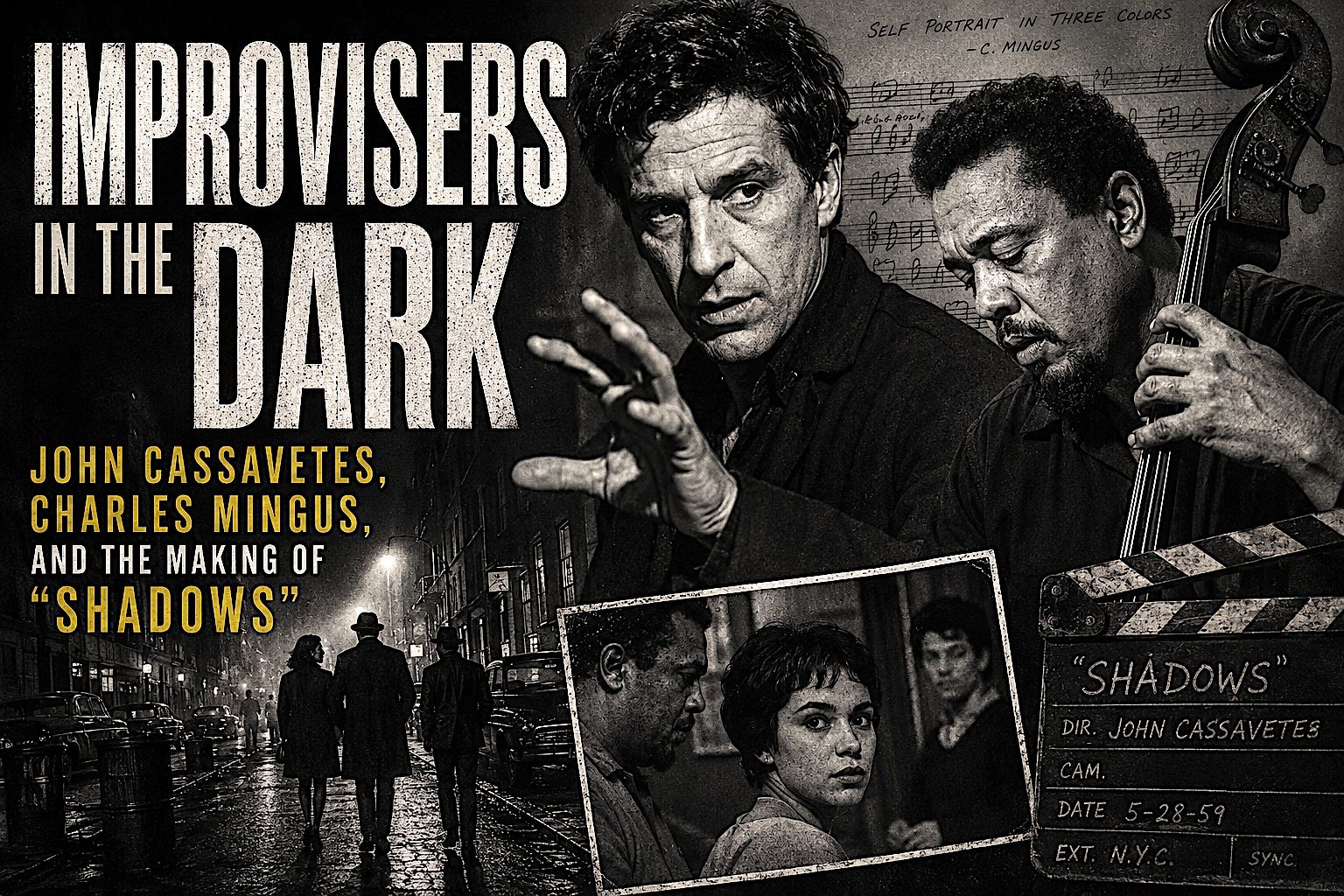
John Cassavetes believed that truth in art came from spontaneity. Charles Mingus believed it came from a composer's fully realized vision. In 1959 they tried to make a film together, and the argument between those two positions produced one of the most important American movies ever made.
Shadows and the Sound of Refusal
There is a line near the end of Shadows that functions less as a credit and more as a declaration of war. “The film you have just seen was an improvisation.” Whether literally true in every frame or not is almost beside the point. As a statement, it was aimed directly at Hollywood’s throat.
The year was 1959. American cinema was a machine. Scripts moved through development processes designed to sand away anything too strange, too uncomfortable, too alive. Actors hit marks on spotlessly lit sets. Dialogue was engineered to sound natural while being anything but. The emotional truth that human beings actually carry around in their bodies — the hesitation, the interruption, the sentence that trails off because the feeling outran the words — none of that had much place in American movies.
John Cassavetes looked at all of it and decided something was missing at the center. And when he looked for a model of how art might recover that missing thing, he looked, as so many restless American minds of that era did, toward jazz.
Jazz had already solved the problem Cassavetes was trying to solve in cinema. It had found a way to hold structure and spontaneity in the same breath. A jazz musician working through a standard was not simply playing a song. He was thinking in real time, responding to what his bandmates had just played, discovering the music rather than executing it. The emotion was not pre-planned and then delivered. It was generated in the moment of performance. That was exactly what Cassavetes wanted from his actors.
The Night People
The film began, improbably, with a radio show. Cassavetes had been conducting workshops for aspiring actors at the off-Broadway Variety Arts Theatre in Manhattan, working with Burt Lane against the grain of Method acting’s ascendance in New York. One exercise became the core of what would become Shadows: a light-skinned Black woman dating a white man, who recoils when he encounters her Black brother. Cassavetes knew he had to put it on film.
In February 1957, he appeared on Jean Shepherd’s Night People show on WOR, ostensibly to promote Edge of the City. Instead he went off-script, criticizing the studio system and spinning out a vision of what real cinema could be. When Shepherd, skeptical, asked how something like that could possibly get financed, Cassavetes replied without hesitation: if people really wanted to see a movie about people, they should just contribute the money themselves.
It was a provocation. It was also a direct appeal. Listeners started mailing money to the station. Within days, roughly $2,000 had come in — most of it in amounts of five dollars or less. A dollar at a time, from the city’s night people: the insomniacs, the bohemians, the taxi drivers and jazz fans and restless minds who made up Shepherd’s audience, people who already understood themselves to be living outside the mainstream culture that Hollywood was busy reflecting back at itself.
What Shepherd did next mattered as much as the initial broadcast. For the next two years, he kept his listeners updated on the making of Shadows, describing it on air as “their film.” He had built a genuine ownership relationship between the project and an audience that had never been asked to own anything before. When the film was finally finished, Shepherd announced the screenings on his show. Three free midnight showings, no admission.
The $2,000 from the radio audience was seed money, not a budget. Additional funds came from Cassavetes’s contacts — Joshua Logan, Hedda Hopper, William Wyler, Robert Rossen, José Quintero, his agent Charlie Feldman. The rest of the roughly $40,000 budget was borrowed. Cassavetes hired German cinematographer Erich Kollmar, the only crew member besides Cassavetes with any film experience, and borrowed camera equipment from independent filmmaker Shirley Clarke.
The Composer
Which is why, when he needed someone to score Shadows, the person he turned to was Charles Mingus.
The choice made sense on every level. Cassavetes was filming guerrilla style on the streets, tenements, and dive bars of mid-century New York, and Mingus at that precise moment was producing some of the most ambitious and emotionally raw music in jazz — compositions that moved between tenderness and fury, between written structure and collective improvisation, between the blues tradition and the outer edges of the avant-garde. His was music that felt lived rather than performed. It seemed like a perfect marriage.
What actually happened in the recording studio was something considerably more chaotic, and considerably more revealing about what both men actually believed.
Cassavetes wanted completely improvised music played spontaneously while the musicians viewed the film for the first time. Mingus arrived having composed specific pieces, without having had access to the finished film. Two artists who shared a deep commitment to emotional authenticity had reached completely opposite conclusions about how authenticity was achieved. Cassavetes believed it came from the immediate, the unplanned, the reactive. Mingus believed it came from a composer’s vision, fully realized and then performed with discipline and feeling. The session produced nothing usable. Studio costs mounted. Both men stared at wreckage.
What came next deserves more than the phrase that has been used to describe it — “an exercise in disaster salvation” — because what emerged from that wreckage was genuinely remarkable. Starting over, with Cassavetes calling for improvised percussion pieces and bass solos that could be cut behind the action, Mingus and his band — tenor saxophonist Booker Ervin, drummer Danny Richmond, pianist Horace Parlan — produced recordings that became the score. The jagged, disjointed quality that resulted from the chaos ended up fitting the film perfectly. Mingus valued the music enough to carry two pieces into his own catalogue: “Nostalgia in Times Square” appeared on Jazz Portraits, and “Self Portrait in Three Colors” became part of the landmark Mingus Ah Um. The collision produced art that neither man had intended and both could claim.
But to understand why this collaboration mattered beyond its formal innovations, you have to reckon with what Shadows was actually about.
This was not merely a formally experimental film. It was a film about race — about three mixed-race siblings navigating identity, desire, and confusion in New York City. Its most explosive scene involves Lelia, who appears white to most people, watching her white boyfriend visibly recoil when he encounters her Black family. In 1959 America, that material carried a social charge that went well beyond drama. It named something the culture was working very hard not to name.
Mingus had spent his entire career fighting racism within the music industry while making some of the most politically charged jazz of his era. He understood, from the inside, what it meant to move through America in a body that made certain people uncomfortable. The film needed someone who knew that specific weight. The contentious collaboration — two uncompromising artists refusing to subordinate their vision to anyone else’s convenience — almost deepens the meaning. They made something together that neither could have made alone, and the friction is audible in every frame.
The City as Instrument
Cassavetes shot on location using handheld cameras and available light. The city breathes into every frame. Cars pass. Noise interrupts scenes. People talk the way people actually talk, sentences colliding, feelings outrunning language. The parallel to jazz was not merely metaphorical. It was structural. A jazz soloist discovers a phrase the way a Cassavetes actor discovers a reaction — in the moment, under pressure, in response to what is actually happening rather than what was planned.
The impact moved slowly through the culture the way important things often do. But the proof of concept Shadows established — that a feature film could be made outside the studio system, in actual streets, with actors discovering rather than executing their scenes — restructured what American independent cinema believed was possible. You can draw a direct line from this film to Scorsese’s restless camera, to the wandering naturalism of Jarmusch, to the long unscripted conversations that define Linklater. What Cassavetes demonstrated here, they inherited.
And running underneath all of it, in more ways than one, was the sound of Charles Mingus, doing exactly what he always did: refusing to simplify, refusing to collaborate on anyone else’s terms, and producing, in spite of everything, music that was unmistakably and irrevocably alive.
Watch 1959’s Shadows:
Brilliant piece! I’ve never seen Shadows, but am really looking forward to it now – thanks from Adelaide, South Australia, Bret, and keep up your great work.
Thanks man!