

Note: Some poetic license going on here.
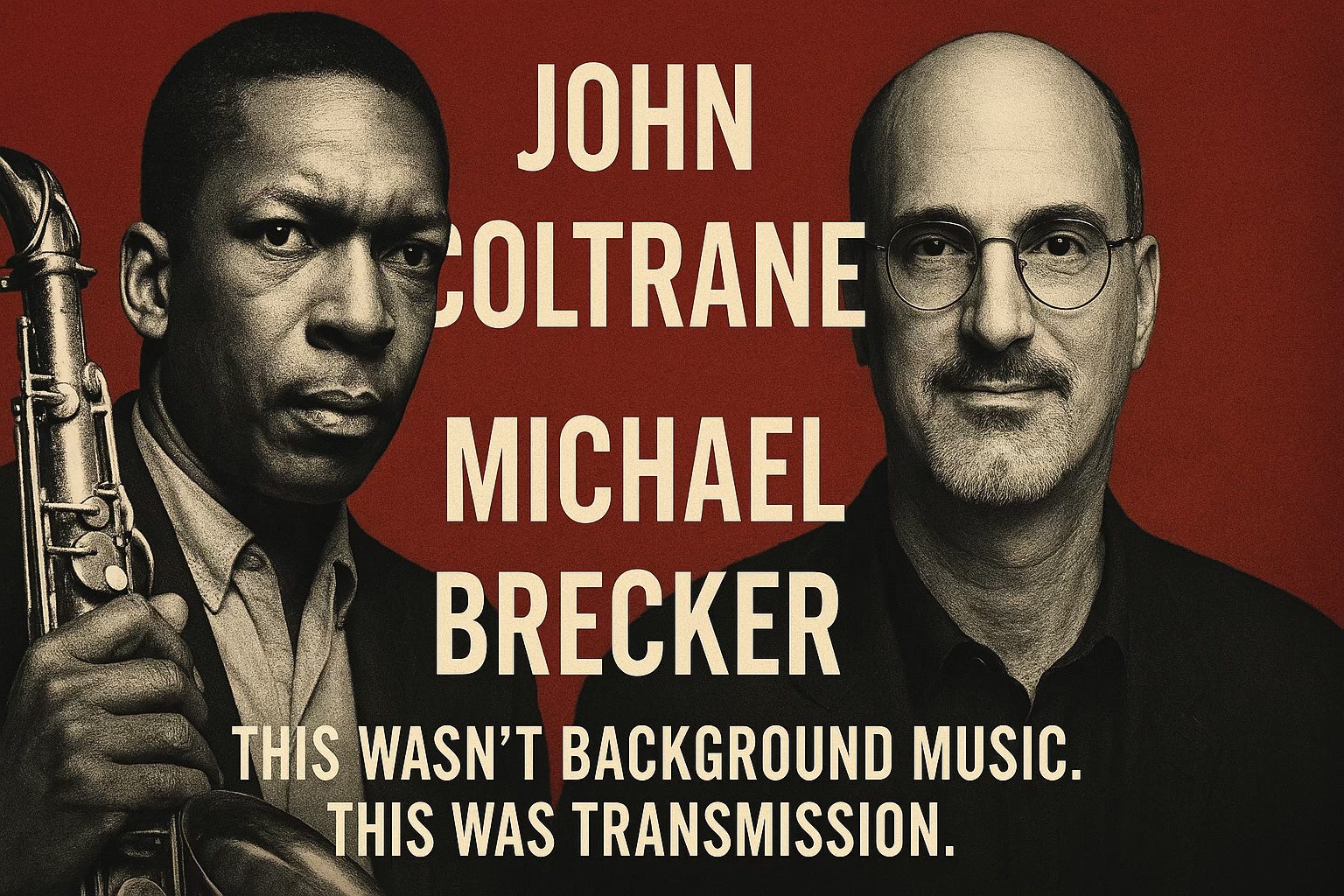
March 29, 3:17 a.m.
(Mike would have been 76 today)
The saxophone was howling through my headphones like a wounded prophet.
Coltrane? No. Too slick. Too electric. This wasn’t the sanctified blaze of A Love Supreme. This was post-Trane. This was Michael Brecker—jacked into the fusion mainframe, surfing the harmonic cosmos on a rig of wires, reeds, and barely controlled chaos.
I’d fallen down another late-night jazz rabbit hole, the kind lined with cracked jewel cases, blurry YouTube rips, and wild-eyed rants from half-anonymous sax heads on dead forums. My desk was a mess—espresso cups, tangled cables, notes scribbled in a manic shorthand only I could understand. Two shots of coffee deep, a haze of indica curling around the edges of my brain, and there he was—Brecker, not playing at me, but through me. Piercing. Relentless. Alive.
This wasn’t background music. This was transmission.
Coltrane was the comet—bright, spiritual, transformative, burning a path across the night sky that changed everything.
Brecker was the satellite we launched after it—spinning through space, collecting every frequency Trane ever emitted…and then some.
He didn’t mimic Coltrane. He metabolized him.
He chewed on Coltrane’s bones and spat out something glossier, more angular, more now—like Trane got downloaded into a supercomputer, rewired for the digital age, and handed a keytar just to see what would happen.
And the crazy thing? It worked.
Against all odds, it worked.
Somewhere around the bridge of Straphangin’, I felt it—his EWI (Electronic Wind Instrument) slicing into the fog of my late-night haze like a laser-guided shofar. I swear I could feel him in my bloodstream. Like a coded frequency designed to bypass language and logic and go straight to the soul.
That’s when it hit me:
This wasn’t imitation. This was reincarnation.
In Brecker’s Voice: “The First Time I Heard Trane…”
“Man, I was a teenager. A skinny, pimply kid in Philly. I put on A Love Supreme ‘cause someone said I had to, and when it started, it was like the room cracked open. I swear I saw sound. He wasn’t playing notes—he was confessing.
And I thought, ‘I’ll never get there.’ But that’s what made it holy. That’s what made it worth chasing. Trane had this… thing. This sacred fire. It wasn’t about chops. It was about searching. About honesty.
I carried that with me. Every gig, every solo, every goddamn fusion festival in the middle of nowhere—Trane was on my shoulder, whispering: ‘Keep going. You haven’t touched it yet.’
Even when I picked up the EWI—people thought it was a gimmick. Nah, man. That was my way of blowing through the ceiling Trane already cracked open. He opened the door. I just walked through it in a spacesuit.”
The Cosmic Baton Pass
Brecker never tried to be Coltrane. That would’ve been sacrilege.
What he did instead was pick up the cosmic saxophone baton and keep running—breathless, fearless, and plugged in.
And what a run…
With Steps Ahead, electrifying jazz-fusion with digital nerves and human blood.
With Herbie Hancock, sharing space with a sorcerer of sound.
With his brother Randy in the Brecker Brothers, slicing through funk with surgical precision.
With McCoy Tyner—yes, Trane’s own pianist—as if destiny needed a signature.
With Joni Mitchell, weaving jazz into poetry and giving it wings.
Always circling back to the source. Always asking, “Is this the note that breaks the sky?”
And then came Pilgrimage.
His final album. Recorded while dying.
No grand speeches. No farewell tour.
Just seven tracks of molten spirit—every solo like a blood-letting, every chord a prayer.
You could practically hear the oxygen tank hissing in the background of the session, but he never missed a note.
He played like a man who knew his visa was expiring and wanted to leave everything on the table.
You listen to Pilgrimage, and you hear Trane in the background.
Not as a ghost.
As a witness.
The Epilogue in Static
So yeah—Coltrane was the prophet. The original fire breather.
He shattered the old temples and rebuilt them with sound.
But Brecker?
Brecker was the astronaut. The engineer of spirit and circuitry.
He took the saxophone into the future and made it weep, scream, pray, and laugh—all at once.
In the age of drum machines and hair metal, Brecker made the horn holy again.
He didn’t betray the Church of Trane.
He expanded it.
If you’re looking for God, start with Coltrane.
But if you’re looking for what comes after God—the echo in the circuit, the prayer inside the machine, the next chapter of the gospel played in binary and breath—try Michael Brecker.
3:17 a.m.
Eyes closed
Volume way too loud.
And something sacred still ringing in your chest.
###
On Friday, some of the best Trane ever caught on film.
Until we meet again, let your conscience be your guide.
I appreciate the passion in your writing about listening. But as for the title, fog is analog.
As a saxophonist, the link I think about between Coltrane and Brecker is practice. Lots and lots of practice.
And the difference in the link is what they practiced. Coltrane included musics of many cultures in his practice, compositions, and performances - spirituals, ragas, scales from Africa, Middle East, Asia, Europe, Eastern Europe, South America, etc. but I haven't seen that same wide scope in what I know of musical Brecker's disciplined diet.
Coltrane was on a path to transcend his lived experience through becoming a disciple of Ravi Shankar. Brecker's path did not cross into becoming a student of another master.
Perhaps I am ill informed. I am hungry to learn.
Oh, Bret! I read your words and heard my sister Lili-"when I sing, I want to sound like a saxophone." Her muse id Michael Brecker. I saw him every time he played in NY, particularly in his and Randy's club, "7th Avenue South." It was school for me, with Don Grolnick as his pianist (I play the piano) and the rest was church. On top of it all, he was the nicest person. I am certain Lili will write a post. Thank you, Bret. This article took me "there."