

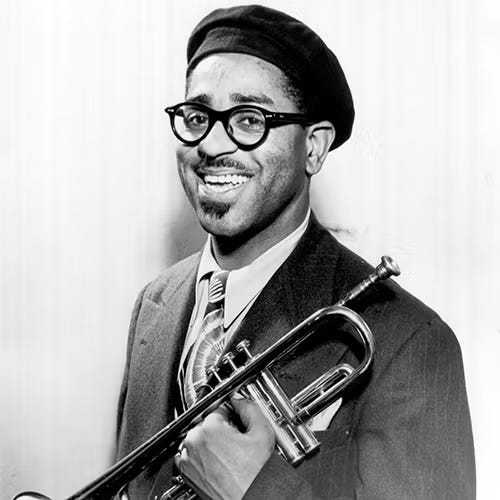
When I was a thirteen year old trumpeter getting into jazz, Dizzy Gillespie was my main man. The first jazz record I purchased was the Dizzy Gillespie Big Band Live at Newport, 1957. I loved big bands and Dizzy’s group totally blew me away. As a budding jazz fan, what grabbed me was the sheer force of that brass section, the way they could execute those intricate bebop lines in unison at breakneck speed, then open up for solos that seemed to defy gravity. The energy was relentless, joyful, and utterly sophisticated all at once.
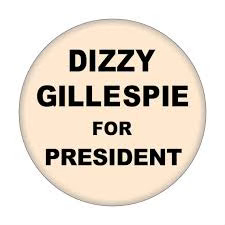
As I began to learn about Diz, Charlie Parker entered the picture, as well, as did bebop. I word a Dizzy Gillespie for President button to school every day in seventh grade. Aside from my hipster musician buddies, including Mark Kaplan, who became a superb tenor player, everyone else thought I was from another planet.
I’d get to school an hour early, go to the music room, and blast Jazz at Massey Hall. It all seemed perfectly natural to me, as I was already a fan of Maynard G. Krebs, the beatnik character on the Dobie Gillis Show, who frequently mentioned Dizzy, Bird and Monk. Television was teaching me about jazz before I fully understood what I was hearing.
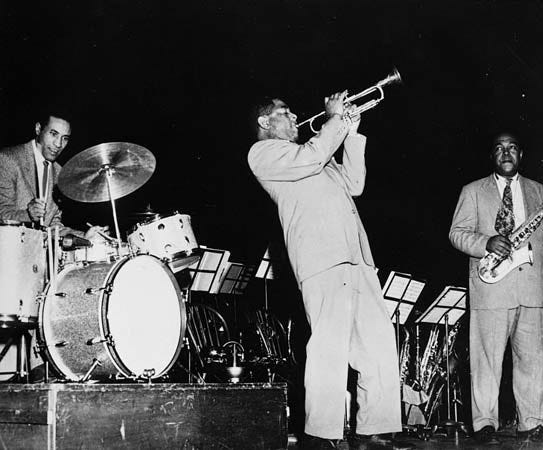
When I was fourteen, Dizzy came to Hartford for a Sunday matinee at the Hofbrau Haus and my trumpet teacher, Joseph Talone, took me to the gig and introduced me to Dizzy. It was the first jazz I’d heard live. The band included James Moody, a very young Kenny Barron, Chris White on bass and Rudy Collins on drums.
I remember standing there, a skinny kid with a trumpet case, shaking Dizzy’s hand. He had this enormous grin and those cheeks, already legendary, that seemed built specifically for the trumpet. He asked me how long I’d been playing, and when I said about a year, he laughed and said, “Keep at it, young man. The trumpet will teach you everything you need to know.” Then he went out and played a set that redefined what I thought was possible on the instrument. The sound in that room was focused and penetrating, every note clear even in the fastest passages, and the way he could float above the rhythm section while somehow driving it forward seemed to contradict the laws of physics.
Fifteen years later Moody would become a friend and I’d also get to know Kenny Barron, who thankfully, is still with us. This was my destiny.
Over the years, I heard Dizzy live many times and got to know him after I started writing for DownBeat. I even went to a pool party at his house in Englewood, New Jersey, where he held court with the same generosity and humor he brought to the bandstand, telling stories about the bebop revolution while younger musicians hung on every word. Watching him in that relaxed setting, I understood that his accessibility and warmth were as important to his legacy as his technical mastery.
The Bebop Revolution
When jazz historians compile their lists of the most influential figures in the music’s history, John Birks “Dizzy” Gillespie invariably appears near the top. His childhood nickname, which stuck for life, somehow captured both his playful personality and the dizzying complexity of his music. This placement isn’t simply due to his virtuosity on the trumpet or his memorable stage presence, though both were formidable. Rather, Gillespie’s importance stems from his role as a true revolutionary who fundamentally transformed jazz at a crucial juncture in its development, then spent decades as an ambassador spreading that revolution across the globe.
To understand Dizzy Gillespie’s significance, we need to consider the landscape of jazz in the early 1940s. Swing music dominated, with big bands providing danceable entertainment for massive audiences. The music, while sophisticated, prioritized accessibility and commercial appeal. But in after-hours jam sessions at clubs throughout Harlem, particularly Minton’s Playhouse and Monroe’s Uptown House, a small group of young musicians were cooking up something radically different.
Gillespie, along with alto saxophonist Charlie Parker, pianist Thelonious Monk, drummer Kenny Clarke, and others, developed what became known as bebop. This wasn’t merely a new style but a complete reimagining of jazz’s possibilities. Where swing featured relatively straightforward chord progressions and melodic lines designed for dancing, bebop employed complex harmonic substitutions, lightning-fast tempos, and angular melodies that demanded concentrated listening.
Gillespie’s contribution to this revolution went beyond simply participating. He possessed a sophisticated understanding of harmony that allowed him to codify and teach bebop’s principles. While Parker often played by intuition and feeling, Gillespie could explain the harmonic logic behind their innovations. He understood how to use flatted fifths, extended chords, and chromatic passing tones to create new pathways through familiar songs.
Compositions That Endure
Gillespie’s legacy as a composer deserves special attention. “A Night in Tunisia,” written when he was just twenty-five, remains one of jazz’s most recorded compositions. The piece brilliantly demonstrates his ability to blend exotic harmonic colors with irresistible rhythmic drive. The interlude section, with its dramatic breaks and shifting rhythms, still challenges musicians today and remains a test piece for aspiring bebop players.
Other Gillespie compositions became fundamental parts of the jazz repertoire. “Salt Peanuts,” with its playful vocalizations and breakneck tempo, showcased bebop’s virtuosic demands while remaining accessible through sheer exuberance. “Groovin’ High,” based on the chord changes to “Whispering,” demonstrated how bebop musicians transformed familiar standards into vehicles for improvisation. “Con Alma,” “Woody ‘n’ You,” and “Blue ‘n’ Boogie” further established Gillespie as a composer whose work balanced complexity with memorable melodic content.
The 1945 Guild recordings that captured “Groovin’ High” and “Dizzy Atmosphere” gave the jazz world its first clear documentation of the bebop revolution in full flower. These weren’t tentative experiments but fully formed statements of a new musical language.
Technical Mastery and Innovation
Dizzy’s trumpet playing set new standards for technical excellence. His speed was extraordinary, his articulation crystal clear even at the fastest tempos. He possessed remarkable range, particularly in the upper register where he could execute complex lines that would defeat lesser players. His use of the entire range of the instrument, from growling low notes to stratospheric high ones, expanded the trumpet’s expressive vocabulary.
The famous bent bell on his trumpet, while originating from an accident at a birthday party in 1953 when someone fell on his horn, became integral to his sound. The upward angle changed the way sound projected from the instrument, creating a more focused, penetrating tone that cut through any ensemble. Gillespie immediately recognized the sonic advantages and played bent-bell horns for the rest of his career. That distinctive silhouette became as recognizable as his puffed cheeks, another trademark that resulted from his unique embouchure.
His rhythmic conception was equally important. Gillespie mastered the art of playing across the beat, creating tension by implying different meters simultaneously. His phrasing often seemed to float above the rhythm section, connected but independent, demonstrating the kind of rhythmic sophistication that defined bebop’s relationship to time. He could suggest triple meter over four-four time, delay his entrance to create anticipation, or rush slightly ahead to generate excitement, all while maintaining perfect time.
The Afro-Cuban Connection
In the late 1940s, Dizzy Gillespie made another revolutionary contribution by systematically incorporating Afro-Cuban rhythms into jazz. While earlier musicians had flirted with Latin elements, Gillespie’s collaboration with Cuban conga player Chano Pozo created something unprecedented. Together they developed what became known as Cubop or Latin jazz.
Pieces such as “Manteca” and “Tin Tin Deo” weren’t simply jazz tunes with Latin percussion added. They represented a genuine fusion where complex Cuban clave-based rhythms interacted with bebop harmonies to create something entirely new. This work anticipated the global fusion movements that would emerge decades later and demonstrated Gillespie’s openness to musical ideas from beyond the bebop circle.
What truly set Gillespie apart from some of his bebop peers was his personality and commitment to spreading the music. Where some pioneers remained insular or difficult, Gillespie was gregarious, funny, and generous with knowledge. His humor and showmanship made him accessible to audiences who might have found bebop intimidating.
As an educator, Dizzy Gillespie was invaluable. He could articulate bebop’s principles clearly, helping younger musicians understand the harmonic and rhythmic concepts underlying the music. Players who studied with him or absorbed his lessons became conduits for bebop’s language, ensuring the style’s survival and evolution. His small group recordings for Verve in the 1950s, particularly the sessions with Sonny Rollins and Sonny Stitt, documented his role as a mentor figure who could inspire younger players to their best work.
Dizzy Gillespie continued performing and innovating until shortly before his death in 1993. His late work incorporated elements from various world music traditions, demonstrating that his curiosity and openness never diminished. He mentored younger players, participated in all-star sessions, and maintained bebop’s visibility even as jazz fragmented into numerous subgenres.
Despite his enormous contributions and constant touring, Gillespie faced periodic financial struggles throughout his career. The economics of jazz were never kind to even its greatest innovators, and Dizzy worked far harder for far less money than his importance to American music would suggest he deserved. Yet he never became bitter or stopped sharing his knowledge.
His later big band recordings and his work with the United Nation Orchestra in his final years showed a musician still eager to explore new possibilities. He embraced younger players, incorporated Brazilian and Caribbean influences, and proved that bebop’s principles could accommodate an ever-widening world of musical ideas.
The Legacy
Today, Gillespie’s influence permeates jazz at every level. The harmonic language he helped develop remains fundamental to jazz education. His compositions appear on countless recordings. Young trumpeters still study his solos for their blend of technical brilliance and musical logic. The Afro-Cuban tradition he helped establish has become a major stream within jazz, influencing everyone from Cal Tjader to Arturo Sandoval, who Dizzy mentored and helped defect from Cuba.
More broadly, Dizzy Gillespie demonstrated that innovation and accessibility need not conflict. He showed that music could be intellectually sophisticated while remaining emotionally direct, technically demanding while never losing its sense of joy and swing. His example as a cultural ambassador proved that jazz could function as a universal language, bridging divides and fostering understanding.
In assessing Dizzy Gillespie’s importance, we find a figure who changed jazz’s direction at a critical moment, expanded its technical and harmonic vocabulary, opened it to global influences, and spent a lifetime ensuring that the revolution he helped create would continue to evolve. That’s not just important; that’s essential.
That thirteen-year-old kid blasting “Jazz at Massey Hall” in an empty music room at seven in the morning had stumbled onto something real. Dizzy Gillespie wasn’t just a great trumpet player or an important historical figure. He was proof that music could be revolutionary and joyful at the same time, that the highest levels of artistry could coexist with warmth and generosity, that you could change the world and still remember to encourage a nervous kid with a trumpet case.
Every time I hear that bent horn cutting through a big band arrangement or floating above a rhythm section, I’m back in that Hartford club at fourteen, understanding for the first time that jazz wasn’t just music you listened to. It was a way of being in the world, and Dizzy Gillespie showed me how.
From Jazz at Massey Hall, “A Night in Tunisia” featuring Dizzy, Bird, Bud Powell, Max Roach and Charles Mingus.
Thank you, Bret, for such a fantastic synopsis. I can’t help but think that anyone reading this would become even more interested in the music Dizzy helped create. Look for my post next Sunday where I intend to discuss Dizzy, the educator, and the effect his tutelage had on his many disciples, including yours truly.
In addition to the manny fine qualities you enumerate, Dizzy was also a great humanitarian. At the end of his life he left an endowment for his fellow musicians who were in need. A few years ago I went to hear trumpeter Warren Vache’. I was surprised to see him walking with great difficulty, and he remained seated on stage the whole night. I happened to see him again the next year, and he was walking and standing just fine. I asked him what had changed, and he responded, “Dizzy Gillespie paid for my hip replacement.” Goose bumps broke out all over my body.