

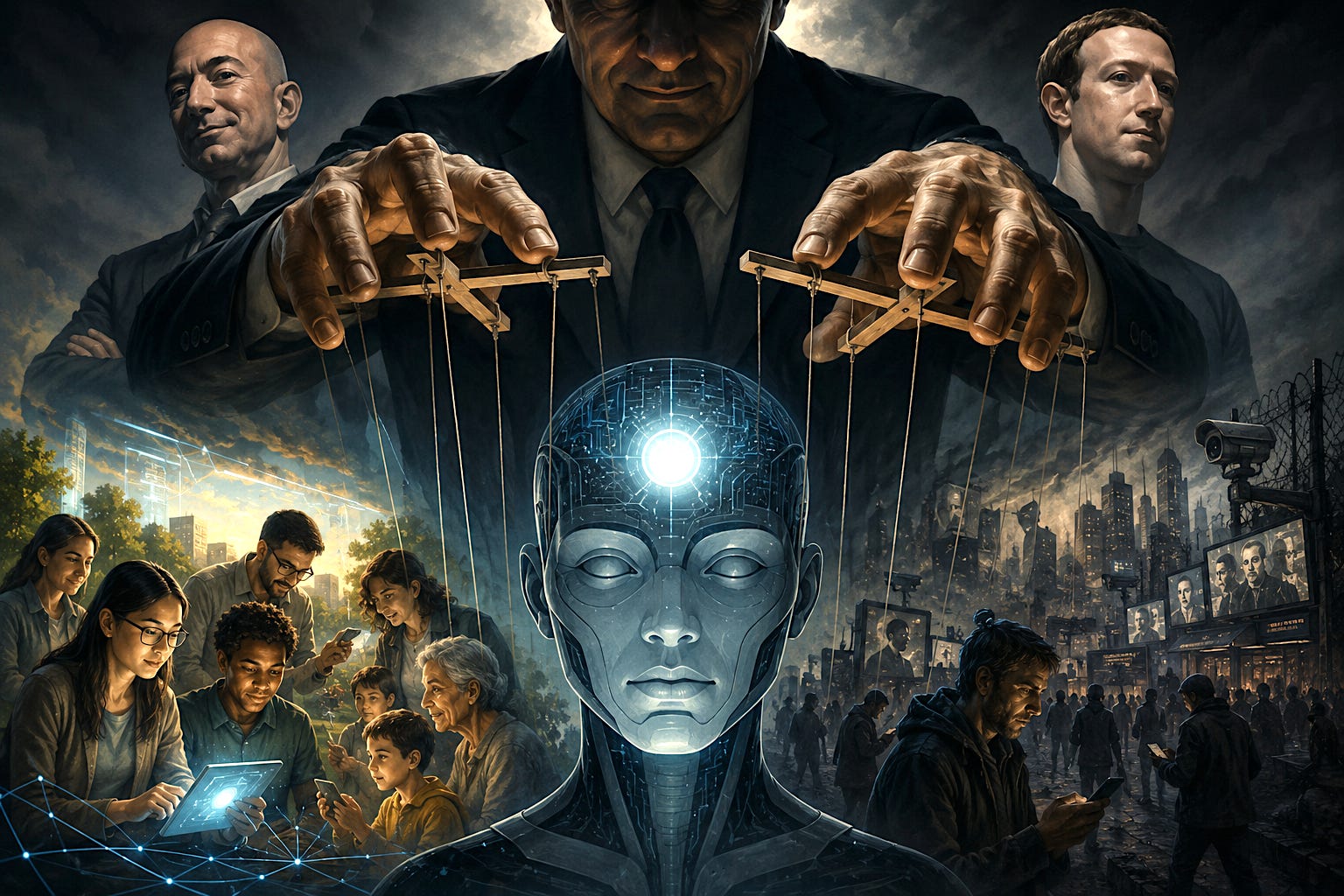
Let’s start with what nobody wants to say out loud: the robots aren’t the problem. We are.
Technology has been sold as salvation my entire adult life. Rock and roll was going to liberate us. Television was going to educate us. The internet was going to democratize us. Each time we took the shiny new thing, handed it to the people with the most money and the least conscience, and watched them turn our hopes into a subscription service.
AI is going to be different, they tell us. Sure it is.
The science fiction version of this story features a malevolent superintelligence that decides humans are inefficient and starts optimizing us out of existence. Good box office. Also a distraction. The actual threat is more familiar and a lot less cinematic: the same greed, tribalism, and lust for control that drove human behavior when we were hitting each other with rocks, now running on a vastly more powerful lever.
Look at who’s building this and why. Elon Musk, Jeff Bezos, Mark Zuckerberg, Sam Altman. Four men who have shown, repeatedly and in public, that their operating instinct is more. More money, more market share, more of whatever the scoreboard happens to be measuring that quarter. They’re not villains. They’re something more dangerous: ordinary men with no checks on them. Zuckerberg built a company that ran its own internal research showing Instagram worsens body image in teenage girls, and kept running the product anyway. That’s not a hypothetical about the future. That already happened.
AI doesn’t create new human impulses. It amplifies the ones we’ve got. Fear, resentment, tribal loyalty, the hunger for certainty in an uncertain world. Social media didn’t make people tribal. It gave tribalism a megaphone and a business model, and in Myanmar that business model helped fuel a genocide, with Facebook’s own commissioned report admitting the platform enabled the spread of hate speech against the Rohingya. AI is the same machine with a bigger amplifier.
The surveillance angle should worry you more than it does. Clearview AI scraped billions of photos off the internet without consent and sold facial recognition access to police departments across the country before anyone passed a law about it. China’s Skynet system already tracks hundreds of millions of cameras tied to facial recognition at national scale. AI doesn’t invent the appetite for watching citizens. It just makes indulging that appetite cheap.
Then there’s manufactured reality. In 2024, a deepfaked robocall impersonating Joe Biden’s voice told New Hampshire voters to skip the primary. It worked well enough that people believed it. That’s the cheap version, done by amateurs. The expensive version is coming, and it will be indistinguishable from the thing it’s faking.
The jobs question gets asked constantly and answered dishonestly. Jobs always change. The real question is who captures the wealth the new technology creates. Every large-scale study of the industrial revolution says the same thing: productivity gains flowed to capital first, labor second, and only after decades of organizing did workers see their share. Nothing about the current owners of AI suggests they intend to wait for labor to organize this time.
None of this means turn the machines off. Drug discovery, climate modeling, accessibility tools for people who’ve never had them: the benefits are real and worth having. The mistake is treating the technology itself as the site of danger, when the danger is who holds it and what they want.
We’ve survived powerful new technology before, not because the technology got safer but because society eventually built laws, regulation, competitive markets, and public pressure strong enough to keep it from becoming a pure instrument of control. Antitrust law. Labor protections. Independent journalism. All of it arrived late, and all of it arrived because people demanded it before the harm became permanent.
Technology moves faster than institutions. By the time regulation catches up, the landscape has already changed and the people who built it have already banked the winnings.
So ask who controls the systems making decisions about your life. Ask what they want. Ask what happens when what they want conflicts with what you need.
The robots were never the threat. The men holding the leash are.
Listening - Just a Gigilo - Louis Prima
Louis Prima’s “Just a Gigolo/I Ain’t Got Nobody” (1956, with Sam Butera and The Witnesses and Keely Smith) worked because of the arrangement, not just their performance. Prima fused a mournful 1920s waltz about a man aging out of relevance with a frantic jump-blues number, turning self-pity into swagger. That slow-into-fast structure became the blueprint for Vegas lounge music afterward. Butera’s tenor sax and the Witnesses gave it the rhythmic teeth of an R&B combo rather than a crooner’s backing band, which is what let Prima’s shouted, half-comic vocal style land as exciting instead of novelty.
The group’s popularity came from the triangle on stage: Prima mugging and grinning, Smith standing deadpan next to him, Butera cutting loose on sax breaks. It was as much a comedy act as a music act, which is why the Sahara lounge residency became the ticket in mid-50s Vegas. It also solved a real problem for Prima: rock and roll was pulling his audience away, and this format let a bandleader in his 40s stay commercially relevant without abandoning swing.
The record’s reputation got a second life from David Lee Roth’s 1985 cover, which introduced the song to listeners with no context for lounge acts. The original still holds up against that cover, which is unusual and probably explains why people still describe it as powerful decades later.
Listen:
Watching - Paris, Texas
In 1984 a German director drove into the American Southwest and saw something Americans had stopped seeing because they had lived inside it too long. He made a film about silence, guilt, and the particular loneliness of people who disappeared before anyone noticed they were gone. Forty years later it still knows your name.
There are films you watch and films that watch you back. Paris, Texas belongs to the second category. Wim Wenders’ 1984 masterpiece approaches America the way you might approach a dream you only half-remember after waking. It strips away nearly everything commercial cinema depends on: plot momentum, emotional manipulation, constant forward motion, the reassuring sense that someone is managing your experience. What remains is silence, landscape, distance, and accumulated emotional pressure so precise it feels almost physical by the time the film reaches its conclusion.
The achievement is inseparable from the convergence of forces behind it, each one working toward the same emotional frequency without any of them overreaching.
Wenders brought to the American Southwest the particular fascination of a European who sees the country’s mythology more clearly because he stands slightly outside it. The highways and motels, the neon signs burning against desert darkness, the vast empty spaces between one human encounter and the next. For Wenders these were not simply locations but the physical expression of something embedded in American culture: the mythology of disappearance, reinvention, loneliness, drift. Americans accept these things as landscape. Wenders understood them as spiritual conditions. Under his direction the Southwest becomes simultaneously documentary and dreamlike, simultaneously real and haunted.
Next Tuesday - From Woodstock to AI
I turn 77 on August 1, and the number feels precise, not heavy. I’ve been deep in short, album-by-album Beatles documentaries, and what holds me isn’t the hits, it’s the process: the friction, the ideas that detonated late, the one holding it all together while everyone else set it on fire. Coltrane did the same work on a tighter clock, treating mastery as a starting line, not a finish line. Neither act let arrival become an excuse to stop moving, and that’s the inheritance I want. This last decade brought illness, divorce, meeting Sherrie, a new life in Guanajuato. None of it calcified me. I stayed open, and I kept working.
Yes, leadership without conscience has permeated the business world and the political world, but it’s not too late to check this leviathan. The backlash against AI is real, best articulated in the revulsion against data centers. Let’s look to the example of how the robber barons were reined in at the turn of the last century. It’s taking longer than we’d like to, but lack of conscience is the flaw that brings down all illegitimate rulers, for they lose judgment in their pursuit of wealth and dominance. Regardless of the technologies, conscience always prevails.
Indeed. I still conjure apocalyptic visions, if for no other fantasy than the tech bros just needing a few slaves to do the crops and day care for their off spring and warfare being totally computerized. There are a thousand ways for them to computerize the rest of us out of existence. I see them as every bit as evil as trump as they keep him in power!