

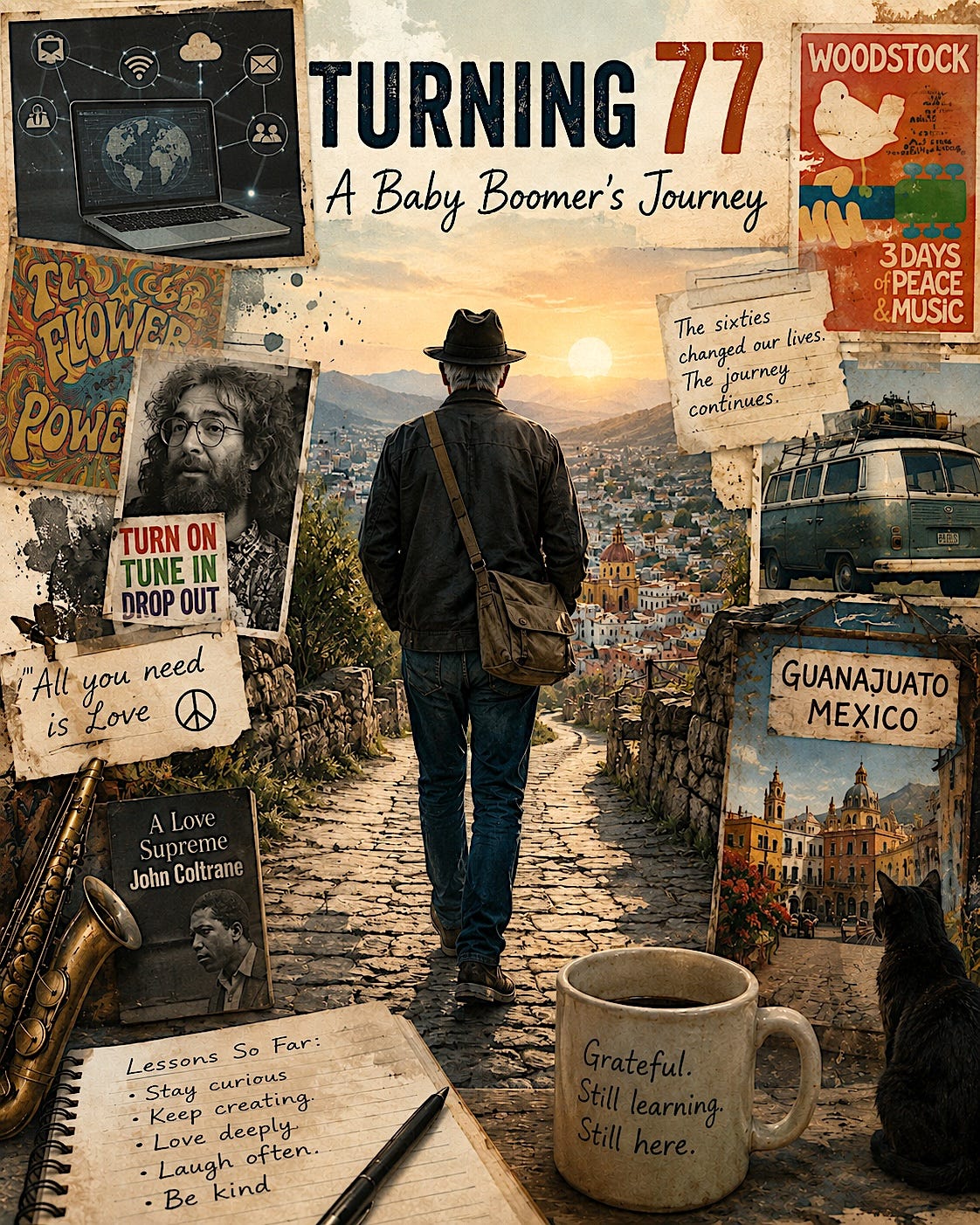
At a certain age, birthdays stop being celebrations and become accounting problems. The end is closer than the beginning. This is not pessimism. It is arithmetic.
I’m not frightened. If anything, these reminders inspire me to use my remaining time wisely. I have a long to do list and nowhere near enough calendar days.
After seventy, the body begins filing formal complaints.
Mine arrived after a large birthday dinner. Something felt wrong—wrong in the unmistakable way a machine sounds wrong just before a belt snaps and comes flying through the casing.
I already knew I had aortic stenosis, a genetic defect in my heart valve. It was a family gift, the sort nobody wraps. Doctors had told me it would eventually need repair. Apparently “eventually” had arrived.
I went to the hospital. They ran tests, examined the evidence and sent in a cardiologist to deliver the verdict: open-heart surgery, and soon. They connected me with the best heart surgeon in Tucson, where I was living then. He was originally from Japan and carried himself with the quiet confidence of a man who did not need to advertise. I trusted him immediately, everything about how he worked said he knew what he was doing.
Eight weeks after the operation, I was almost completely healed. The body, for all its treachery, remains a remarkable animal. You cut it open, stop the heart, repair the defective part and stitch the whole contraption back together. Then, if everyone has done his job, the patient gets up and begins complaining about hospital food.
The surgery changed something in me beyond the valve.
I stopped spending so much time prosecuting my younger self. I had been running a private courtroom for years, reopening old cases, examining bad decisions and calling witnesses who were either dead, absent or imaginary. It was exhausting, and no verdict changed anything.
I also stopped worrying so much about the future. After all, the future has never once consulted me about its plans.
My doctrine now is borrowed and simple: stay in the moment and deal with what is directly in front of you. It lacks grandeur, but it works.
When you’ve lived this long, there is a great deal of material to process. Every life becomes a warehouse filled with broken furniture, old records, unpaid emotional invoices and a few mysterious boxes nobody remembers packing.
I used to ask why I made one choice instead of another. Why did I take that road? Why didn’t I take the other? But this assumes the person making those decisions knew what he was doing.
He didn’t.
None of us do. We choose a road because someone smiled at us, because rent was due, because we were horny, frightened, ambitious or bored. Forty years later we invent a philosophy to explain it.
These days I prefer returning to what was good. Why interrogate every happy memory until it asks for a lawyer?
After my first semester of college in 1967, my parents refused to let me into the house until I cut my hair. So I cut it. Revolution has limits when your laundry is inside. By 1971, my father had grown a mustache and wore his hair over his ears. We never discussed this reversal. Families are full of historical events everyone agrees not to recognize.
Thanks to Maynard G. Krebs on the Dobie Gillis show, I came of age with Lenny Bruce and Charlie Parker. Then the Beatles arrived in 1964, a few months after Dallas, and something in the atmosphere shifted. America had watched a president’s head explode in a motorcade, and then four young men from Liverpool appeared with guitars, jokes and indecent quantities of hair. The national nervous system was already smoking.
As the Beatles changed, their music became my music. When the San Francisco sound arrived, it reached me too. I felt at home immediately. The counterculture was already lurking in me; I simply hadn’t known what to call it.
Lately I’ve been watching short documentaries about how the Beatles built each album. The mechanics interest me because making anything new is usually a miserable business. Inspiration is the public-relations department. The actual work involves repetition, arguments, accidents, bad ideas and long hours spent wondering whether the whole enterprise is fraudulent.
Then something catches fire.
The distance between where the Beatles began in the early sixties and where they landed at the end of the decade still looks miraculous. They went from clever love songs to making records that seemed to arrive from another civilization. They did it while the world watched, which is even more unreasonable.
Coltrane made a similar journey, though he died in 1967 at forty. In his final ten years, his music underwent a transformation that was technical, emotional and spiritual. He kept pushing until the instrument sounded less like a saxophone than a man trying to tear a hole in the ceiling of the universe.
That journey has remained one of my great inspirations. I wrote a book about how deeply Coltrane affected me, because sometimes admiration becomes a debt and writing is the only currency you have.
Plenty of other music and film have mattered to me over the past fifty years, but lately most of the roads lead back to those early discoveries.
I feel alienated from much of what is being made now. Music, film, whatever we’re calling the endless sludge pouring through the screens. This is part of aging, and I’m not alone. My readers and viewers tend to be over sixty. We are the demographic advertisers approach with cholesterol medications, retirement warnings and outdoor bathtubs.
Fine.
What has kept me going, both now and for most of my life, is my own work: writing and making films.
There is more “content” in the world than anyone could consume in a thousand lifetimes. Content is what we call art after removing the dangerous parts. The market is flooded with it. Finding an audience is difficult. Keeping one is worse.
I don’t spend much energy worrying about that anymore. I just do the work and enjoy the process.
I was never going to be rich or famous. Somewhere along the way this became obvious, and the realization was oddly liberating. The point was always to make something that meant something.
Ten years ago, I could not have predicted where I would be today. During that decade I had prostate cancer, went through a divorce, met my soul mate at seventy and moved to Mexico.
That is a lot of plot for the final act.
I feel lucky. Most days begin with gratitude in my garden. Gratitude sounds suspiciously wholesome until you have survived enough things to understand it isn’t virtue. It’s astonishment.
In 1968, the Beatles went to India to study with the Maharishi. The expedition went badly. Within a year, two of them were publicly calling it a mistake. Spiritual enlightenment had collided with personalities, money, sex and publicity.
I began transcendental meditation and yoga around 1972 or 1973. By then the search had become visible, including the failure. That was important. The Beatles did not prove enlightenment existed. They proved you could make a public fool of yourself looking for it and remain alive afterward.
I also took LSD during that period, more than once. I learned something from it. The meditation outlasted the drugs by fifty years and counting. That may be the most responsible sentence I have ever written.
I started writing professionally for DownBeat in 1977. When I discovered that persoal computers could do word processing, I bought an Apple 2e in 1984. It came with a modem and I discovered online interaction. In 1994 I helped create Jazz Central Station, the first major jazz website. A jazz blog emerged in 1997, Bird Lives, before the phrase had been rubbed into cliché, and then live webcasts from Birdland in 1999.
People sometimes ask where the do-it-yourself instinct came from. My answer depends on the day. Sometimes I credit the Beatles. They wrote their own songs and started their own label when neither was normal. By the time the internet appeared, I had absorbed the idea that if no platform existed, you built one yourself instead of standing outside an office waiting for permission.
On other days, that explanation sounds like a story assembled afterward to make the accidents appear intentional. The truth may be simpler: I couldn’t stand asking permission. Nobody can trace their own wiring.
Four years ago, I moved to Guanajuato, Mexico, one of the best decisions of my life.
Last November, some neighbors took me to the cemetery for Día de los Muertos. A woman two graves away had arranged food and photographs beside the dead. A boombox played rancheras at full volume. Children ran between the headstones.
I stood there caught between being moved and feeling intrusive, a guest at another family’s grief. Nobody treated me as an intruder.
I was raised to whisper in cemeteries. Nobody there was whispering.
That struck me as healthy. The dead were not hidden or sterilized. They remained part of the family. They got music, food, flowers and company.
I'm aging in Mexico, and I'll die there too, though I can't predict when. It seems a better country for both than the one I left, where elderly people are stored out of view and the dead are handled by professionals behind the word “arrangements.”
A kid at the corner store has started calling me joven (which means young person in Spanish). Maybe he calls every gray-haired man that. Maybe it’s a joke. I don’t care. It still beats New York, where at my age you mostly register as an obstacle on the sidewalk.
Meanwhile, I buy tomatoes and avocados. And every morning, I sit in meditation as I have since 1973.
The heart keeps beating. The clerk keeps subtracting. The garden keeps growing.
Watching - The Front
The end credits of The Front list the years several cast and crew members were blacklisted, including writer Walter Bernstein, director Martin Ritt, Zero Mostel, Herschel Bernardi and Lloyd Gough. The film reveals their personal connection to the story only at the end, without a speech or musical flourish. That restraint reflects its broader tone: rather than presenting the blacklist solely as a political tragedy, it uses uneasy comedy to explore its everyday workings.
Woody Allen plays Howard Prince, a cashier and small-time bookmaker who submits television scripts under his name for blacklisted writers and keeps ten percent of their fees. Bernstein had used fronts himself, and the film captures the practice through commissions, contracts, meetings and the constant risk of exposure. Howard initially thrives, gaining money and status from work whose real authors cannot claim it. The comedy darkens through Hecky Brown, a blacklisted performer played by the great Zero Mostel, in one of his most important performances. Hecky’s decline was influenced partly by actor Philip Loeb, Mostel’s friend, who was forced off The Goldbergs and died by suicide in 1955, giving the performance unmistakably personal weight.
Although the institutions of the blacklist have changed, the film’s depiction of careers destroyed through private pressure, withdrawn opportunities and guilt by association remains recognizable. It avoids forcing that modern analogy, just as it avoids turning Howard into a conventional hero. He remains compromised and largely apolitical until he appears before the committee and refuses to cooperate, answering with two profane words. His achievement is smaller than heroism but more believable: when it finally matters, he says no.
You can watch The Front on YouTube.
Listening - Abbey Road Medley: The Beatles
Most people think the “Abbey Road medley” was performed. It wasn’t. The Beatles never played that sequence from start to finish. What you hear is construction masquerading as spontaneity. George Martin and Geoff Emerick didn’t record a moment. They assembled one.
By 1969, the Beatles were fragments themselves. McCartney had scraps. Lennon had beginnings. Harrison had ideas that went nowhere. Rather than finish anything, McCartney saw a solution in collage, something classical composers understood but rock musicians didn’t: you can make fragments feel inevitable if you cut them the right way.
This is the invisible achievement. The medley doesn’t feel edited because editing is where it lives entirely. Each transition erases the seam. “You Never Give Me Your Money” doesn’t fade into “Sun King”—they’re made to feel like one impulse split across takes. The repeated motif of “You Never Give Me Your Money” during “Carry That Weight” feels like thematic return when it’s actually engineering. Martin and Emerick discovered what film editors know: the right cut makes the artificial feel like fate.
The final line, “In the end, the love you take is equal to the love you make,” has weight not because of how it’s sung but because they placed it there, the last word after everything fragments and resolves. They didn’t write an ending. They edited one.
Abbey Road mattered because the Beatles learned to think like editors instead of performers. That’s why it still sounds like a single achievement, more than fifty years later. The work is invisible. That’s the whole point.
Listen to the Beatles “Abbey Road” medley:
Next Tuesday - The Tragedy of Jackie Wilson
Jackie Wilson was one of the architects of soul music, a performer of such physical and vocal intensity that Michael Jackson, James Brown, and Elvis Presley all studied and borrowed from him. The industry extracted his labor, mob-connected managers drained his earnings, and after his teenage son was murdered in 1970, he never fully recovered. He collapsed onstage in 1975, spent nine years brain-damaged and institutionalized, and died broke at forty-nine.
Completely agree with your thoughts about living here in Guanajuato.
About Abbey Road, Side 2: it always felt like a symphony to me. In 1980. I heard an amazing live cover by a Mexican band in a basement dive in Mexico City: note for note perfection you could have thought you were listening to Beatles themselves.
Absolutely fantastic to find you on Substack! 69 years young, talented and living as a jazz musician in Atlanta, teaching of course, that’s what jazz musicians do. Thank you. Happy days ahead in Mexico.