

George Young, a virtuoso saxophonist, passed away from cancer on April 23, 2026. He was eighty-eight. When I first started writing for DownBeat in 1977, George was my first assignment. Although he was better known to musicians in New York because of his extensive studio work, anyone who heard him play realized they were in the presence of a master.
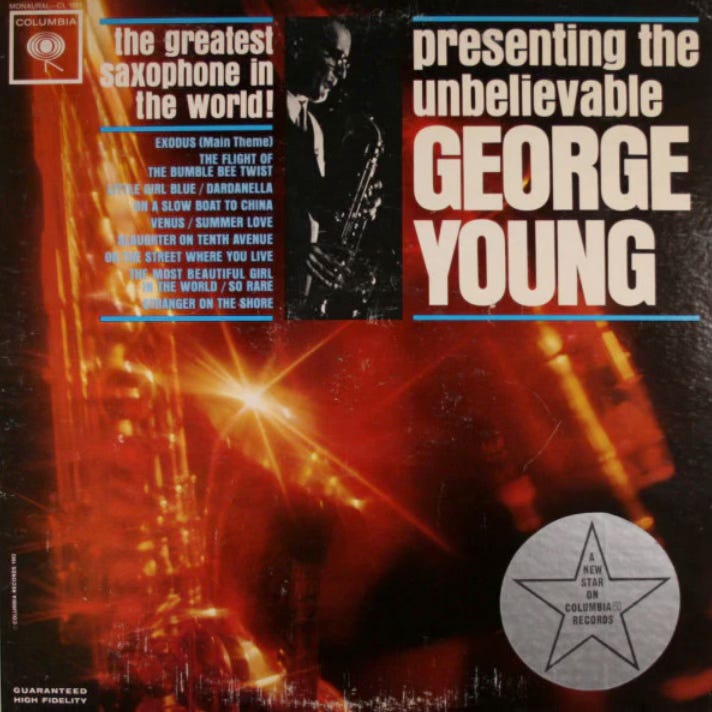
As a teenage jazz fan in 1963, I used to spend a fair amount of time in record stores (remember those?) browsing new releases. One day I came across a record with a rather startling cover: “The Greatest Saxophone in the World, Presenting the Unbelievable George Young, A New Star on Columbia Records.”
I read the liner notes and checked out the personnel. George Young on tenor, alto, and flute. Clark Terry and Doc Severinsen on trumpets. Jimmy Cleveland on trombone. Hank Jones on piano. Milt Hinton on bass. Osie Johnson on drums. Manny Albam arranging and conducting. Hard to go wrong with those cats. I was already familiar with Manny Albam too, an influential jazz arranger, composer, saxophonist, and bandleader, known less as a front-line star and more as one of the finest architects behind the scenes in modern jazz.
So I bought it.
From the first track, it was obvious that George could play. Even then, though, I knew that hoisting him onto the pedestal of greatness was a record company ploy. There never was, and will never be, the greatest saxophonist in the world.
After that I lost track of him, though by all accounts he stayed busy as a studio player. Like all the great ones, he could read and execute complicated charts at a moment’s notice, which kept him perpetually in demand.
Eventually I moved to New York to attend NYU Film School. When I wasn’t driving a cab at night, I spent my time at jazz clubs, finally hearing in person the incredible music I had only known from records.
In 1976, the pianist Walter Bishop, Jr. played a gig at a party I attended. I knew about Bish from his work with Charlie Parker, and the two of us became fast friends. The following June, he invited me to his first recording session in some time, for Muse Records. The date featured Bish with some of the best studio players in New York. That’s where I first met Randy Brecker who I knew from Blood, Sweat and Tears. And right there, on soprano and alto sax, was George Young.
I was a bit awestruck to be in the studio that afternoon, my first time present at an actual recording. I didn’t speak to Randy or George that day, but I was deeply impressed by how they worked, no rehearsal, just reading the charts and nailing the music in one or two takes. And the icing on the cake, Bish asked me to do the liner notes, the first of many such assignments I would have.
An interview I did with Bish became my first appearance in print in DownBeat. The editors liked my writing and started giving me assignments. As fate would have it, the first was George Young. I got his number out of the Musicians Union book, and he invited me up to his studio for the interview after he had finished playing on four sessions in a single day.
When George passed, Randy wrote on Facebook that like Randy, George was “from Philly and one of the greatest saxophonists ever; we met when I was a teenager playing local gigs. We both moved to NYC around the same time, and were on a million sessions, gigs and jingles together.”
There was an old building next to Carnegie Hall where a number of studio musicians kept rooms to practice and relax between dates. This was at the apex of the studio scene in New York, before synthesizers gutted that part of the music business. Some hipster had dubbed the building Father Flotsky’s Home for Wayward Beboppers, a reference to a Lenny Bruce routine.
Before I continue, a few words about the studio scene in Manhattan half a century ago.
The New York studio scene across those three decades was one of the most concentrated hubs of recorded music anywhere in the world, and the players who worked there shaped an enormous portion of what people heard on radio, in films, and on Broadway. In the 1950s, Manhattan was packed with active studios. The session musicians of that era were largely jazz players moonlighting on pop dates. Names you would see on countless contracts included Clark and Doc, Saxophonists Phil Woods, Al Cohn and Jerome Richardson, trombonists Urbie Green, Bob Brookmeyer and Jimmy Cleveland, guitarists Mundell Lowe, Jim Hall and Bucky Pizzarelli, bassists Milt Hinton and George Duvivier, drummers Osie Johnson, Grady Tate and Bernard Purdie and Panama Francis, and pianists Hank Jones, Dick Hyman and Tommy Flanagan. Milt Hinton in particular played on thousands of dates and kept a camera with him, leaving behind one of the great photographic records of the scene.
By the late 60s and into the 70s, the session pool expanded with players such as Steve Gadd, Richard Tee, Cornell Dupree, Eric Gale, Will Lee, Anthony Jackson, the Brecker brothers, David Sanborn, and the loose collective that became Stuff. Jingle work was a huge income stream, keeping dozens of horn and rhythm players booked solid during the day.
The combination of dense studio infrastructure, a deep bench of versatile players, and the proximity of advertising, Broadway, jazz clubs, and the major labels made New York a place where a working musician could conceivably do a jingle in the morning, a pop date in the afternoon, a Broadway show at night, and a jazz gig after midnight, all within twenty blocks.
I was a mere lad back then and new to writing, but that didn’t stop me. George and I did the interview, and he had many stories that were both enlightening and very funny. Afterwards, he suggested we get some sushi. Sushi? This was long before sushi became so popular in America that it is now sold in supermarkets. He took me to my first sushi bar, Sushiko on West 55th Street, where the sushi master Ya-Chan performed his magic behind the counter. The fish was incredible, and sushi remains my favorite food to this day.
My next encounter with George was at a short-run jazz club on Second Avenue in the late 70s. I forget the rhythm section, but George was joined by Joe Farrell, another monster sax player. It wasn’t a cutting contest. It was a master class. The two were friends, and that night they inspired each other to even greater creative heights.
In the early 90s, I moved to Upper Westchester and discovered that a superb trumpeter and former studio cat, Marvin Stamm, lived in the area. Marvin and I became friends, and one frigid winter night we drove down to Manhattan where he was playing at Fat Tuesday’s with Louis Bellson. And George Young on sax. Another musical master class. I wish they had recorded the music I heard that night.
I lost track of George again, but around twenty years later, after I had become the Jazz Video Guy, I was shooting some video with the saxophonist Michael Pedicin at a club in LA. George had since moved to Pacific Palisades, still playing and still burning. It turned out Michael and George were close friends and George was in the house. I walked over and asked, “Remember me?” He looked at me, thought for a moment, and apologized — I looked familiar but he couldn’t place me. “Your first DownBeat article,” I said. He stood up and gave me a big hug. We talked for a while, and I left feeling exactly the way his playing had always made me feel: that the world is warmer than you think.
There’s a line from A Streetcar Named Desire that comes to mind: Blanche DuBois saying “I have always depended on the kindness of strangers.” George Young was exactly that kind of stranger, arriving early in my writing life with a warmth that made me feel my new creative endeavors were worth something. I will always remember that night, the introduction to sushi, and the sheer artistry of his playing. He opened a door to a world that became my life.
Here’s George Young from a 2008 gig in Hawaii.
Bret, Have you seen this? https://www.youtube.com/watch?v=ArITJgLSJLw&list=RDArITJgLSJLw&start_radio=1
While you were studiously enmeshed in jazz, I was thrilled by Tennessee Williams, and I remember Marlon Brando yelling, "Blanche!"
Different paths, but similar objectives, to be absorbed by art form we loved, and I admire your loyalty to yours. In my case, I have forgotten too many names to be serious about that artform, anymore, but music is always good for the soul!