

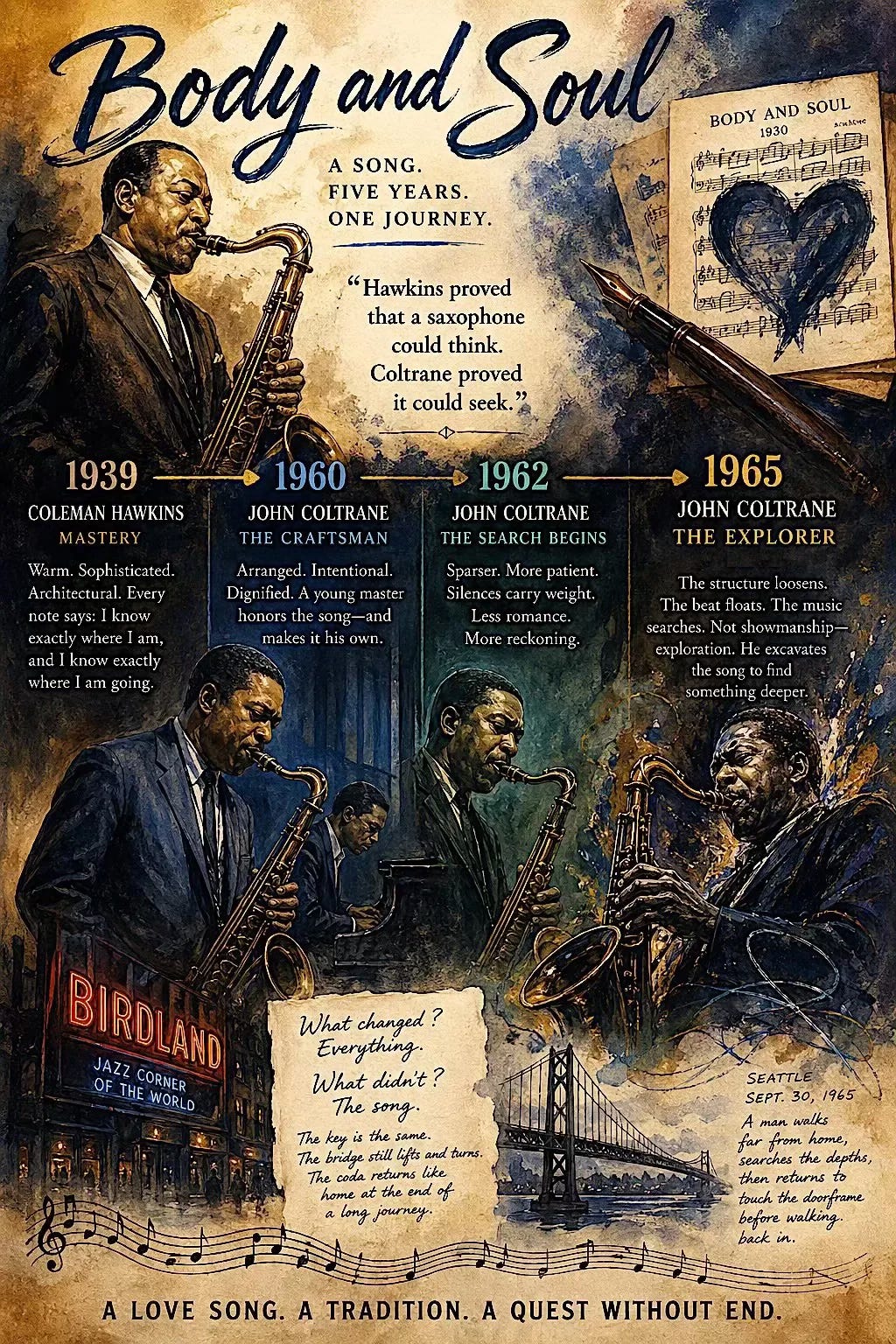
“Body and Soul” is one of the most recorded songs in jazz history. It is a love song, written in 1930, built on longing and loss. For decades, jazz musicians used it as a showcase — a chance to prove how deep they could dig into a beautiful melody.
When Coleman Hawkins recorded it in 1939, everything changed. Hawkins essentially invented modern jazz tenor saxophone playing in those three minutes. He barely touched the melody at all, improvising so freely and so intelligently over the song’s structure that listeners had to lean in and follow where he was going. It was a revelation. He proved that a saxophone could think.
John Coltrane inherited that tradition. Then he went somewhere Hawkins never imagined.
Coleman Hawkins: Mastery
Hawkins sounds like a man completely in command. His 1939 recording is warm, sophisticated, almost architectural in the way he builds his lines. You feel the romance of the song even as he transforms it. There is confidence in every note. He is saying: I know exactly where I am, and I know exactly where I am going.
John Coltrane, 1960: The Craftsman
By 1960, Coltrane was one of the most celebrated musicians in jazz. His album Giant Steps had already announced him as someone operating on a different level — someone who had developed his own harmonic language, a way of moving through chords in great rushing cycles that came to be called “Coltrane changes.”
His 1960 studio recording of Body and Soul, released on the album Coltrane’s Sound, is a masterpiece of control and intention. The arrangement had been carefully worked out. It opens with a slow, swaying piano introduction that settles the room. Then Coltrane enters with the melody, ornamented with fills and phrases that he had practiced and refined to the point where they were part of the arrangement itself — not improvised in the moment, but shaped with the same care a composer gives to a score.
The mood is dignified. Elegant. Deeply respectful of the song’s beauty and its long history. McCoy Tyner plays a piano solo in the middle, and the piece closes with a composed ending that has an almost hymn-like quality.
What you hear is a young master making a personal statement out of someone else’s song. He is saying: this is mine now. And he means it as an act of love toward the tradition.
John Coltrane, 1962: The Search Begins
By 1962, something had shifted. A live recording from Birdland in New York captures Coltrane at a moment of transition. The playing is sparser. More patient. He leaves silences where another musician might rush to fill them. When notes arrive, they arrive with tremendous weight — as if each one has been considered and chosen rather than reflexively played.
The emotional center has changed too. The 1960 version feels like a musician honoring a song. The 1963 version feels like a man talking to himself in public, working something out. Less romance. More reckoning.
John Coltrane, 1965: The Explorer
The final recording we have of Coltrane playing Body and Soul comes from a concert in Seattle on September 30, 1965. It runs over twenty-one minutes. When you first hear it, you might wonder if this is even the same song.
Almost everything that made the 1960 version feel settled and structured has been loosened or dissolved. The opening vamp sounds nothing like the arranged introduction from five years earlier. The beat, while still present underneath, is no longer something you can easily tap your foot to. Solos stretch out for what feels like a very long time, not because anyone is showing off, but because each musician seems to be genuinely searching — following a thread deep into the music to see where it leads.
Coltrane’s saxophone playing has moved into territory that jazz had rarely entered before. He uses techniques that push the instrument beyond conventional sound — notes that split into chords, textures that are more like breath and pressure than melody. He is not decorating the song. He is excavating it.
And yet the song is still there. The key is the same. The underlying structure of the bridge — that section where the harmony lifts and turns — still follows the path Coltrane had mapped out in 1960. The piece ends with almost exactly the same composed coda as the studio recording, like a man who has wandered far from home and returns to touch the doorframe before walking back in.
McCoy Tyner, who had been Coltrane’s pianist through this entire journey, sounds in the Seattle recording like someone trying to hold a kite string in a high wind. His playing is grounded and harmonically rich — more conventional than Coltrane’s, almost as if he is reminding both himself and the audience where the music came from. Within months of this concert, Tyner would leave the band. The music had gone further than he could follow.
What Changed, and What Didn’t
Between 1960 and 1965, Coltrane moved from craftsman to explorer, from master of a tradition to someone actively dismantling it in search of something deeper. The Body and Soul that Coleman Hawkins played as a declaration of sophistication became, in Coltrane’s hands, something closer to a prayer — or a question.
What is remarkable is not only how much changed, but how much survived. The song never disappeared. It kept reappearing, like the shore glimpsed from further and further out to sea.
Hawkins proved that a saxophone could think. Coltrane proved it could seek.
Listening Guide
Coleman Hawkins, Body and Soul, 1939
John Coltrane, Body and Soul, 1960
John Coltrane, Body and Soul, 1962
The entire Live in Seattle performance, 1965
And John Handy proved it could talk... Handy was in the mix but jazz history hates an underdog. John Handy celebrates John Handy day every February 3rd in San Francisco and in Oakland California.
Body and Soul was considered to be the Black national anthem back in the day.