

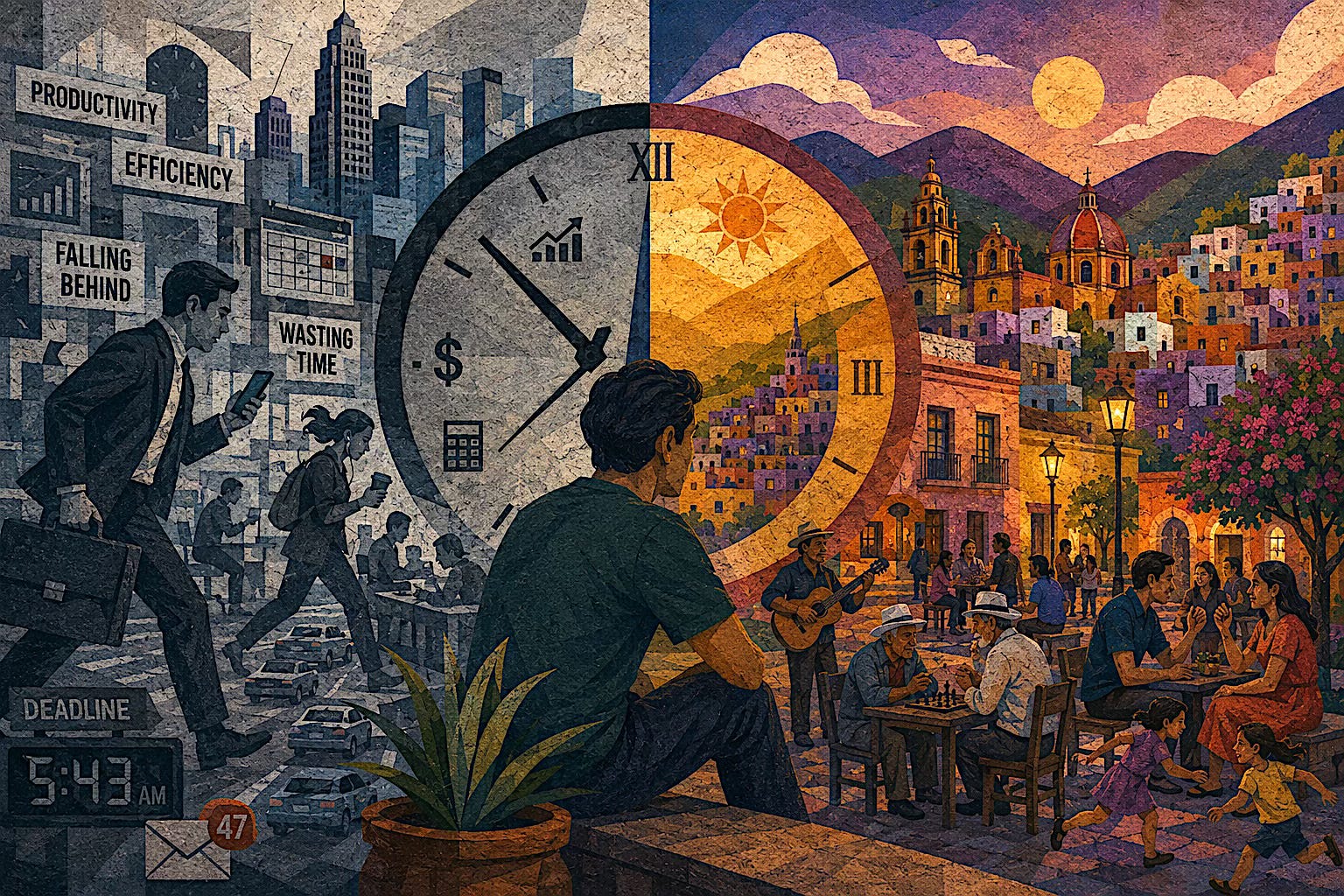
Before I moved to Mexico, I thought I understood time. It took leaving America entirely to discover I had been living inside a machine I could no longer see. This is the kind of insight that sounds profound until you realize it took me sixty-plus years to figure out something every person sitting in a Mexican plaza already knew.
Americans and Mexicans live inside fundamentally different clocks.
The American clock is aggressive. Extractive. Neurotic. Every hour feels monetized before it even begins. Time exists to be managed, optimized, leveraged, saved, and converted into measurable output. The language itself reveals the sickness. “Productivity.” “Efficiency.” “Falling behind.” “Wasting time.” These are not neutral words. They are the vocabulary of a culture that treats time as an enemy combatant.
By the time I left America, I had internalized this machinery so deeply I no longer recognized it as abnormal. My nervous system lived in a permanent low-grade state of acceleration. Even moments of supposed leisure carried the underlying anxiety that I should be doing something else. Reading became productivity. Walking became exercise optimization. Friendship became networking. Rest became recovery strategy. Nothing simply existed anymore. I was, in the clinical language I would have used at the time, crushing it.
Then I came to Mexico.
At first the difference felt frustrating. Things moved slower. Conversations stretched. Meals lasted forever. People stopped in the middle of sidewalks to talk. Appointments operated with a flexibility that would have triggered cardiac arrest in my old life. I once waited forty-five minutes for a repair person who arrived cheerful, unhurried, and completely unbothered by the concept of 10 a.m. The American brain interprets all of this as inefficiency. My American brain was losing its mind.
Then something strange happens.
Your pulse changes. Not immediately. Slowly. Almost invisibly. You begin noticing entire categories of human experience that speed had erased from your life.
People here linger. That sounds trivial until you realize how rarely Americans linger anywhere anymore. In the United States, everybody moves with the haunted urgency of people trying to escape invisible explosions. Coffee is consumed while walking. Meals happen in cars. I once watched a man eat a burrito in an elevator, eyes closed, jaw working steadily, with the focused expression of someone completing a quarterly objective.
Mexico still permits unstructured human time. People sit in plazas for hours doing nothing measurable. Families gather without agenda. Old men argue about football with the gravity of medieval theologians debating salvation. Street musicians play songs no algorithm selected for engagement metrics. Nobody appears concerned about optimizing the afternoon. It’s destabilizing, frankly, if you arrive from a place where even your leisure time has KPIs.
The first few months, I checked my watch constantly, a detoxing addict reaching for a phantom cigarette. For the first three months I checked it with the frequency of a man defusing a bomb. Nothing was happening that required a watch. I checked it anyway. Then one evening in Guanajuato I noticed something startling.
I had stopped caring what time it was.
Not completely. Civilization still requires clocks. But the psychological relationship had shifted. Time had stopped feeling like a predator hunting me through the day. Mexico had quietly reintroduced me to duration.
I felt this most strongly at night. American nights increasingly resemble extensions of daytime productivity. Screens glow endlessly. Work bleeds into personal life. Achievement haunts the bedroom.
Mexican nights still belong partially to the streets.
People walk. Talk. Eat. Laugh. Gather. Music drifts through neighborhoods from open windows and distant cantinas. Public squares fill with families. Couples sit together on benches older than the United States itself. Children chase each other beneath church towers while old women gossip nearby. Nobody appears in a hurry to conclude the evening efficiently. The evening is not a deliverable.
Sitting in a plaza one night, watching all of this, something painful became visible. I realized how much of my previous life had disappeared without being experienced. Not stolen. Not taken. Simply passed through at a speed that made perception impossible. A reformed clock-watcher, now writing about clocks in a plaza, deeply aware of the irony.
America’s relationship with time produces a strange emotional amnesia. Days become interchangeable units of labor and distraction. Years vanish in administrative blur. People wake up at sixty wondering where everything went. I know this because I was one of them, and because sixty came and went while I was answering emails.
Mexico slowed the film down enough for me to notice existence again.
Morning light hitting stone buildings. The sound of distant church bells echoing through the hills. Street vendors setting up before sunrise. Conversations unfolding without urgency. The texture of afternoons. The physical feeling of weather. Silence returning between thoughts.
None of these things are dramatic individually. Together they reconstruct attention. And attention, it turns out, is what a life is actually made of.
A culture moving too quickly eventually loses the ability to perceive itself clearly. Everything becomes reaction. Reflex. Consumption. People stop inhabiting time and begin merely surviving it. I think Americans sense what they have lost, even if they struggle to name it. You see it in the exhaustion. The anxiety. The wellness industries worth billions of dollars attempting to repair nervous systems damaged by the very culture producing them. There is probably an app for what I found by moving to Mexico. It would cost $12.99 a month and include breathing exercises.
People do not need another productivity app. They need time to become human again.
Mexico reminded me that life is not a problem to solve efficiently. It is something to inhabit slowly enough that you can feel it passing through your hands while it is still here.
I walk slower now. I notice more. I no longer panic during silence.
And some evenings, sitting in a plaza while church bells roll across the hills and families drift through the streets beneath the fading light, I experience something that had become strangely rare in my old life.
Time stops feeling scarce.
And starts feeling alive.
Here in Mexico, between musical set, I use to tell the people, “…see you in five Mexican minutes” it means we’ll be back soon.
You captured exactly the culture we are experiencing here in Portugal, Bret. Having arrived only in January – and to the worst and most destructive cyclone in Portuguese history – it’s been even more challenging than we anticipated. But then we pause to look around at the incredible beauty and history here, and the wonderful community of friends we’ve so quickly established, and we are reminded why we moved here. Relocating to “another planet” and having just retired, reprogramming ourselves to no longer feel time is the enemy, takes… time. We are a work in progress, but we’re getting there.