

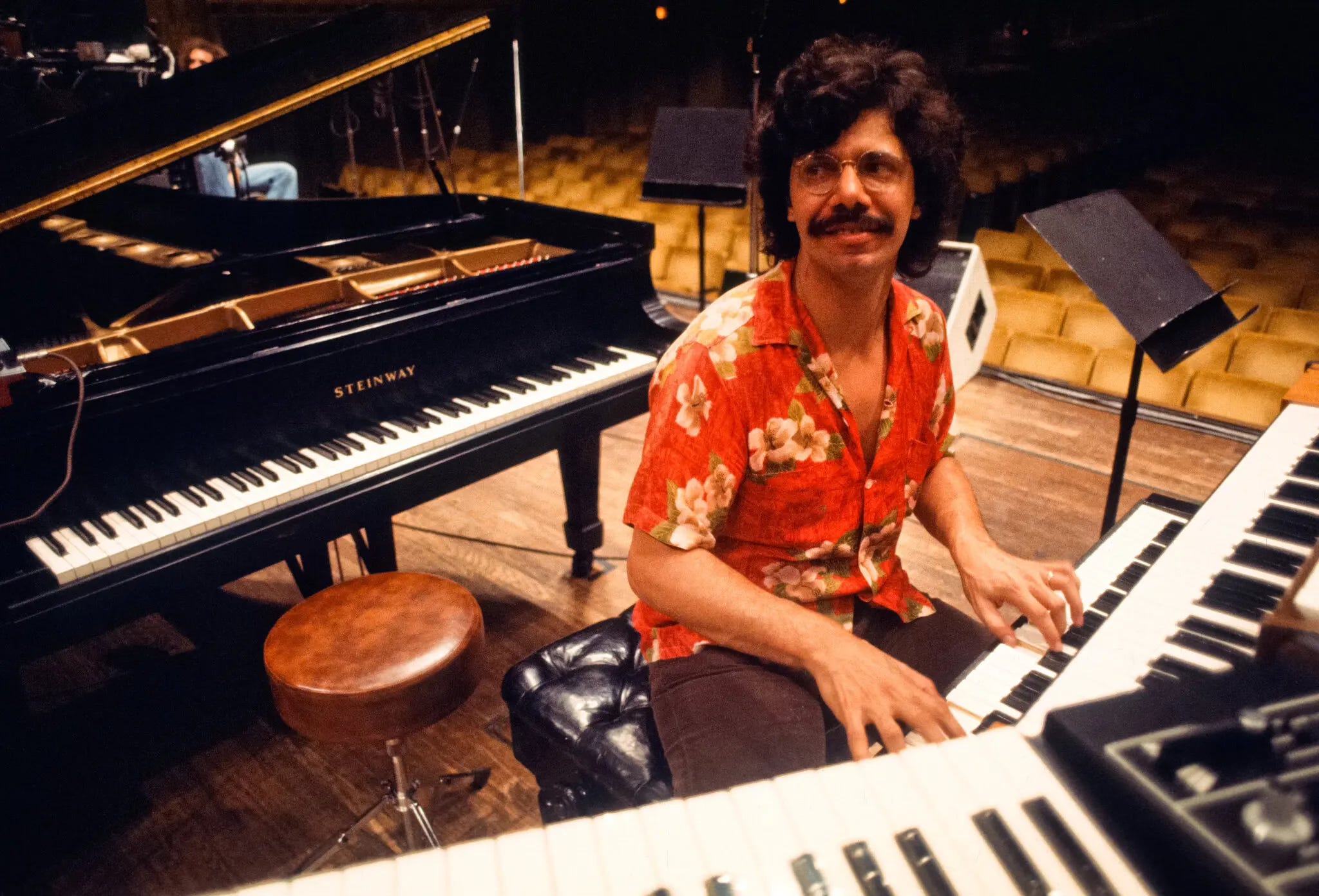
I first heard Chick Corea in the mid-1960s, and I never stopped following him. That turned out to be a full-time job. The man changed directions the way Miles Davis changed bands — constantly, deliberately, and without apology.
Chick Corea did not enter jazz. He smashed through the wall fleeing federal agents with a stolen synthesizer under one arm and a stack of Bartók scores under the other. Bebop, flamenco, avant-garde shrieking, classical counterpoint, electric noise, Latin grooves, psychedelic distortion. The man treated music as an all-night casino buffet. Grab a little of this. Pour hot sauce on that. Add voltage.
And somehow, through all the beautiful wreckage, the man still swung.
I first heard Chick in the mid-1960s on some Blue Mitchell records for Blue Note. Strong playing. Sharp edges. You noticed him immediately because he sounded restless, somebody already bored with the furniture in the room. Then came Now He Sings, Now He Sobs with Miroslav Vitous and Roy Haynes, one of those records that makes you stare at the speakers wondering if the musicians are cheating somehow. The trio moved as a pack of thieves escaping through alleyways.
Around the same time, word spread that Chick had replaced Herbie Hancock in Miles Davis’s band. Nobody replaced Herbie Hancock. That amounted to replacing your central nervous system with experimental machinery from a Soviet submarine. But Miles loved mutation. Stability bored him. He wanted musicians who sounded slightly dangerous.
Their first major statement together came on Filles de Kilimanjaro, where Chick played both acoustic piano and electric keyboards. You could hear the weather changing. The old jazz structures still stood, but cracks had appeared in the walls.
By the late 1960s the entire jazz world had split into hostile tribes. The acoustic purists stood guard over hard bop as medieval priests protecting sacred scrolls while amplifiers and rock rhythms crawled out of the counterculture and infected everything with electricity, chemicals, and volume. Into this chaos stepped Miles Davis, high priest of mutation, assembling a rotating gang of musical outlaws to invent fusion whether the critics approved or not.
Chick sat behind a Fender Rhodes during this madness and played as a man receiving coded transmissions from a dying satellite. The Rhodes did not sound warm or tasteful in his hands. It sounded metallic. Unstable. Hallucinatory. A nightclub hovering above a riot while helicopters circled overhead.
This was not cocktail jazz. Nobody sipped martinis to this music unless they wanted to spill the damned thing down the front of their silk shirt while confronting the collapse of Western civilization.
Then came In a Silent Way. Quiet and electric at the same time. Floating grooves replaced dense chord changes. Space became part of the composition. With Chick, Herbie Hancock, and Joe Zawinul painting different colors across the music, Miles created something suspended in air between jazz, rock, ambient music, and a nervous breakdown. I played that record endlessly. We all sensed the future crawling toward us through the speakers.
Then came March 1970 at the Fillmore East. Miles with Chick, Wayne Shorter, Dave Holland, and Jack DeJohnette. Right after they recorded Bitches Brew. Triple bill with Steve Miller and Neil Young. Somewhere in America, hippies passed joints the size of traffic flares while this band detonated the room.
I sat about ten rows back. At one point Wayne Shorter walked to the edge of the stage, lifted the soprano to his lips, and held a single note so long the air around it seemed to change temperature. That was the moment I understood something irreversible was happening.
That was Wayne’s last performances with Miles. The music lurched, floated, exploded, then vanished into whispers. No maps. No safety rails. The band sounded as five men trying to outrun the 20th century.
A few weeks later, Bitches Brew hit the streets and the jazz establishment reacted as somebody had set fire to the Vatican. Critics screamed betrayal. Purists cried sacrilege.
From the first note I knew it was a masterpiece.
But Miles already moved on. By June he returned to the Fillmore East for four nights with another transformed band. Chick, Dave Holland, and Jack DeJohnette remained. Airto arrived on percussion. Steve Grossman replaced Wayne on saxophone. And then there was Keith Jarrett on electric keyboards.
Keith on one side of the stage. Chick on the other.
I sat about ten rows back staring at the stage in total disbelief. A few years earlier I had heard Keith’s solo on Forest Flower and nearly drove off the road. Nobody sounded like him. When he soloed, the reaction arrived immediate and primitive. Who the hell is THAT?
The Fillmore concerts became the live album Miles Davis at Fillmore. After Miles finished I walked straight out into the East Village, too stunned to sit through another note from anybody. I wandered the streets for hours trying to process what I had heard.
Soon after, Gary Bartz replaced Steve Grossman and the band played the Isle of Wight Festival before the largest audience jazz had ever seen. Half a million people. A sea of mud, drugs, rain, and human confusion stretching to the horizon while Miles’s band played music from another planet.
Then Chick quit Miles entirely and formed Circle with Dave Holland, Barry Altschul, and Anthony Braxton. Total whiplash. One minute he helped invent fusion in front of arena crowds. The next he made fiercely abstract avant-garde music for audiences who looked as graduate students recovering from nervous collapses.
Circle debuted at the Village Vanguard in November. By then my own chemical research program had accelerated dramatically. Earlier that evening Miles was downtown at the Cafe Au Go Go with a new band featuring bassist Michael Henderson from Stevie Wonder’s group. Henderson changed everything. Thick electric bass lines. Dirty grooves. Jarrett was attacking electric keyboards as a man trying to start a prison riot. Before Miles even played, Richard Pryor came out and delivered a set so ferocious it would have made Lenny Bruce sit silently at the bar reevaluating his profession. Then Miles hit the stage with a wah-wah pedal and the whole room tilted sideways.
After the set we staggered uptown to the Village Vanguard for Circle’s New York debut. What a contrast. Miles had sounded as the future of urban America after midnight. Circle sounded as four intellectual arsonists dismantling music molecule by molecule.
One night. Two bands. Two different futures.
And Chick Corea stood at the center of both storms, some cosmic double agent refusing allegiance to any single form of music for more than fifteen minutes.
Inspired by Miles, the floodgates burst open and the mutants came charging through. Weather Report. The Headhunters. Mahavishnu Orchestra. The Tony Williams Lifetime. Suddenly jazz had split into a thousand radioactive fragments. Bebop still lived. Avant-garde wild men still howled in basement clubs. Fusion arrived carrying amplifiers, distortion pedals, and enough volume to loosen dental work in the back row.
The old order never recovered.
After a few years with Circle, Chick assembled Return to Forever. I caught the original lineup with Joe Farrell on tenor and flute, Stanley Clarke on bass, Flora Purim singing, and Airto detonating percussion instruments as if summoning tropical storms. With Flora and Airto in the band, the Brazilian influence ran deep. The music breathed. It danced. It swung with joy and danger at the same time. Nobody else sounded remotely similar.
Then Chick changed direction again because standing still never interested him. Return to Forever kept evolving. Heavier. More electric. Then more abstract. Then lyrical again. By the late 1970s he was touring in duos with Herbie Hancock, two keyboard sorcerers pushing each other into strange corners of harmony and rhythm while audiences sat there grinning in disbelief.
Chick spent his entire career chasing the next sound over the next hill. He approached music the way prospectors approached mountains during the gold rush, convinced another vein waited underground if he kept digging. I heard most of those bands live and every one felt different. New angles. New risks. New madness.
Then the computer age arrived, and most musicians my age looked at it the way medieval villagers looked at incoming plagues. I saw something else entirely. A doorway. The same instinct that drew Miles toward electric instruments pulled me toward the internet. By 1994 I had jumped headfirst into the digital circus and co-founded Jazz Central Station, one of the first major jazz websites, back when the internet still felt as lawless and wide open as fusion did in 1970.
At the 1995 International Association for Jazz Education convention in Atlanta, we attempted something bordering on science fiction. An online chat with Chick Corea speaking directly to fans around the world through the internet. Today this sounds primitive. Back then it felt as if we were trying to communicate with Mars using kitchen appliances and stolen Pentagon equipment.
The internet was still wet cement. No streaming. No video. Barely any audio. Most people still thought email was suspicious. Yet there we were in a cramped Atlanta hotel room while modem signals screeched through phone lines across the planet.
Then everything went sideways.
Fifteen minutes before Chick was supposed to appear, we learned his flight had only just landed. Hundreds of people logging on from around the globe. And Chick still trapped somewhere between baggage claim and Atlanta traffic.
For one brief terrifying moment I considered the unthinkable. Would I have to impersonate Chick Corea? Could I survive ten minutes pretending to possess the musical intelligence of one of the greatest pianists on Earth?
Salvation arrived in the form of the late Ron Moss, Chick’s manager and former trombonist in one incarnation of Return to Forever. Ron possessed one of those early cell phones the size of a cinder block. The appointed hour arrived. Questions poured in from around the world. Ron relayed each question to Chick over the giant phone. Chick dictated answers somewhere in transit through Atlanta. Ron repeated the answers to me. I typed them into the computer while praying the entire operation would not collapse into smoke and humiliation.
Thirty minutes of organized panic. Then Chick burst into the hotel room and took over in person, slightly out of breath, completely unbothered, as if arriving late to your own worldwide internet debut was the most natural thing in the world.
The session ended. We stood up laughing, shaking our heads. We hugged the way survivors hug after crawling out of a wrecked airplane together.
That was Chick. Warm. Open. Curious. No ego armor. No superstar attitude. He approached technology the same way he approached music. Another frontier. Another experiment. Keep moving forward. See what happens next.
Then, near the beginning of the Covid era, a rare form of cancer took him away far too soon.
The recordings remain. Every phase still alive somewhere. Acoustic Chick. Electric Chick. Avant-garde Chick. Latin Chick. The eternal restless explorer. And every time I hear those records, I remember that hotel room in Atlanta, the giant cell phone, the panic, the laughter, and the feeling that the future had arrived twenty years early.
View Chick Corea and Return to Forever at the 1972 Molde Norway Jazz Festival with Chick on Fender Rhodes, Joe Farrell on soprano sax, Stanley Clarke on bass, Airto Moriera on drums and Bill Tragesser on percussion. Stanley had just turned twenty one and was already a powerhouse And so nice to hear Airto on trap drums instead of his usual array of percussion. They play Chick’s “500 Miles High”.
Listening - Silver ‘n Brass
Released in 1975 as part of his "Silver 'n" series, the album gave Silver's hard bop sensibility an unusual processional weight -- brass arrangements that by rights shouldn't coexist with his funk and gospel undertow, but do, because he kept the groove locked while the horns stacked up around it. Horace’s mid-70s group was one of his best and included Bob Berg on tenor and Tom Harrell on trumpet. The series landed during fusion's moment of maximum critical distraction, and the sale of Blue Note records to a much bigger corporation, which is why it got undervalued. Silver wasn't interested in electronics or crossover. He was going deeper into his own thing, and this is one of the clearest records of what that thing was.
Watch: The Mad Magazine Documentary
Finally caught up with When We Went Mad! On Netflix, looking at Mad’s history and influence on American satire and comedy.
Mad’s parody format, lampooning movies, TV shows, and ad campaigns, gave readers a model for media literacy. You couldn't watch a commercial the same way after Mad had spent a few pages tearing apart its logic and hypocrisy. Alfred E. Neuman's "What, me worry?" became shorthand for a kind of cheerful nihilism about institutions.
Mad mattered because it taught a generation of Americans to distrust authority and media before they had the vocabulary for it. It took aim at advertising, politics, Hollywood, and the wholesome self-image of postwar America at a time when that kind of mockery was rare in mainstream culture.
For jazz and counterculture history specifically, it’s part of the same postwar current of American irreverence that runs through Lenny Bruce, the Beats, and early rock and roll critics, all pushing back against the conformity of the era. Even Sonny Rollins had a subscription.
Next Tuesday: A Face in the Crowd
In 1957, Elia Kazan and Budd Schulberg made a film about a charismatic drifter who uses television to seduce a nation, and critics called it unrealistic. Nearly seventy years later, A Face in the Crowd plays less like a period piece than a document someone left behind after watching what was coming.
I first heard Chick Corea and Return to Forever played on WRVR in NYC. I was 15 years old, seriously studying classical piano and theory and immersed in the classical piano library. Regardless, this music turned my head. I was stunned. I purchased every recording that was out and even learned some tunes by ear. I remember my mother saying " I pay for you to take piano lessons, and you are playing space music!." I was very fortunate to have met and spoken with Chick several times. He was a gem of a human. He even sent me the score to "The Romantic Warrior." I miss hearing new music by him. So glad he was here with us.
Great post. Loved Chick. Once when I went to see him there was a single snare drum at the front of the stage, I wondered why. Return To Forever came out Chick went to the snare and played the march part from “Sketches Of Spain” then they played “Spain”. He was so wonderful.