

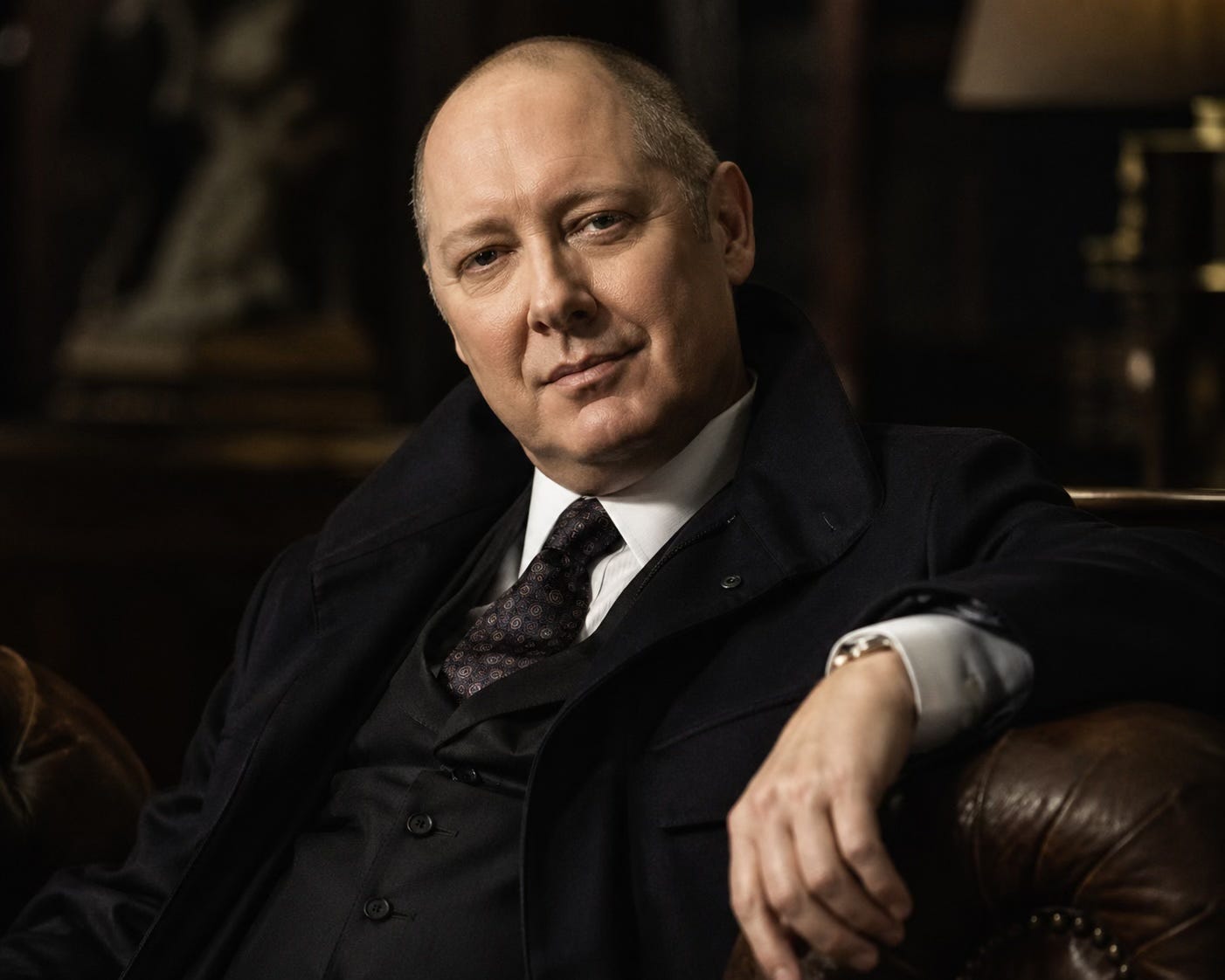
I don’t watch television series. I watch films on my big screen and clips on my computers, and every video platform has accumulated content on every imaginable subject. As a devoted fan of film noir, I’m naturally drawn to clips featuring fascinating criminals, which is how I’ve spent considerable time with the Godfather, the Sopranos, Goodfellas and most recently, Raymond “Red” Reddington from The Blacklist, the NBC crime drama that ran for ten seasons with James Spader in the lead role.
The show’s afterlife in short-form video is staggering. Somewhere between 25,000 and 100,000 individual Reddington clips have accumulated across platforms over the last decade, generating hundreds of millions of views between them — a testament to how completely Spader’s performance transcended the original broadcast and took on a second life of its own. The clip legacy Reddington has accumulated is, as far as I can tell, without precedent in television history.
Raymond Reddington did not arrive on television so much as stroll into the room, pour himself a drink, compliment the drapes, and order three men executed before dessert.
That is the trick of him. Charm fused to menace so cleanly you stop trying to separate the parts. Most shows hand you villains with a tragic backstory or heroes with a dirty streak. Child’s play. Red is something nastier and more honest. A man who enjoys beauty, music, tailored suits, ripe fruit, and selective homicide with equal sincerity. No split personality. No hidden compartment. The darkness moved in years ago and now pays half the rent.
He smiles like a diplomat and kills like an accountant.
What made the beast sing was language. When cornered, he did not bark threats or pound tables like some steroid deputy from network hell. He told stories. Long, winding, absurd tales involving Armenian smugglers, Belgian pastry chefs, widows in Odessa, counterfeit orchids, mangoes in Cartagena, and one-legged jewel thieves with gout. You’d think the man was rambling. Then suddenly the anecdote lands like a brick through stained glass and everyone realizes too late they’ve been mugged philosophically.
That was Red’s finest weapon. Not the gun. Not the money. Not the Rolodex of monsters. Narrative control.
He could turn a hostage scene into a dinner party and a death sentence into a parable.
Then there was the strategy. Ordinary criminals react. Red arranged weather patterns. Other people believed they had leverage because he wanted them to feel tall for thirty seconds. He walked into traps with the confidence of a man who designed the trap, hired the guards, and chose the wallpaper. He used vulnerability the way cobras use stillness.
Even fear worked for him on commission. Often he did not need to threaten anyone. His reputation entered the room first and sat down in the best chair. Violence, in lesser hands, is expensive. Red understood economy. A whisper saved bullets.
But pure cruelty gets old. Every thug with a pulse can snarl. What elevated him was code. Twisted, private, inconsistent, but real. He had lines. He had loyalties. He loved with the same intensity he destroyed. His bond with Liz Keen gave the machine a pulse. The show never fully solved the contradiction, which was wise, because mystery breathes where explanation suffocates.
And then there was James Spader.
Without Spader, you do not have Red. You have a pitch meeting.
Spader was born in Boston in 1960, raised by teachers, dropped out of Phillips Academy at seventeen, then wandered New York doing the sort of jobs that make actors interesting later. He bussed tables, shoveled manure, taught yoga, drove a meat truck. Good preparation for Hollywood.
He built an early career playing seductive abnormalities, men who looked polished but carried weather systems inside them. Then came Steven Soderbergh’s Sex, Lies, and Videotape in 1989, where Spader weaponized stillness and won Best Actor at Cannes. He specialized in intelligence with rot underneath. Few did it better.
And Reddington nearly went elsewhere. Other names circled first. Respectable names. Predictable names. Then Spader got the call three days before filming. Three days. Enough time to buy socks and ruin ten years of competition.
He understood immediately what others missed. Red was not a gangster. Not a spy. Not a villain. He was rhythm.
Spader played him musically. The pauses mattered as much as the words. He knew when to purr, when to whisper, when to let a sentence drop like a body from a tenth-floor window. He could make the word “Elizabeth” sound like affection, warning, grief, and strategy in the same breath.
He obsessed over scripts too. Read everything. Questioned everything. Produced from inside the performance. Every line stress-tested. Every scene tuned. That level of scrutiny shows. Red’s dialogue felt spoken by a man thinking three moves ahead because the actor was doing exactly that.
Even Robert California on The Office now looks like a rehearsal dinner for Reddington. Same calm dread. Same weird authority. Same sensation that everyone in the room should check for exits.
Spader once said contradiction was the key. Ruthless yet vulnerable. Brutal yet attentive to beauty. That is the pulse of Red. Not hero versus villain. Not good versus evil. Something harder. A whole person made of incompatible truths.
Those are rare on television. Most characters are slogans in expensive shoes.
Reddington was alive.
That is why people watched for ten seasons. Not for the cases. Not for the conspiracies stacked like cheap furniture. They watched to see what this elegant monster would say next, who he would save, who he would bury, and whether a man built from paradox might reveal one final secret before the lights went out.
Best Monologue Ever — Raymond Reddington (S1E9) — widely considered the clip that launched the phenomenon. An early, defining demonstration of how Red uses storytelling as a weapon.
Raymond Reddington’s Most Badass Moments — NBC’s official compilation, including the courtroom scene where he represents himself and the “Do You Know Who I Am” sequence back to back.
This was great fun! I forgot how charming Red could be, before killing someone, of course.
Just started rewatching The Sopranos with a friend who never watched ANY of the really good stuff that made American culture. Also, turning him on to Ozark. Now, you've given me a great idea for our next streaming binge. Thanks!!