

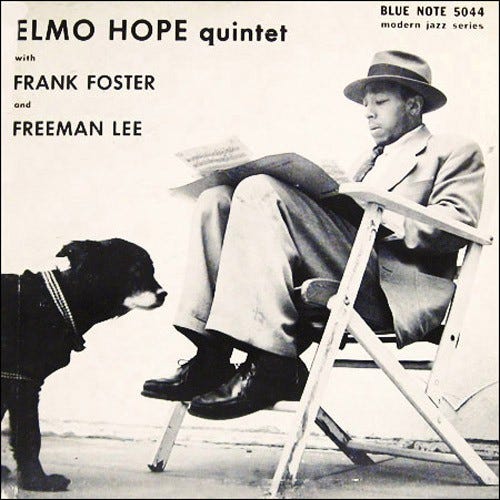
There is a photograph that exists in the imagination of anyone who has spent time with the music of Elmo Hope. It is 1966, somewhere in New York, and Thelonious Monk comes upon his old friend collapsed from exhaustion on a stoop. Monk, a man not known for extravagant declarations, looks at him and says: “the world’s greatest pianist.” The world, of course, had no idea.
That image contains almost everything you need to understand both the beauty and the devastation of Elmo Hope’s story.
St. Elmo Sylvester Hope was born on June 27, 1923, in New York City, the son of Caribbean immigrants. He started piano lessons at seven and by his early teens was winning solo recital contests. He came of age inside one of the most electrically creative circles in the history of American music. His childhood friends were Bud Powell and Thelonious Monk. The three were together constantly, their minds and their harmonics intertwined. One associate recalled that “Bud had the powerful attack, and Elmo got into some intricate harmonies.” Johnny Griffin, who knew all three, called them “triplets.” The word fits. What they were doing in those rooms, in those years, was helping to invent bebop.
Hope attended Benjamin Franklin High School in upper Manhattan, where he was already composing in both jazz and classical idioms. The harmonic sophistication that would define his mature work was present early, nurtured by Powell’s ferocious attack and Monk’s angular, dissonant logic, but filtered through something distinctly Hope’s own: a romantic lyricism, an introspective quality, a kind of beauty held at a slight remove from the listener.
Then, at seventeen, a New York police officer shot him in the back. The bullet narrowly missed his spine. He survived. He enlisted in the Army in 1943 and served through the war. He came home to New York and picked up where he had left off.
The early 1950s were his most prolific period as a recording artist. In June 1953 he appeared on Blue Note sessions with Clifford Brown and Lou Donaldson, sessions now recognized as among the earliest examples of hard bop. Producer Alfred Lion was impressed enough to immediately arrange Hope’s debut as a leader. That recording, Elmo Hope Trio, with Percy Heath and Philly Joe Jones, was followed by a quintet date with Frank Foster and Art Blakey. He played on Sonny Rollins’s Moving Out. He recorded the sextet session Informal Jazz for Prestige in 1956 alongside John Coltrane, Donald Byrd, Hank Mobley, and Paul Chambers. He was everywhere, and yet somehow nowhere.
One reviewer, looking back, observed that Hope “too often recorded with young, rising, overshadowing talents.” The names beside his on those album covers went on to become monuments. Hope remained, in most accounts, a footnote.
Part of what happened was structural, and structurally vicious. A drug conviction in 1956 cost him his New York cabaret card, the license required to perform in the city’s clubs. Without it, a musician might as well be invisible. Hope was not the only jazz musician destroyed by this system, a system that functioned as a mechanism of racial control dressed up as public safety regulation. Monk lost his card too. So did Charlie Parker. The difference is that Monk and Parker, for all their suffering, found their way into the canon. Hope largely did not.
He moved to Los Angeles in 1957. The West Coast years were in some respects his finest musically. He worked with Harold Land and Curtis Counce, contributed four original compositions to Land’s album The Fox, and led his own groups. A 1959 Pacific Jazz trio recording earned a rare five-star review in Down Beat. The critic described Hope’s aesthetic as “a sort of bittersweet melancholy” belonging to musicians who sometimes find the world a bit much to cope with. It was a perceptive line, if also a slightly too comfortable one. The world was not simply too much for Hope to cope with. The world, in very specific and documentable ways, had been actively hostile to him since a policeman’s bullet nearly killed him at seventeen.
He met and married pianist Bertha Rosemond in California. She would prove to be the most devoted guardian of his legacy, long after the world stopped paying attention.
Hope returned to New York in 1961. Monk helped him find work. He recorded prolifically that year, including Homecoming for Riverside, and Hope-Full, a solo and duo album with Bertha. But the addiction that had shadowed him for years was tightening its grip. By 1963, the album Sounds from Rikers Island, featuring musicians who had all been incarcerated, made clear where his life had brought him. His presence on the club scene grew sparse, then nearly nonexistent.
Monk found him on that stoop in 1966. That same year, Hope cut two final trio sessions. They went unreleased for eleven years.
He died on May 19, 1967, of heart failure, the consequence of years of drug-related health deterioration. He was forty-three years old.
What makes his neglect so striking, and so instructive, is the testimony of those who knew his playing best. Griffin, who called him one of Monk’s triplets, also said he was “the real genius of the piano.” Philly Joe Jones put it plainly: “Elmo was Bud’s influence, and Monk. Monk and Bud loved Elmo. He was a real genius.” Pianist Eric Reed, generations later, said: “There’s one Monk, there’s one Duke Ellington, there’s one Billy Strayhorn, and there’s one Elmo.”
Hope wrote approximately seventy-five original compositions. His melodies range from what the New Grove Dictionary calls “tortuous nervousness to introspective, semi-lyrical romanticism.” A piece like “Minor Bertha” unfolds in an asymmetrical thirty-five-bar form. His improvisations moved across bar lines unpredictably, using asymmetric phrase lengths, sudden intervallic leaps, and percussive accents that arrived exactly where you did not expect them. David Rosenthal, writing about the 1953 Blue Note sessions, described “somber, internally shifting chords, punchy, twisting phrases, and smoldering intensity.” He was “dynamically smoother than Monk, with a spidery, spacy touch,” one reviewer noted. Leonard Feather and Ira Gitler wrote that he was “a pianist and composer of rare harmonic acuity and very personal interpretation.”
He was, in short, singular. Not a synthesis of Monk and Powell, though he grew up alongside both and absorbed their approaches. Something unto himself.
His story sits within a long and painful tradition. A Black musician of extraordinary gifts, present at the creation of a revolutionary American art form, ground down by addiction, by racism, by the cabaret card system, by the cruel and familiar mechanics of who gets remembered and who gets erased. The cabaret card was not an accident. The conditions that produced his addiction were not random. The police bullet in his back when he was seventeen was not an aberration. These were systems, and systems have victims.
After the fire destroyed many of his manuscripts, Bertha Hope transcribed his recordings by hand to preserve his compositions. She formed a band called Elmollenium devoted to performing his music. She kept him alive because no institution was going to do it.
In 2016, the Bronx co-named a street “Elmo Hope Way, Jazz Pioneer.” On his hundredth birthday in June 2023, WBGO aired tributes celebrating how he “merged his vast knowledge of harmony with his command of the blues” and helped redefine jazz piano.
It is something. It is not enough. But the music itself is enough, if you go looking for it. Start with the 1953 Blue Note trio session. Or The Fox. Or the 1959 Pacific Jazz recording with its five stars and its bittersweet melancholy. Sit with it.
Monk was right about a lot of things. He was right about this.
Dig Elmo Hope’s composition, “Crazy,” featuring Frank Foster on tenor
And something he wrote for his wife, who has long struggled to keep his music in the public ear, “Minor Bertha”
Thank you for shedding light on one of the truly forgotten giants of modern jazz. I used his composition “Low Tide” as my radio theme song for a while. When Frank Foster was leading the Basie band in the 1990s, I gave him a cassette of the Hope session. Even HE had forgotten it! I remember he also remarked that trumpeter Freeman Lee was very much forgotten. I hope your piece will generate new interest in Hope’s music.
Great write up. Any recommendations for those who are new to his music? Thanks