

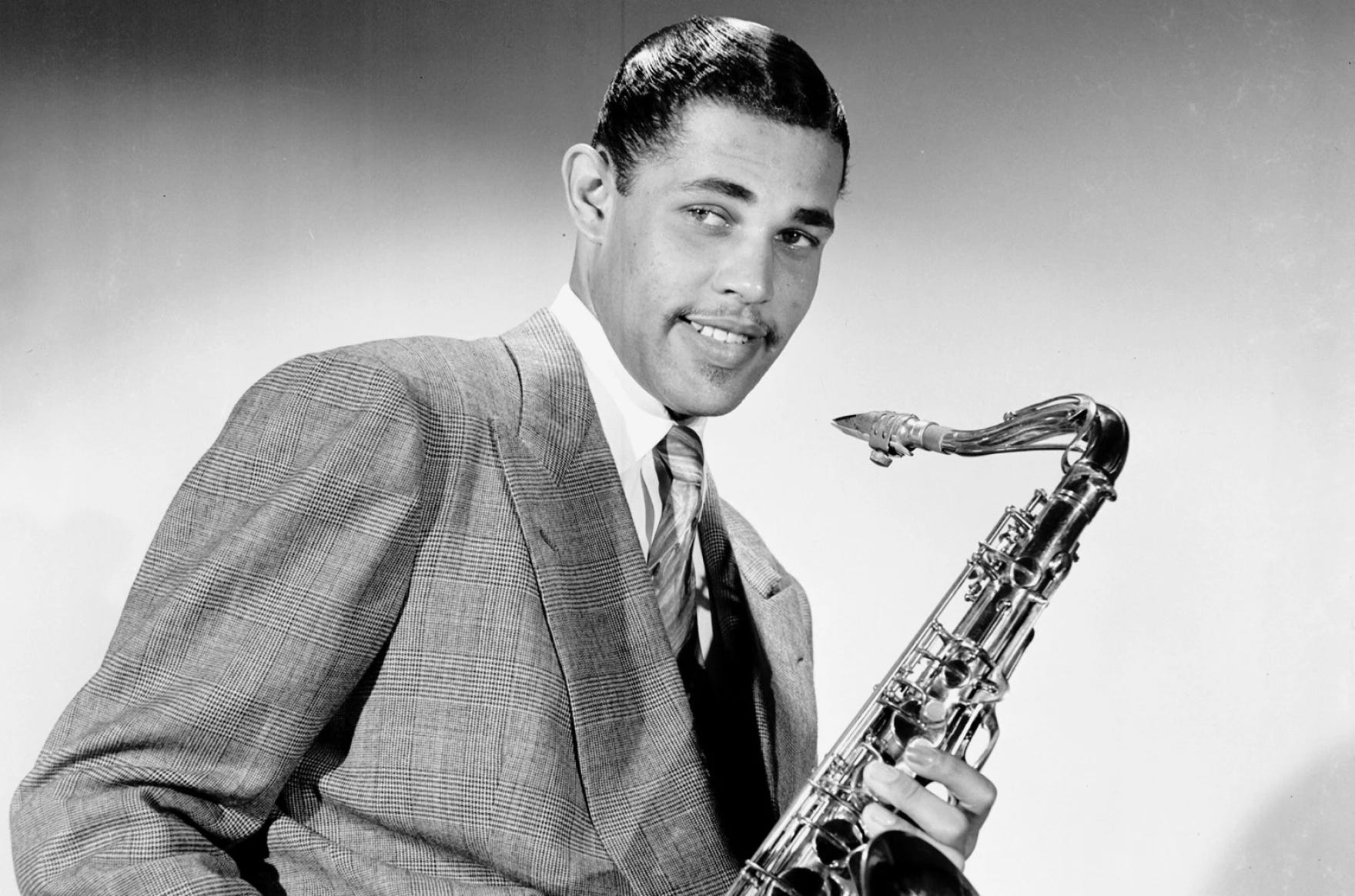
Dexter Gordon’s influence on the tenor saxophone and his popularity with audiences stemmed from his unique position as a bridge between jazz eras and his commanding, charismatic presence both on and off the bandstand.
As one of the first tenor saxophonists to fully translate bebop vocabulary to the larger horn, Gordon essentially created the template for modern tenor playing. While Coleman Hawkins and Lester Young had established the instrument’s foundational approaches, Gordon was among the first to successfully adapt Charlie Parker’s alto innovations to the tenor. His approach solved a crucial problem: how to maintain the tenor’s naturally robust, full sound while executing the rapid, complex lines of bebop. Players including Sonny Rollins, John Coltrane, and virtually every major tenor saxophonist who followed studied his solutions carefully.
Gordon’s sound was immediately recognizable and deeply satisfying to listeners. He had a huge, warm tone that could fill a room without amplification, yet he could also play with remarkable subtlety. His behind-the-beat phrasing created constant tension and release, making even simple phrases swing hard. This relaxed approach to time became a defining characteristic of tenor playing, particularly influencing Coltrane’s early development and continuing through players such as Joe Henderson and beyond.
His harmonic sophistication set new standards for the instrument. Gordon quoted extensively from the American songbook, classical pieces, and other jazz solos, weaving these references into his improvisations with wit and intelligence. These quotes weren’t mere showing off; they demonstrated a deep musical literacy and sense of humor that connected with audiences. When Gordon quoted “Laura” in the middle of a burning bebop solo, listeners got the reference and felt included in the conversation.
The biographical elements of Gordon’s career added layers to his influence. His battles with addiction and years of expatriation in Europe during the 1960s created a mythology around him. When he returned to the United States in 1976, he was received as a conquering hero, introducing a new generation to bebop tenor at its highest level. His Columbia recordings from this period, particularly Homecoming and Sophisticated Giant, became essential texts for understanding modern jazz tenor.
Gordon’s physicality and stage presence revolutionized how tenor saxophonists presented themselves. Standing six feet six inches tall, he cut an imposing figure, holding his horn at an angle that became widely imitated. His way of walking on stage, his humor between tunes, and his generous acknowledgment of his bandmates showed younger players that jazz performance was about more than just the notes. This performance aspect influenced how Sonny Rollins, Johnny Griffin, and countless others approached their craft.
For listeners, Gordon represented jazz at its most accessible without compromising sophistication. His ballad playing could break your heart, particularly on pieces such as “Body and Soul” or “Darn That Dream,” where his vibrato and note choices conveyed profound emotion. Yet he could also burn through uptempo numbers with an excitement that was visceral and infectious. Audiences didn’t need theoretical knowledge to understand that Gordon was telling them stories through his horn.
His recordings for Blue Note, Prestige, and later labels provided a recorded legacy that taught by example. Each solo was a masterclass in construction, showing how to build intensity, when to use space, and how to balance tradition with innovation. Young players learned entire Gordon solos note for note, not just to copy but to internalize his logic and phrasing concepts.
The cultural impact extended beyond music. Gordon’s performance in the film Round Midnight brought authentic jazz to mainstream audiences and earned him an Academy Award nomination. This visibility helped validate jazz as a serious art form worthy of preservation and study. His portrayal showed the dignity and artistry of jazz musicians, countering many of the stereotypes that had plagued jazz in popular media.
Gordon’s influence on vocabulary cannot be overstated. Specific phrases he played became part of the standard jazz language, practiced in music schools worldwide. His approach to playing rhythm changes, his solutions for navigating complex chord progressions, and his methods for building excitement in a solo became foundational knowledge for serious tenor players.
The continuing influence shows in how contemporary players still reference Gordon’s work. Whether it’s the way Joshua Redman phrases certain passages, how Chris Potter approaches ballads, or how Kamasi Washington builds extended solos, Gordon’s DNA runs through modern tenor playing. His combination of technical mastery, emotional depth, and sheer swing remains the gold standard.
For audiences, Gordon represented everything compelling about jazz: sophistication without pretension, tradition with innovation, and above all, the ability to communicate directly through pure sound. His music spoke to both the Saturday night dance crowd and the Sunday morning contemplative listener. That dual appeal, combining intellectual achievement with gut-level emotional impact, explains why his recordings continue to attract new listeners decades after they were made.
This combination of musical innovation, pedagogical influence, and audience connection made Dexter Gordon not just important but essential to jazz history. He showed that bebop tenor could be both challenging and entertaining, that tradition and innovation could coexist, and that jazz at its best speaks simultaneously to the head, the heart, and the feet.
When I was living in the New York, I saw Dexter Gordon in person many times, mostly notable upon his return from Europe in the late 70s. His playing was always superb, and his presence, distinguished.
Check out Dexter’s solo on “The Maze” (starting at 2:52) from Herbie Hancock’s debut album, Takin’ Off recorded May 28, 1962 This superbly demonstrates how a tenor solo builds with rising intensity. I also love the way twenty three year old Herbie Hancock comps for Dexter during the solo. Freddie Hubbard is on trumpet, Butch Warren on bass and Billy Higgins on drums.
And here’s a video recorded March 1, 1964 in Holland during Dexter Gordon’s long European stay, Dizzy Gillespie’s “A Night in Tunisia” featuring George Grunz on piano, Guy Pedersen on bass and Daniel Humair on drums. I chose this clip for his strong playing and a glimpse of Dexter Gordon’s personality during the song’s introduction.
Thank you for this. Dexter Gordon was my introduction to jazz. His recordings inspired me to start playing the saxophone, and to this day he remains my greatest musical hero. To me, he represents the highest level of artistry and sophistication.
My Man Bret, you hit for the cycle with this piece. It is the best sketch of Long Tall Dexter that I can recall ever reading. I have to believe that anyone reading this piece will be motivated to find out more about this giant of the tenor saxophone. The best way to achieve this, of course, is to sit still, turn off your computer/phone, and listen to his recordings with intent! Thank you, Bret.