He Never Lost His Mask. He Was Buried Wearing One.
How Masked Wrestlers Shaped Mexican Culture

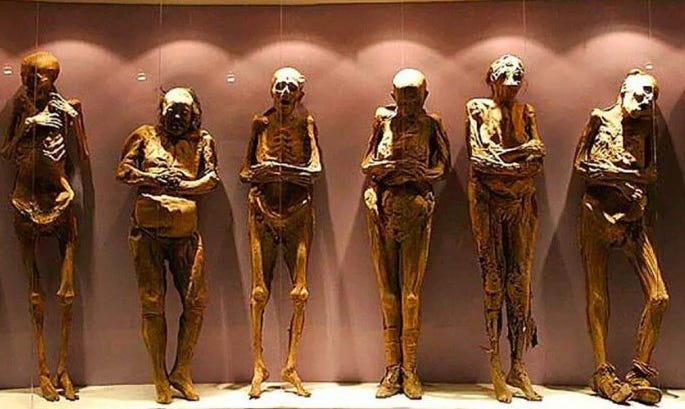
There’s a museum in Guanajuato full of dead people. When burial fees went unpaid, bodies came out of their graves. Some had dried instead of decomposing. Eventually somebody put them on display and charged admission.
I’ve been through once. I had never stood face to face with a mummy before. What stays with me is how much they look like us. Somebody’s aunt. A man you’d pass in the market. People, stopped in the middle of something. Once was plenty.
In 1970, Federico Curiel came here to shoot Las Momias de Guanajuato featuring the Mexican wrestlers Santo, Blue Demon, Mil Máscaras. An evil wrestler named Satán returns a hundred years after losing to Santo’s ancestor. He has made a deal with the devil. Blue Demon and Mil Máscaras handle most of the trouble. Santo was added late and spends much of the picture elsewhere.
At the end the three of them drive off in three separate cars. Santo in gold, Blue Demon in a green MG, Mil Máscaras in a dune buggy. Three masked wrestlers, three cars. Still my favorite ending in pictures.

Blue Demon is the one I think about. His name was Alejandro Muñoz Moreno. He put on the blue mask in 1948 and kept his face out of public view for the rest of his career. In public he was Blue Demon.
In a mask against mask match, the loser removes his mask in the ring and announces his real name. Years of protecting his identity end in front of the crowd. Blue Demon never lost his mask in the ring. He retired with the mask on and reportedly went into the ground wearing one.
He and Santo were rivals for years and sold out buildings. Santo, the silver saint. Blue Demon, quieter, harder. In 1953 he beat Santo and took the welterweight title from him. Santo remained the bigger star. Blue Demon had beaten him all the same.
Later they made movies together. Vampires, mad scientists, mummies, whatever the week called for. Cheap pictures. Kids loved them across Latin America.
The wrestling business took shape in the thirties, with Salvador Lutteroth promoting matches in Mexico City. Here in Guanajuato, the posters near the market are hand-lettered. New ones go up every week. I stop and read them.
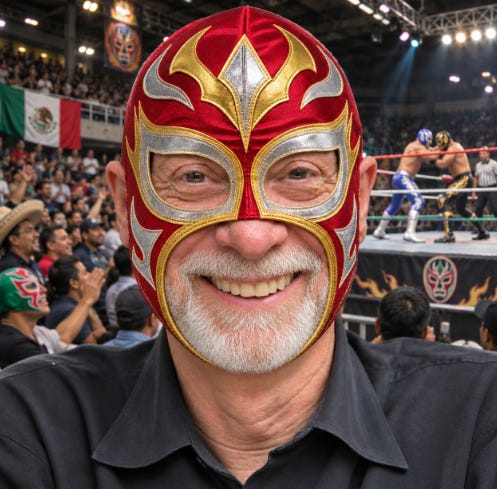
Lucha Libre is tied up with Mexican culture because it draws on traditions far older than the sport. Masks held sacred meaning long before wrestling, in Aztec and Maya rituals and in danzas that blended Indigenous and Catholic tradition, where the wearer took on the identity of a god, animal or ancestor. Luchadores carry that idea forward: the mask is the wrestler, which is why losing one in a lucha de apuestas is so dramatic and why many wrestlers keep their identities secret for life. Matches act out a good-versus-evil drama between técnicos and rudos that echoes Catholic morality plays, melodrama and the telenovela, and loud, emotional crowds make it feel more like popular theater than sport. Lucha took off in the 1930s in working-class urban neighborhoods with cheap tickets, so it has always been entertainment by and for ordinary people, with luchadores as barrio heroes.
From there, lucha libre grew into a national myth and a symbol of identity. El Santo, the “Man in the Silver Mask,” starred in more than 50 films fighting vampires and Martians, became a real folk hero and was even buried in his mask, while Blue Demon and Mil Máscaras helped make the luchador a homegrown superhero. The mask also took on political meaning: after the 1985 earthquake, Superbarrio Gómez wore one to fight for housing rights, turning it into a sign of the anonymous common person standing up to power. Lucha’s high-flying acrobatic style and bright, extravagant look fit with Mexican visual traditions like alebrijes and Día de Muertos. Above all, it blends Indigenous symbolism, Catholic morality, mass media and urban popular culture, a kind of mestizaje central to how Mexico understands itself. That is why Mexico City declared it part of its intangible cultural heritage in 2018.
I’ve been to Arena Mexico in Mexico City to see Lucha Libre matches several times. The evenings felt like the other sporting events I’ve attended in Mexico. Whole families came together. Children, teenagers, parents, grandparents. Plenty of alcohol for the adults. Sweets for the kids. Children wore the masks of their heroes. Their grandparents shouted as loud as anyone.
The técnicos wrestled clean and the rudos cheated. The referee managed to miss the cheating, and the crowd let him know. A rudo with enough nerve got cheered anyway. The crowd wanted justice and enjoyed the man who broke the rules, both at once.
The falls were choreography. The insults were dialogue. The crowd had the best lines. Everyone knew how the evening worked. The children had someone to cheer for. The adults had someone to shout at. Nobody had to sit quietly.
Then the wrestlers left the ring. As they approached the exit, they hugged. Opponents a few minutes earlier, arms around each other now. The respect was there to see. The rivalry belonged to the performance.
I walked past the museum Tuesday evening. Hot day, finally cooling. The line was gone by then, only the building and the hill behind the museum. Inside were people whose faces had become an attraction. Blue Demon had spent forty years keeping his face to himself.
And then there’s the green MG. Somewhere the car rusted out, or got parted, or sits in a collector’s garage in Monterrey. I’d rather not find out which.
Next Tuesday - The Wrong Singer, The Wrong King
Hollywood discovered early that the word “jazz” could sell a movie. Whether the movie represented the music was another matter.
In 1927, the word meant almost anything modern, syncopated, and young. It was a brand before it was a definition, and the studios used it that way. The Jazz Singer, released that year, is the clearest example. Al Jolson was billed as the World’s Greatest Entertainer, and he earned the title on Broadway and in vaudeville with sentimental songs and a delivery big enough to reach the back of any theater. What he did not do was sing jazz. And then there was Paul Whiteman, the King of Jazz?
Discussion about this post