

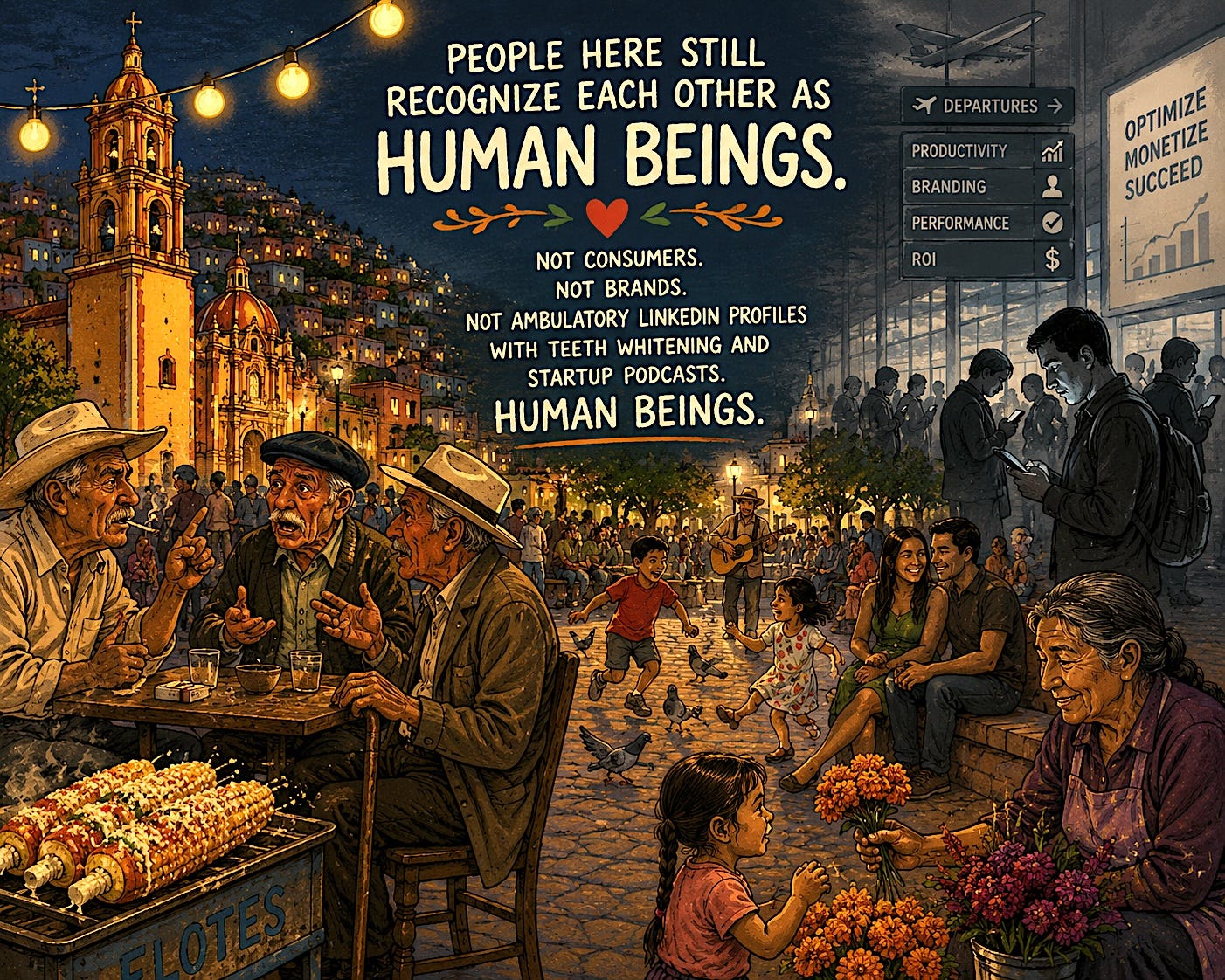
America has traded human warmth for marketplace logic, turning every social interaction into an economic evaluation and every citizen into a self-managing brand. Mexico, for all its corruption and chaos, has preserved something the United States has nearly destroyed: the ability to simply exist together in public, across generations, without needing to justify it. Living in Guanajuato makes that contrast impossible to ignore.
I have lived in Mexico long enough to notice something that has become nearly extinct north of the border.
People here still recognize each other as human beings.
Not consumers. Not brands. Not ambulatory LinkedIn profiles with teeth whitening and startup podcasts. Human beings.
The realization hit me one night in Guanajuato watching three old men argue about football with the intensity of Cold War diplomats negotiating missile treaties. One had a cigarette hanging from his mouth like a fuse. Another was waving a cane dangerously close to a child chasing pigeons through the square while church bells exploded overhead and somebody nearby sold roasted corn dripping with enough mayonnaise to kill a horse.
Nobody was in a hurry. Nobody was monetizing the moment. They were simply there, alive, occupying space together without needing an app to justify it.
Standing in that plaza, I understood how profoundly insane the United States has become.
America now feels like a giant airport terminal operated by pharmaceutical executives and marketing consultants. Every interaction carries the faint smell of financial evaluation. People meet and immediately begin probing each other for economic data. “What do you do?” Innocent on the surface. But beneath it lurks the real interrogation: How much money do you have? How important are you? Should I pretend to respect you?
The country has absorbed marketplace logic so completely that Americans now evaluate each other the way investors evaluate distressed commercial property. Human value gets tied to productivity, visibility, personal branding. The soul gets flattened into a résumé. Every citizen becomes a tiny corporation managing perception around the clock.
Even children have become optimization projects. Soccer practice. Coding camp. Advanced placement. The whole culture vibrates with nervous exhaustion.
Then you come to Mexico.
This is not a Disneyland hallucination for spiritually dehydrated expatriates in linen pants talking about authenticity over artisanal mezcal. Mexico has corruption, violence, poverty, and bureaucratic nightmares capable of driving a sane person into the Sierra Madre with nothing but tequila and a stolen goat.
But beneath all that chaos, something America has nearly exterminated still survives.
Human warmth.
You notice it in small moments your American nervous system no longer expects. The cashier looks you in the eye. An old woman selling flowers speaks to you with dignity even if you buy nothing. Entire families occupy public spaces at night — grandparents, teenagers, infants, dogs, wandering musicians — human beings colliding in real time under actual moonlight instead of staring into glowing rectangles while sitting three feet apart.
Mexico still understands public life. America understood it once, before the tech companies and hedge fund logic got hold of the culture and turned the population into isolated dopamine addicts living inside algorithmic slot machines.
The difference begins with children. Mexican kids grow up understanding that other people matter. Not the fake respect of diversity seminars run by emotionally hollow HR executives. Real respect, the old-fashioned kind rooted in presence and attention. Grandparents remain part of daily life instead of warehoused in institutional exile until death arrives with daytime television and low-sodium pudding. Children learn social warmth organically because they are surrounded by people interacting across generations. Human beings teaching other human beings how to exist together.
In America, children increasingly learn life through screens supervised by exhausted parents trapped inside economic systems designed by sadists. The United States became one of the richest societies in human history while simultaneously producing staggering levels of loneliness, anxiety, addiction, and spiritual malnutrition. That is an achievement worthy of a bald eagle wrapped in antidepressant prescriptions.
Mexico remains materially poorer and emotionally richer in ways Americans have forgotten how to measure. Because the most important parts of human life are gloriously inefficient. Friendship is inefficient. Long meals are inefficient. Old men arguing in plazas for three hours about football formations from 1987 is wildly inefficient. And thank God for that. America worships efficiency the way medieval peasants worshipped saints’ bones — desperately, blindly, in the belief that the ritual will save them from something they cannot name.
It won’t.
Then there is death, which reveals more about a culture than almost anything else.
America treats death like an embarrassing accounting error. The entire culture conspires to hide it behind hospital curtains, pharmaceuticals, and wellness influencers selling immortality through mushroom powders and cold plunges. Mexico looks death directly in the skull and laughs. The Day of the Dead alone contains more psychological wisdom than the entire American self-help industry. Skeletons dance. Families picnic in cemeteries. Children grow up understanding what modern America desperately denies: you are going to die, everyone you love is going to die, so stop behaving like a frightened stockbroker at a networking brunch and enjoy the music while it plays.
That wisdom changes a culture.
Civilization is not GDP, not military hardware, not billionaires launching themselves into space while public infrastructure collapses beneath them. Civilization is whether old people are respected. Whether children are loved. Whether strangers are acknowledged. Whether people still know how to sit together in the evening without requiring entertainment delivered by satellite.
One night in the plaza, children chased each other between benches older than the United States itself. A couple leaned against a stone wall. Somebody played guitar badly but with total commitment. Old women gossiped. Vendors shouted. Dogs barked. Church bells thundered through the valley.
Nobody was optimizing. Nobody was building a brand. Nobody was performing a lifestyle for an audience of strangers.
They were just there together — and after years inside the cold fluorescent machinery of modern America, that turned out to be everything.
Listening - Science Fiction - Ornette Coleman
By 1971, Ornette had been largely absent from recording for years and Science Fiction was his creative rebirth after that silence, The album sits between Coleman’s past and future, combining the fire of his Atlantic years with early hints of the electrified, globally conscious experiments that were coming. You can hear where he’d been and where harmolodics was heading, in the same listening session.
The expanded ensemble, which includes Don Cherry and Dewey Reman, features busy rhythms percolating underneath sustained chords and melodic figures, and the dream-like vocals contain the kind of tradition/anti-tradition dialectic that would show up in much of his new music that followed.
Listen to the entire recording.
Watching - Looking for Ornette
Jacques Goldstein sets out on a wild chase after a ghost. Not the kind rattling chains in a haunted house. This one drifts through the history of jazz, elusive, misunderstood, impossible to pin down. His name is Ornette Coleman.
The world finally caught up with Ornette’s music. The records that once sparked outrage now sit among the most celebrated achievements in modern jazz. Yet the man himself remained hidden behind layers of mystery, speaking in riddles, sidestepping labels, refusing to explain himself.
Goldstein follows the trail. He tracks down musicians whose lives and careers were altered by Ornette’s arrival. They tell stories, offer clues, share memories. Piece by piece, a portrait begins to emerge. Not a tidy biography, but a collage of impressions, contradictions, and revelations.
Out of the fragments comes the outline of a singular figure. A visionary who broke the rules and ignored the consequences. A man who searched for beauty where others heard chaos. A man convinced that beauty was one of the rarest things on earth.
Looking for Ornette can be seen on YouTube.
Next Tuesday:
Booker Little died in 1961 at twenty-three, before most people knew who he was. That remains one of jazz history’s most consequential losses, and one of its least discussed.
Having lived in Mexico myself, I concur with your assessment. Having travelled all over the world, I can tell you that the same can be applied to several other countries and cultures. American insanity at present is not at all normal.
Glad you have found your home in Mexico. Seems you are very happy there, especially when you look in the rear-view mirror. Still, I would be hesitant to paint a large diverse country such as the US with a broad brush. Living seasonally in two distinct regions of the States, and having visited many others, I note that attitudes and lifestyle can be vastly different. NYC where you spent a good portion of time, is almost a Country to itself, and the attitudes there can vary substantially from the farm towns of Eastern Connecticut, Central Florida, etc. I remember visiting Mexico City in the early 80's, with a warning from the locals, to watch my wallet and stay within certain parameters of the City. I'll guess (or hope) things have changed there since then, but the point being that any large Country has it's good and bad elements.