

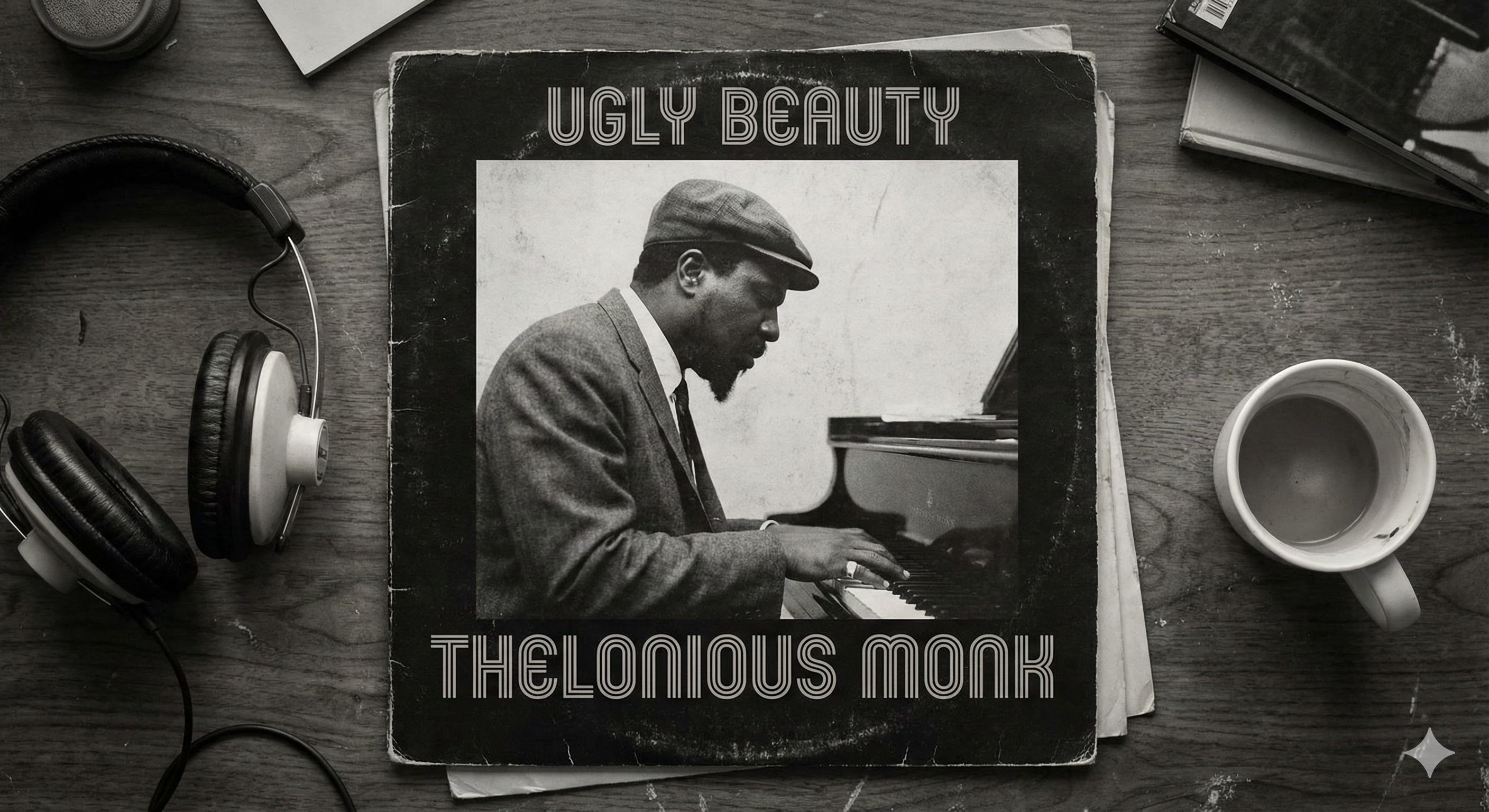
The title alone tells you everything you need to know about Thelonious Monk’s artistic vision. While other jazz composers were writing standards with names such as “All the Things You Are” or “Body and Soul,” Monk gave us “Ugly Beauty.” The juxtaposition captures perfectly what made him one of the most revolutionary figures in jazz history: a willingness to find profound elegance in unexpected places, to embrace dissonance as a path to truth, and to trust his own singular vision above all conventional wisdom.
Monk’s compositions operated according to an internal logic that seemed baffling at first encounter but revealed itself as inevitable upon deeper listening. His melodies zigged where others zagged, incorporating unexpected intervals and rhythmic displacements that sounded wrong until you realized they were precisely right. Take “Epistrophy,” with its repeated two-note pattern that shouldn’t work but becomes hypnotic, or “Brilliant Corners,” which earned its title honestly by presenting technical and harmonic challenges that left even accomplished musicians scratching their heads.
What Monk understood, perhaps more clearly than any of his contemporaries, was that beauty doesn’t require smoothness or conventional prettiness. His compositions often featured angular melodies, jarring intervals, and rhythmic ambiguities that violated the established rules of jazz composition. Yet within these apparent violations lay a rigorous musical logic, a deep understanding of how tension and release could work in ways that went beyond the standard playbook. When you listen to “Ugly Beauty” itself, you hear this philosophy made manifest: a waltz that moves through surprising harmonic territory, finding moments of genuine loveliness in places where textbook harmony would never venture.
His piano playing matched his compositional aesthetic perfectly. Where other pianists aimed for fluid, virtuosic runs, Monk attacked the keyboard with percussive jabs and unpredictable silences. He used space as aggressively as he used sound, letting notes hang in the air or dropping sudden rests into the middle of phrases. His fingers seemed to strike the keys at odd angles, producing a tone that was both percussive and somehow vocal. Critics who didn’t understand what he was doing accused him of technical limitations, but musicians who worked with him knew better. Monk’s technique was utterly precise, completely intentional, and perfectly suited to the music he was creating.
The spaces between notes mattered as much as the notes themselves in Monk’s playing. He would pause mid-phrase, creating moments of suspension that made listeners lean forward, wondering what would come next. Then he might drop a single note that recontextualized everything that had come before. His sense of time was equally distinctive, sometimes playing just behind the beat, sometimes ahead of it, always creating a sense of rhythmic tension that made his music feel alive and unpredictable.
His harmonic language drew from stride piano and the blues while pushing into territory that wouldn’t become standard jazz vocabulary until years later. He loved whole-tone scales and flatted fifths, using them not as exotic colors but as fundamental building blocks. The dissonant intervals that pepper his solos weren’t mistakes or modernist provocation; they were Monk speaking his native musical language, one he had developed through years of working things out at the keyboard, trusting his ears over any theoretical framework.
What made Monk truly radical was his refusal to compromise this vision. He could have softened his approach, made his music more palatable to audiences and critics who found it difficult. Instead, he doubled down on what made him unique. He wore unusual hats and danced in circles during performances. He kept writing compositions that challenged even the best musicians. He maintained his artistic integrity at considerable professional cost, spending years without steady work because club owners and record executives didn’t know what to do with him.
This uncompromising stance eventually paid off, though not without struggle. By the late 1950s and into the 1960s, the jazz world had caught up to Monk. Musicians began to understand that what had sounded wrong was actually revolutionary. His compositions became standards, covered by everyone from John Coltrane to Art Blakey. His Columbia Records albums brought him to a wider audience. He appeared on the cover of Time magazine. Yet even as recognition came, Monk never altered his fundamental approach. He remained exactly who he had always been.
The influence of Monk’s music extends far beyond jazz. You can hear his angular melodies and rhythmic displacement in hip-hop, his use of space and silence in experimental music, his harmonic daring in contemporary classical composition. Musicians across genres have learned from his example that artistic authenticity matters more than commercial appeal, that beauty can emerge from unexpected places, and that the most important audience to satisfy is yourself.
“Ugly Beauty” stands as perhaps the perfect encapsulation of Monk’s artistic philosophy. The title confronts us with a paradox, forcing us to expand our definition of what beauty can be. The composition itself delivers on that promise, finding moments of genuine gorgeous melody within a harmonic framework that conventional wisdom would consider problematic. It’s Monk in miniature: challenging, profound, and ultimately unforgettable.
In an era when jazz musicians often tried to prove their sophistication through complexity or their accessibility through simplicity, Monk did neither. He simply played his truth, wrote his truth, and trusted that anyone with open ears would eventually understand. That trust was justified. Today, Thelonious Monk stands as proof that the most personal art can become universal, and that only by remaining completely yourself can you create something truly timeless.
View Monk’s solo piano version of “Ugly Beauty”
Ugly beauty is a French expression, “Jolie laide ” which translates loosely to finding beauty in the unconventional and imperfect. The last occurrence in popular culture was in 1981, with the song Laide, Jolie Laide,” written by Serge Gainsbourg. I’ve always thought it means a dissonance in one’s features. Like a Picasso cubist portrait of his wives and mistresses!
No jazz musicians composed “All The Things You Are” nor “Body And Soul”.