

Sixty years of films have been sitting in the dark like loaded weapons, waiting for me to crawl back through the wreckage and face them again. I used to think movies stayed frozen in time, preserved like insects in amber, but that’s a lie people tell themselves when they’re young and stupid and still under the impression their opinions matter more than their scars.
The films did not change. I did. The years piled up. Bodies disappeared. Illusions burned off like cheap whiskey fumes at sunrise. And now when I return to these old pictures, they hit differently. Scenes I once ignored suddenly feel radioactive. Small gestures crack open like land mines. Entire meanings emerge from corners I never even noticed before.
Great art plays the long game. It waits. Patiently. Like an old hustler at the end of the bar watching you destroy yourself for decades before finally leaning over to tell you what the joke was all along.
You come back older, heavier, carrying your private cemetery of failures and half-finished dreams, and the work finally opens itself to you. Not because the art matured. Because you did. Or because life beat you hard enough to understand what the artists were trying to say before you were qualified to hear it.
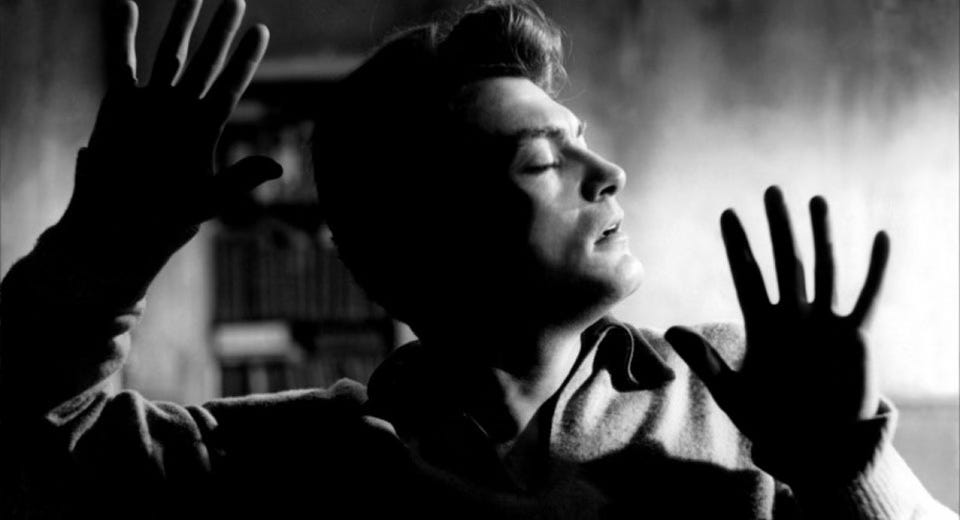
Orpheus (1950) earns masterpiece status the hard way. No nostalgia. No academic embalming fluid. No museum-glass reverence. The thing still breathes. Still stalks around the room at three in the morning looking for cigarettes and doomed young poets.
Jean Cocteau took the ancient Orpheus myth and dragged it straight into postwar Paris, into a city full of cracked mirrors, existential smoke, ruined buildings, motorcycle engines, and starving artists trying to outtalk death long enough to survive another night. Radio transmissions arrive like coded messages from the underworld. Poetry moves through black markets like heroin. Death rides a motorcycle entourage with the calm authority of organized crime.
And somehow, against all odds, Cocteau never betrays the myth itself. That is the miracle. Most people who “modernize” mythology end up flattening it into graduate-school sludge. Cocteau understood the story from the inside because he had spent his entire life romancing death like a dangerous lover he knew would eventually bankrupt him.
Every frame looks invented under chemical pressure. Mirrors become liquid portals. Human bodies move backward through time. The land between life and death resembles a bombed-out legal district abandoned after the apocalypse. These are not “special effects” in the Hollywood sense. They are metaphors made flesh. Dream logic photographed directly onto film stock before the accountants arrived to sterilize cinema forever.
The secret weapon is Death herself, played by María Casares with enough erotic gravity to collapse nearby planets. She is not a symbol. Not a lecture. Not some bloodless philosophical device for French intellectuals to scribble essays about between cigarettes. She is ambitious, jealous, wounded, hungry, capable of tenderness, and fatally attracted to the people she destroys. That gives the tragedy real torque. You feel the machinery grinding the characters apart.
Behind the entire picture lurks the ghost of Raymond Radiguet, Cocteau’s lost prodigy, dead young and permanently embalmed in memory. The film aches with grief. You feel Cocteau trying to negotiate with the dead through art itself, trying to bargain his way across the border for one more conversation. That autobiographical wound is what separates the film from formalist trickery. Without the pain, the movie becomes clever. With the pain, it becomes immortal.
The film stands in the middle of Cocteau’s strange holy trinity alongside The Blood of a Poet and Testament of Orpheus. Seeing all three together deepens the experience, but Orpheus survives perfectly well on its own, which is the final proof you are dealing with the genuine article and not some fashionable relic dragged out for film-school autopsies.
View “Orpehus” and for english, click on closed captions and set to English.
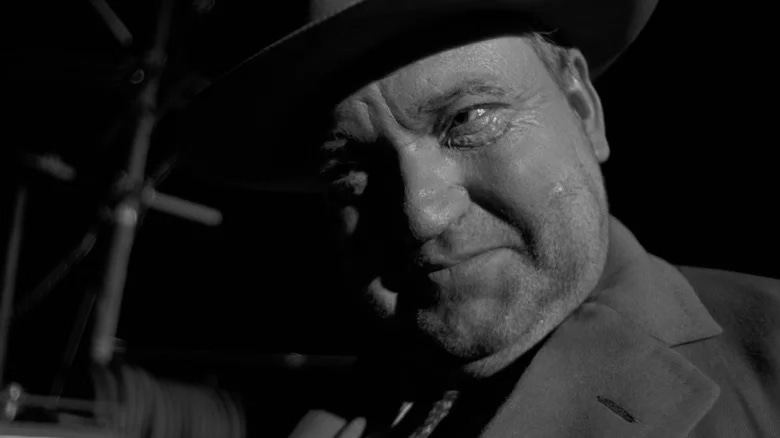
Touch of Evil (1957) kicks the door open with one of the great acts of cinematic arrogance. Three-plus minutes of unbroken movement. A crane shot gliding above a filthy border town while a car packed with explosives crawls through the night like a doomed animal. The bomb ticks away somewhere under the audience’s nervous system. Welles is not showing off. He is declaring war. The message arrives immediately: in this world, corruption is not hidden in alleyways or back rooms. It hangs in the air like industrial smoke. Everybody breathes it.
From there, Orson Welles and cinematographer Russell Metty shove noir straight into fever-dream territory. The camera tilts sideways like a drunk trying to stand upright during the end of civilization. Faces crowd the frame so tightly you feel trapped inside other people’s bad decisions. Shadows swallow entire rooms whole. Every visual choice argues the same ugly truth: the environment itself is diseased. The camera is not observing corruption. The camera is infected by it.
At the center waddles Hank Quinlan, one of the great bloated ghosts in American movies, played by Welles like a police chief who ate his own soul twenty years earlier and has been digesting it ever since. Quinlan solved too many crimes through lies, intimidation, planted evidence, and rotten instinct until the line between justice and personal mythology dissolved completely. The terrifying part is that he is often right. He sniffs out guilt with animal accuracy. But he arrives there through methods so poisoned that morality itself collapses around him. Hollywood almost never permits this level of ambiguity inside genre filmmaking. Most crime films hand you heroes and villains with bright labels attached. Quinlan arrives as a human catastrophe.
Then there is Marlene Dietrich, drifting through the wreckage as Tanya, exhausted, amused, and somehow wiser than everyone else in the picture combined. She delivers Quinlan’s final epitaph with the efficiency of a guillotine blade. One sentence. Entire lifetimes buried inside it. The whole movie operates this way. Nothing wasted. Maximum despair compressed into tiny spaces.
The production history feels almost too perfect, like Hollywood accidentally produced its own autopsy report. Welles took the assignment as hired labor. The studio panicked. Executives hacked the film apart in the editing room with the confidence of men who mistake accounting for intelligence. Welles fired back with his legendary memo, page after page begging them to restore the picture’s rhythm and logic. They ignored him, because studios traditionally fear artists the way livestock fears wolves.
For decades the mutilated version staggered around theaters while the real film existed like contraband folklore among obsessives and insomniacs. Then in 1998 the reconstruction finally surfaced, and suddenly the full nightmare snapped into focus. The masterpiece had been there all along under layers of studio vandalism.
That is what makes Touch of Evil feel immortal. Welles took compromised conditions, hostile executives, cheap genre material, and industrial sabotage, then somehow bent the entire rotten apparatus into art dense enough to survive the century.
View the nearly four minute continuous opening shot from Touch of Evil:
Dr. Strangelove (1964) begins with one savage realization from Stanley Kubrick: the nuclear age was too insane for solemn speeches and respectable drama. You could not explain mutually assured destruction with dignity because the entire premise already sounded like a psychotic break in a Pentagon conference room. The only honest response was comedy so black it leaves fingerprints on your throat.
Everything in the film grows out of that ugly little truth.
Kubrick structures the movie like a precision-engineered panic attack. Three storylines running simultaneously. The airbase spiraling into fascist paranoia. The bomber crew lumbering toward apocalypse with cheerful professionalism. The War Room packed with bureaucrats and military dinosaurs calmly discussing planetary annihilation like accountants arguing over parking validation. The editing moves with machine-like exactness. Every cut tightens both the suspense and the absurdity until they become the same sensation.
And looming over all of it sits Ken Adam’s War Room, one of the greatest sets ever built for a motion picture, a cathedral erected for the worship of extinction. The giant circular table. The overhead lighting turning generals into undertakers. The cavernous blackness surrounding the men supposedly managing civilization. Every inch of the room tells you humanity handed ultimate power to people emotionally unqualified to supervise a grocery store.
Then there is Peter Sellers performing three separate nervous breakdowns disguised as characters. Not a gimmick. A diagnosis.
Group Captain Mandrake represents baffled human decency trapped inside systems built by lunatics. President Muffley is liberal rationalism rendered completely impotent, a man politely negotiating the end of the species over the telephone like a middle manager apologizing for a shipping delay. And then comes Dr. Strangelove himself, grinning in from the edge of the abyss like some escaped Nazi ghoul feeding on thermonuclear theory and amphetamines.
The hand. God almighty, the hand.
That involuntary Nazi salute remains one of the great comic inventions in cinema because it exposes something hideous and true. Ideologies outlive the people carrying them. They twitch. They mutate. They seize control of the body when the conscious mind pretends civilization has moved on. Strangelove wrestling with his own arm looks funny until you realize Kubrick is talking about the twentieth century itself.
The film never pauses to explain its deeper argument because Kubrick trusted audiences back when filmmakers still believed viewers possessed functioning nervous systems. The message hums underneath everything: the systems humans invent to prevent catastrophe eventually manufacture catastrophe as a side effect. Deterrence logic, followed to its final destination, produces Dr. Strangelove sitting in a wheelchair screaming about mine shafts and survival ratios while the planet burns.
And then Kubrick delivers the ending.
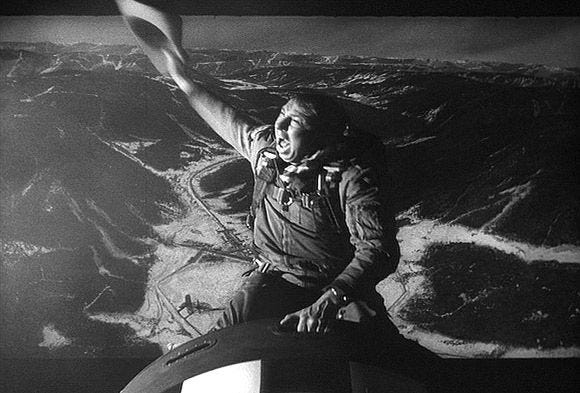
Slim Pickens riding the nuclear bomb downward like a rodeo cowboy drunk on patriotism and destiny, hollering into the apocalypse while Vera Lynn sings “We’ll Meet Again” over blooming mushroom clouds swallowing the Earth whole.
It is hysterically funny. It is genuinely horrifying. The miracle is that Kubrick forces both reactions to exist simultaneously without weakening either one. Most directors spend careers trying to balance two tones in a single scene. Kubrick balanced annihilation and slapstick at the exact same moment and somehow made the collision feel like documentary footage from the human condition itself.
View the ending of Dr. Strangelove:
this column is just wonderful makes me want to revisit all 3 films
You need an award for your metaphors, my friend.
It's been so long since I have seen these films, I had forgotten them. Thanks for reminding me to see them, again. At the time, as you offer, I don't think I could have appreciated them the way I can now.