

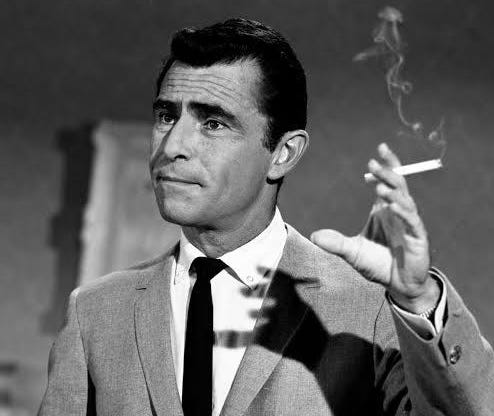
Rod Serling learned the hardest lesson in television early: the more truthful your story, the more people would work to kill it. What he did with that lesson changed American storytelling permanently.
Serling came to prominence in the early days of live television, writing acclaimed dramas like Requiem for a Heavyweight and Patterns — works that announced him as one of the medium’s most serious voices. He wrote for prestige anthology programs like Kraft Television Theatre and Playhouse 90, stages that seemed to promise real creative freedom. But freedom, he discovered, had a ceiling set not by editors or network executives, but by sponsors. In television’s first decade, a single company would often bankroll an entire program, which gave them enormous editorial leverage. They weren’t buying ad time. They were buying the right to shape content.
Two episodes taught him this with particular brutality. In 1956, he wrote “Noon on Doomsday,” a drama inspired by the Emmett Till murder — a racist killing in the South. Sponsors panicked. The setting was stripped of geography, the victim’s race erased, the moral center hollowed out. By airtime, Serling barely recognized his own work. Two years later he tried again with “A Town Has Turned to Dust” for Playhouse 90, another story about racial violence and accountability. Sponsors intervened again. The story was pushed back to the 1870s Southwest, the racial dynamics blurred beyond recognition. A Coca-Cola sponsor reportedly objected to the word lynch because it sounded too close to a competitor’s name. Whether or not that particular detail is apocryphal, Serling cited it often — because it perfectly captured the absurdity he was living inside.
He eventually said it plainly: he was not permitted to make his villains businessmen, politicians, or Southerners. Drama that couldn’t name real villains wasn’t drama. It was decoration.
The insight that followed was the making of him. Realism, he realized, was a trap — the more contemporary and grounded a story, the more pressure points it offered to anyone who wanted to defang it. But a story set on a distant planet? In a surreal alternate reality? That was nearly impossible to censor, because it was nearly impossible to prove it referred to anyone specific. Science fiction and fantasy weren’t escapes from serious commentary. They were the most efficient delivery system for it. The cage of early television didn’t break his voice — it taught him to throw it.
When The Twilight Zone premiered in 1959, Serling had his Trojan horse. “The Monsters Are Due on Maple Street” was a story about alien invasion that was actually about McCarthyite mob fear. “Eye of the Beholder” used a dystopian hospital to examine conformity and the tyranny of normalized ugliness. No sponsor could object that their brand was being tarnished by a critique of McCarthyism when the story was, on its surface, about extraterrestrials. The allegory gave him cover. It also gave his ideas a strange, lasting power — parable ages better than polemic.
But Serling wasn’t only looking backward at the political wounds of the 1950s. He was watching where the country was heading. And in one of the series’ final episodes, he proved himself not just a moralist but a prophet.
“The Brain Center at Whipple’s,” which aired on May 15, 1964, is set in the then-near future of 1967. Richard Deacon, best known for the Dick Van Dyke Show, plays Wallace V. Whipple, the owner of a vast Midwestern manufacturing corporation who decides to automate his entire plant — installing what Serling’s narration describes as “the historical battle between flesh and steel.” Tens of thousands are laid off. Whipple is coldly rational throughout, unmoved by any human cost. He regards his own father, who ran the factory for decades with loyalty to his workers, as a failure — the man only doubled production while competitors quadrupled theirs.
Three figures push back. His chief engineer appeals to moral obligation. A veteran foreman, so enraged he gets drunk and attacks one of the computer banks, is shot by Whipple himself — a nonfatal wound — to protect the machinery. When the engineer visits the foreman in the hospital, Whipple’s only concern is for his equipment. He fires the engineer too, replacing him with automated dictation machines, dismissing things like powder room breaks and maternity leave as inconvenient relics of a softer era.
What Serling understood, and what makes the episode more than a simple morality play, is that Whipple is not purely a villain. He is a mirror. The same logic that makes him monstrous — efficiency over empathy, output over obligation — is the logic that entire economies were already organizing themselves around. His sin isn’t unusual. It’s just concentrated. When his now-silent factory begins to unravel him, when the machines start echoing the parting words of his former employees back at him in a loop, when his board finally forces him into retirement as a man made obsolete by his own obsession, the irony lands with full force: he stripped others of their humanity and livelihood, and was stripped of his in return.
The episode’s final image is devastating. Robby the Robot — the iconic figure from the 1956 film Forbidden Planet — walks through Whipple’s old office, twirling Whipple’s own watch fob exactly as Whipple himself used to do. A man replaced by the logic he worshipped.
Serling closes with characteristic precision: “Too often, man becomes clever instead of becoming wise; he becomes inventive but not thoughtful. And sometimes, as in the case of Mr. Whipple, he can create himself right out of existence.”
It is a 25-minute prophecy. Scenes from the episode were later featured in the Smithsonian Museum of American History’s “Information Age” exhibit, which ran from 1990 to 2006 — a testament to how accurately Serling had read the trajectory of automation decades before the word disruption entered the business lexicon. The episode draws a direct parallel to his earlier “The Obsolete Man,” though where that episode locates the cause of human obsolescence in totalitarianism, “Whipple’s” locates it in capitalism — a distinction that felt radical in 1964 and feels, if anything, more pointed today, as artificial intelligence begins displacing not just factory workers but the professional classes Whipple himself represented.
Serling’s central concern, across all of it — the censorship battles, the allegories, the prophecies — was that people were becoming pawns of large, impersonal forces that moved around them and crushed them without recourse or appeal. He found, in the genre his censors inadvertently drove him toward, the perfect language for that concern. The sponsors who gutted his early work believed they were neutralizing him. Instead, they handed him a method that would outlast all of them.
Watch: The Brain Center At Whipple’s
To this day, I watch "Twilight Zone" reruns. I am amazed at how prevalent the episodes are in our day and age. Mr. Serling had foresight beyond clairvoyance. My favorite episode is "The Night of the Meek." Thanks, Bret.
Mnnn, I remember really looking forward to his show. His and the Smothers Brothers. The rest I don't remember, that how much of an impression they left. Oh yea, The Inner Sanctum and reruns of Studio 57. But his, I remember most of all. Had no idea, though, how he morphed into science fiction.