

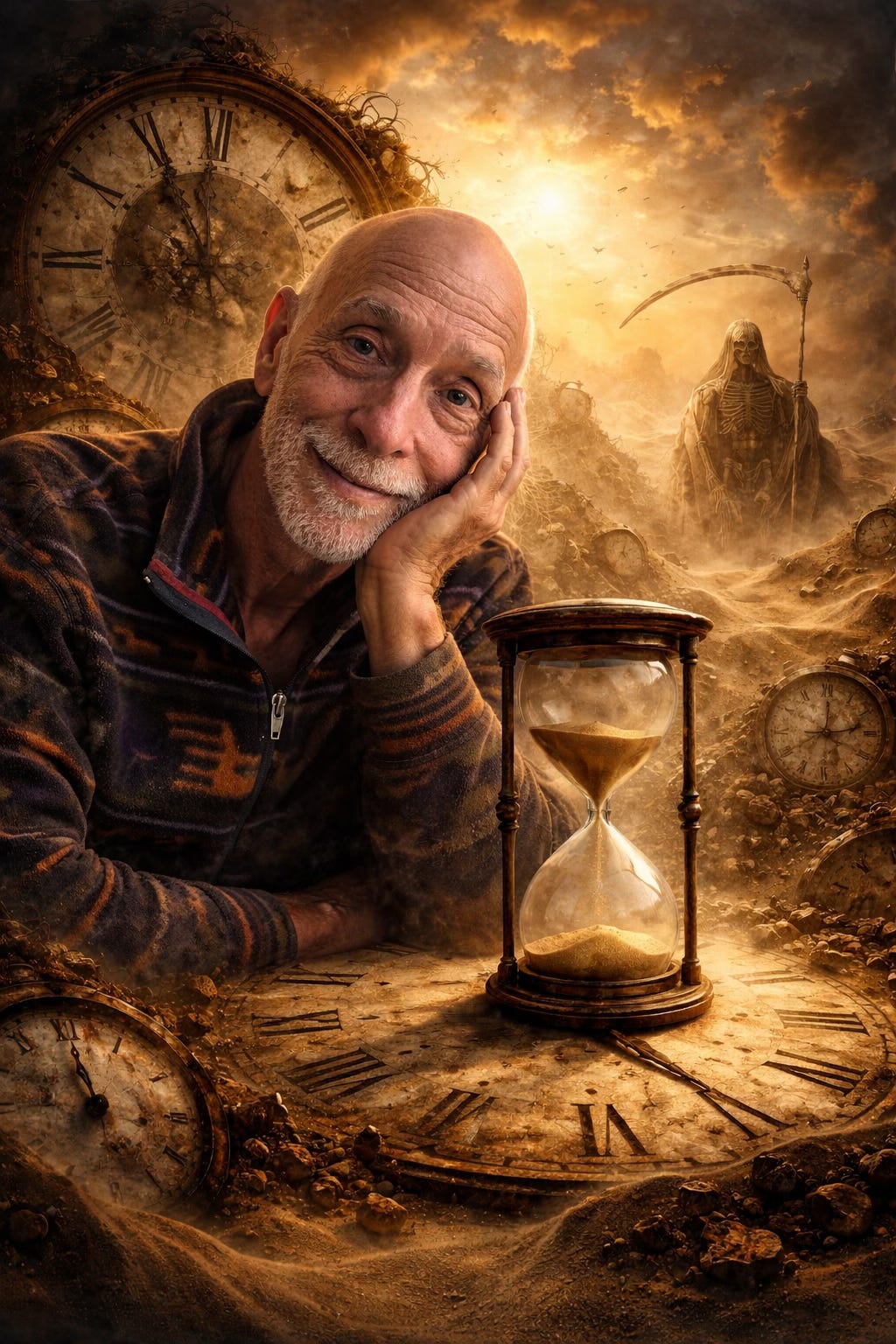
On August 1, I turn seventy-seven. I’ve been sitting with that number, rolling it around, trying to decide what it means. The answer, I think, is both everything and nothing. A number is just a marker. What it points to — that’s another matter entirely.
At the core of my existence — now and always — lie two inseparable elements: mind and body. And hovering above both of them, two things that have quietly risen to the top of the importance list in a way they never quite did before: time and health. Not money. Not status. Not what people think of me. Time and health. It’s clarifying, really, when the clutter falls away.
The body keeps score
My body tells me I’m old. Not rudely, not all at once — but persistently, in the way an honest friend delivers uncomfortable news. I’ve survived prostate cancer. I’ve survived open heart surgery. Sixty years ago, those two sentences together would have been an obituary, not a paragraph in a birthday essay. I know, without any ambiguity, that modern medical technology is the reason I’m sitting here writing this. That’s not a small thing. That’s everything. And I carry a genuine gratitude for it — not the performed, greeting-card kind, but the deep, quiet kind that surfaces when you really understand how close the margins were.
It’s only been in the past three or four years that I look in the mirror and see an old man looking back. For a long time, the person in the mirror lagged behind the calendar — younger than the math suggested, still recognizable as some earlier version of myself. That gap has closed now. The old man is there, no question. But here’s what surprises me: it doesn’t bother me the way I imagined it would when I was younger and thought about it hypothetically. I’m not a model. I’m not in the market for a new partner. I don’t make my living from the way I look. And with Sherrie, I am in the best relationship of my life — the kind that makes the mirror largely irrelevant. So what do I have to prove to my reflection? Nothing. We’ve made our peace.
I try to exercise regularly — walking at least thirty minutes a day, lifting weights five times a week. I’m careful about what I eat. I take it seriously. And yet, despite all of that, I can feel the decline. Not dramatically, not catastrophically — but unmistakably. Less energy than I had five years ago. Sleep that’s shallower and less reliable. The need for breaks during walks that I would have laughed at a decade ago. And a slower healing time that nobody warned me about with any real clarity. Cut yourself, strain something, catch a cold — and the recovery that once took days can now takes weeks. The body is less forgiving of itself than it used to be.
This is all normal. I know that. I’m not chasing immortality. I gave up on fame and fortune long ago. I’m simply trying to stay in the best shape I can so that these final chapters of my life are worth reading — to myself, and to the people I love.
The mind and its locked files
As for my mind: the main symptom is that memory has become unreliable in ways it wasn’t before. Not gone — I can still remember quite a bit, sometimes with an almost embarrassing precision. But nearly every day, there’s something that escapes me. A name. A place. An event. I know the information is there — I can feel it the way you feel a word sitting just behind your tongue — but I can’t retrieve it on demand. It’s a file that won’t open. The system is running. The data exists. But the access is temporarily denied.
And then, twenty minutes later, it opens. Unbidden, while I’m doing something else entirely — the name pops into my head, or the title of the film, or where I was when that thing happened. The retrieval system still works. It’s just no longer instant.
I’ve made a kind of peace with this too, though it took some adjustment. The mind, at seventy-seven, is not what it was at forty. But it’s still a remarkable thing. It still makes connections, still gets curious, still finds ideas genuinely interesting. That, I think, is what matters most.
The perspective that only age can buy
What I didn’t expect — what no one really told me about aging — is the perspective. The strange, sometimes brutal, sometimes beautiful vantage point that comes from having lived long enough to see your own life as a story, with a beginning, a middle, and a visible horizon.
I’ll think about something — a decision I made, a road I took — and realize: that was fifty years ago. Half a century. And the question that follows is almost always the same: What the hell was I thinking? When I arrived at a crossroads, why did I go left instead of right? What possessed me? What was I afraid of? What was I reaching for?
Some of my mistakes I recognized quickly and corrected. Some I had to make four or five times — as if I needed repeated exposure to the lesson before it would finally stick. And some decisions, the ones I’d call the truly consequential wrong turns, I can now trace forward through decades of consequence. I can see exactly where the thread unraveled. That’s a strange kind of knowledge to carry. Not useful in any practical sense — you can’t go back and reknot the thread. But instructive, in the way that autopsies are instructive. You understand what happened, even if you can no longer change it.
What happens to people
One thing I haven’t fully reckoned with, even now, is the attrition. Most of the people I’ve known in my life are no longer here. Not most of the people I know now — most of the people I have ever known. That’s what seventy-seven looks like from the inside. The population of your life thins out. People you loved, people who shaped you, people whose voices you can still hear perfectly in your memory — gone. Some I miss with an ache that hasn’t dulled. They can’t be replaced. There’s a particular kind of absence that’s shaped exactly like a specific person, and nothing else fits it.
Over the years, I've watched many people deteriorate in ways I never anticipated. Age does surprising things. Some people become smaller versions of themselves — more fearful, more rigid, more diminished. Others seem to expand, to soften, to arrive at something like wisdom or grace. And some, frankly, just disappear slowly into confusion, or pain, or illness, in ways that are hard to witness and harder to accept. That’s the truth of the long view. You see what happens to people over the full arc of their lives. Not just the chapters they showed you. All of it.
What seventy-seven is
So what is seventy-seven? It’s a number on a calendar, yes — but it’s also a position. A particular spot in the landscape of a life from which you can finally see both directions clearly. Behind you, all those decades, all those choices, all those people, all that weather. Ahead, a shorter road with a horizon that’s no longer abstract. You can see it now. You let yourself see it.
I’m not afraid of it. Or rather — I’m no longer as afraid as I once was. Fear of death is loudest when you’re young enough to believe you can outrun it. At seventy-seven, you stop running. Not because you’ve given up, but because you’ve realized the running was never the point.
What I want now is simple, even if it isn’t always easy: to stay healthy enough to enjoy what’s left. To be present for the people I love. To keep being genuinely curious about the world.
And my creativity — that, I’m happy to report, shows no signs of slowing. If anything, it feels more alive than ever. I do some of my best writing in bed. Having AI as a collaborator has made the work easier and more fun — less a replacement for thought than an accelerant for it, a creative partner that doesn’t mind my hours or my tangents. And AI filmmaking is still in its infancy, just finding its legs, and I intend to be part of that story. The idea that I might be learning a genuinely new art form at seventy-seven strikes me as one of the better jokes the universe has told at my expense. I’m grateful for it.
As for the world itself — living in Mexico is one of the best decisions I have ever made. Not a perfect country; there isn’t one. But the people here are something. There is a warmth, a genuine humanity, that survives and even thrives here in ways I stopped expecting from the world. It lives in the importance placed on family — not as a concept, but as a daily, practiced reality. It lives in the way people greet each other, in the patience, in the color of ordinary life on an ordinary street. There is no twenty-four-seven news cycle grinding away at everyone’s nerves. There are just people — surviving, loving each other, finding pleasure in small things, living their lives with dignity no matter how little they have. That is not nothing. That is, in fact, quite a lot.
So here I am. Seventy-seven years old, body aging, memory occasionally unreliable, grateful beyond measure, still loving, still writing, still curious, still learning new things in a country that reminds me daily what actually matters.
The final frontier isn’t death. It’s figuring out, at last, how to live — and then doing it, for as long as you have.
I think I’m getting there. In fact, I know I am.
A wonderful description of my somewhat parallel life. I will be 72 in July and the clarity you describe is beginning to show itself. As a result, I have become very guarded with respect to time. That, health, and relationships are now front. I am grateful for arriving at this point in my life. The good is outweighing the rest. Thanks for the salient reminders, Bret. Es un privilegio conocerte.
Reading this at 25 is incredibly humbling. I find myself constantly rushing running to work, worrying about whether I’m building enough, or falling behind. I question everything: what it all means, why life has to be this way, and whether the constant hustle is worth it.
Your words made me pause. They reminded me how easy it is to overlook the simple, meaningful moments while chasing something that may never truly satisfy. There’s something deeply peaceful and almost ethereal in the perspective you’ve shared.
Wishing you continued health and many more days filled with things worth cherishing. Thank you for this.