

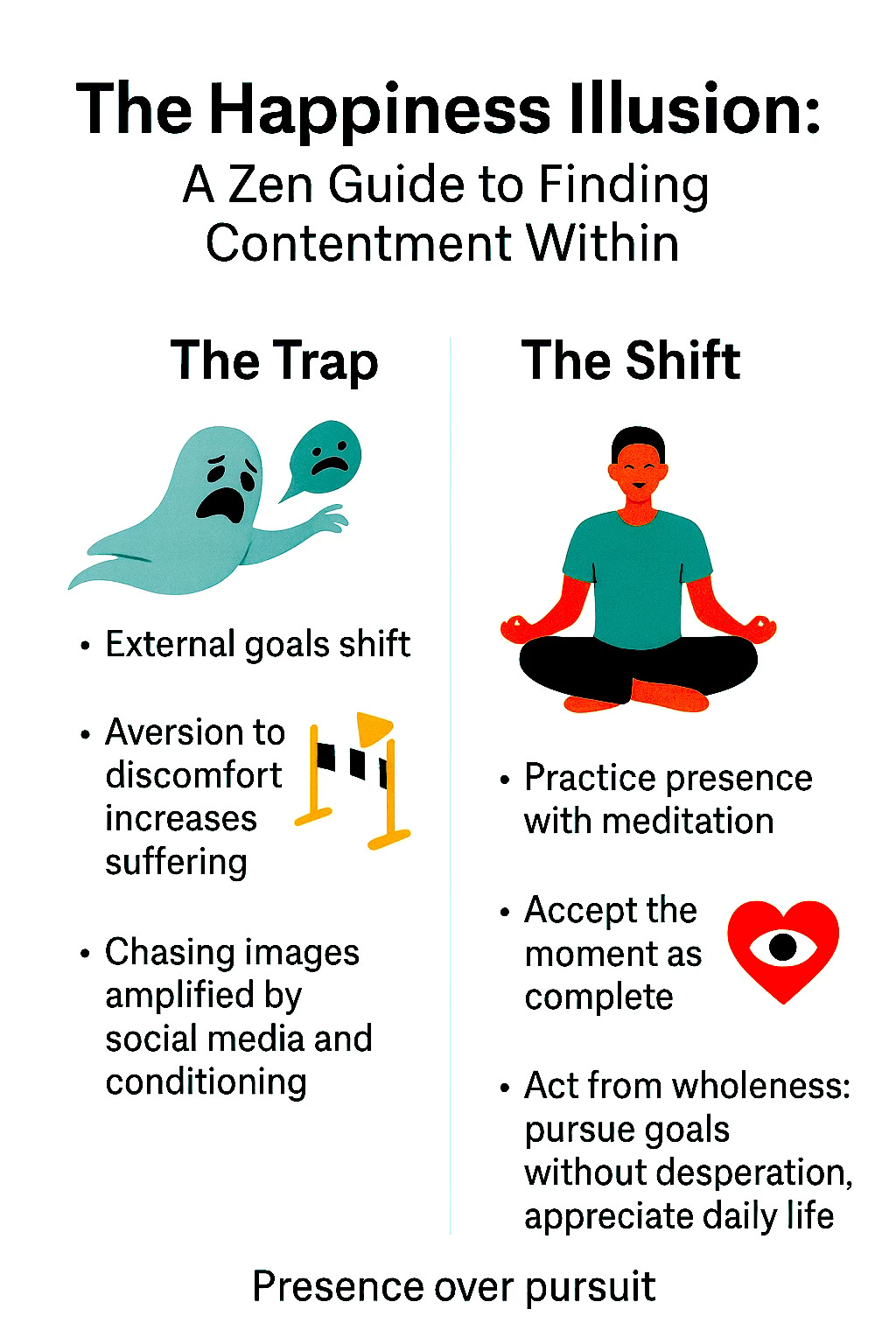
The Zen teaching about our illusions of happiness reveals a fundamental pattern of human suffering: we persistently believe happiness exists somewhere outside ourselves, waiting to be captured through the right combination of circumstances, achievements, or acquisitions.
This illusion manifests in endless variations. We convince ourselves that happiness will arrive when we get the promotion, find the perfect partner, reach a certain bank balance, or finally receive recognition for our work. Even when we achieve these goals, the satisfaction proves fleeting. The promotion brings new pressures. The relationship reveals unexpected challenges. The bank balance seems insufficient compared to new desires. The target keeps moving, always just out of reach.
Zen identifies this pattern as a fundamental misunderstanding of consciousness itself. We project our internal sense of incompleteness onto external objects and situations, believing they contain the satisfaction we seek. This projection creates what Buddhists call “hungry ghosts” - beings with enormous appetites but tiny mouths, never able to consume enough to feel satisfied. We mistake temporary pleasure for lasting happiness, not recognizing that the new car’s excitement fades within weeks, the vacation ends, and we return to the same restless searching with updated targets.
Beyond seeking pleasure, we create equally powerful illusions about avoiding unhappiness. We imagine that preventing certain experiences - rejection, failure, aging, loss - will ensure contentment. This aversion creates its own suffering as we exhaust ourselves trying to control the uncontrollable, building elaborate defenses against life’s natural movements without recognizing that our resistance creates more pain than the experiences themselves.
Social conditioning reinforces these illusions from birth. Cultural narratives about success, romance, and fulfillment shape our expectations before we can examine them. We measure our lives against inherited stories, feeling deficient when reality doesn’t match the script. Social media amplifies this by presenting curated versions of others’ lives, making our own experience seem inadequate by comparison. We absorb these messages so deeply that we can’t distinguish between our authentic desires and what we’ve been programmed to want.
These illusions serve a psychological function. They provide hope, direction, and motivation while helping us avoid confronting the raw uncertainty of existence. As long as we’re chasing the next thing that will complete us, we don’t have to face the possibility that nothing external ever will. The illusion protects us from existential vertigo - the dizzying recognition that life offers no ultimate guarantees or permanent solutions.
But this protection costs us dearly. We spend decades, even entire lifetimes, pursuing mirages. We make major life decisions based on imagined future happiness, only to discover we were chasing phantoms. We sacrifice present experience for promises that never materialize as expected, missing the actual texture of our lives while focused on an imagined better version.
Meditation reveals these illusions through direct observation. Sitting still, watching thoughts and sensations arise and pass, we notice how the mind constantly generates stories about what’s missing and what would complete us. We see how happiness and unhappiness come and go regardless of circumstances. We recognize that our deepest contentment often arrives in moments when we’re not seeking anything at all - the unexpected phone call from an old friend, the sudden beauty of afternoon light, the simple satisfaction of completing a mundane task.
This doesn’t mean external conditions don’t matter. Zen isn’t suggesting that poverty and wealth, sickness and health, loneliness and connection are equivalent. Rather, it points out that our happiness depends far more on our relationship to these conditions than on the conditions themselves. Two people in identical circumstances can experience vastly different levels of contentment based on their internal orientation. The wealthy person consumed by anxiety about losing their fortune may suffer more than someone with modest means who feels basically secure.
The illusion extends to spiritual seeking itself. We can turn enlightenment into another object to acquire, another achievement that will finally make us happy. This “spiritual materialism” transfers the same grasping pattern to a subtler level. We collect teachings, experiences, and insights, still believing happiness exists somewhere we haven’t yet reached, turning even the path to freedom into another form of bondage.
Breaking through these illusions doesn’t mean becoming passive or indifferent. It means recognizing that happiness emerges from accepting the present moment fully, including its incompleteness. This acceptance doesn’t preclude working for change or improvement, but shifts the foundation from “I’ll be happy when...” to “I can be present with what is while moving toward what might be.”
The radical proposition is that what we’re seeking is already here, obscured by our constant seeking. The happiness we project onto future conditions is available in immediate experience, but we can’t see it through the fog of our illusions. Consciousness itself, when not filtered through stories of lack, contains an inherent completeness. This isn’t about settling for less or spiritual bypassing - it’s recognizing that the peace we seek through acquiring and achieving is actually found in the quality of presence we bring to each moment.
This understanding transforms how we engage with life. Instead of using present experience as a stepping stone to future happiness, we can appreciate it directly. Goals and desires continue, but lose their desperate quality. We pursue what calls to us without believing our fundamental wellbeing depends on the outcome. Paradoxically, this often leads to greater external success, since we’re acting from wholeness rather than desperation, making clearer decisions and taking more effective action when we’re not driven by the anxiety of incompleteness.
Some Ideas On Meditation
My thoughts are not
I
more like I
am driving down a highway
while thoughts pass like billboards…
as I leave downtown
billboards disappear
and the mind is quiet:
or…uh oh! there’s another one.
Hard to ignore
billboards
when they have sexy images
and the road is nearly deserted:
almost…damn! there’s another one.
Even this idea, this poem
interrupted me, got me up
from my cushion to write.
Ah, I still can't come to terms with consciousness. Is it us, or are we it? Is it Jungian or is it as much of an illusion as perhaps life itself?