

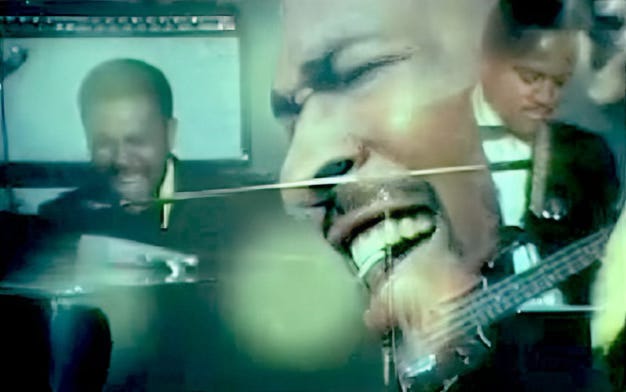
The collaboration between Marvin Gaye and James Jamerson on “What’s Going On” represents one of the most significant partnerships in popular music history.
By 1971, both men were at creative crossroads. Gaye was fighting Berry Gordy for artistic control, wanting to move beyond love songs to address social issues: the Vietnam War, police brutality, environmental destruction, and urban poverty. Jamerson, meanwhile, had refined his bass playing into something approaching high art, creating melodic lines that functioned almost as a second lead instrument. He had absorbed the vocabulary of jazz bassists such as Paul Chambers and Ray Brown, translating their harmonic sophistication into the pop idiom.
When Gaye brought “What’s Going On” to the studio, Jamerson was initially reluctant. According to legend, he was coaxed into the session and played the iconic bass line while sitting on the floor, possibly intoxicated. Some say he was flat on his back and had been reluctant to come to the session. But he still played great. Whether that story is embellished or not, what he created was revolutionary: a fluid, jazz-influenced bass line that weaves through the song with unusual freedom, answering and commenting on the vocal melody rather than simply anchoring the rhythm.
The bass doesn’t just support the track, it converses with it. Jamerson’s line has a lyrical quality that matches Gaye’s vocal approach, both men working in a more open, atmospheric style than typical Motown production. Where conventional bass playing marks time and outlines chord changes, Jamerson creates countermelody. He plays in the spaces between Gaye’s phrases, filling silences with commentary. When Gaye sings “Mother, mother, there’s too many of you crying,” Jamerson’s bass responds with a descending phrase that sounds almost mournful, as if validating the grief in the lyrics.
This isolated recording reveals the intricate choreography between voice and bass. Jamerson doesn’t simply follow Gaye; he anticipates where the vocal will go, sometimes arriving at a melodic destination just before the voice does, other times hanging back to let the lyric land in silence. When Gaye’s voice rises in questioning what’s going on, Jamerson’s bass often descends, creating harmonic tension that mirrors the confusion and searching in the words. The two men are engaged in call and response, but it’s subtle, sophisticated, more conversation than echo.
The restraint both artists demonstrate is equally important. Jamerson had the technical facility to play far more notes, to fill every measure with virtuosic runs. Instead, he chooses economy, allowing individual notes to breathe and resonate. Gaye, too, sings with unusual spaciousness, his phrasing relaxed and conversational rather than declamatory. Both men understand that silence carries weight, that the spaces between sounds can communicate as powerfully as the sounds themselves.
The entire “What’s Going On” album showcased this deeper musical relationship, with Jamerson’s bass providing emotional undercurrent to Gaye’s social commentary on “Mercy Mercy Me” and “Inner City Blues.” On “Inner City Blues,” Jamerson’s walking bass line has a relentless quality that mirrors the grinding poverty and desperation in the lyrics. On “Mercy Mercy Me,” his tone becomes almost elegiac, mourning the environmental devastation Gaye describes.
This represented Motown evolving from hit factory to artistic statement, with both Gaye and Jamerson pushing beyond commercial formulas toward something more personal and politically conscious. Berry Gordy initially refused to release the album, believing it was uncommercial and too political. He was spectacularly wrong. The album’s success validated their risk-taking and changed what was possible in popular soul music, proving that audiences would embrace art that treated them as thinking adults capable of grappling with difficult subjects.
The messages in “What’s Going On” resonate with eerie precision today. Gaye sang about brothers coming home from war traumatized and unwelcome, about police violence in Black communities, about environmental collapse, about economic inequality creating desperation in American cities. More than fifty years later, these remain urgent American realities. Veterans return from Iraq and Afghanistan struggling with PTSD and inadequate support systems. Police killings of unarmed Black citizens spark ongoing protests and demands for accountability. Climate change threatens human survival. Income inequality has reached levels not seen since the Gilded Age, with cities experiencing homelessness crises and failing infrastructure.
The question Gaye asked in 1971 remains unanswered in 2026: “What’s going on?” The song’s power lies partly in its refusal to provide easy answers or false hope. It simply bears witness, asking us to see what’s happening around us, to feel the weight of it, to recognize our shared humanity in the face of systemic failure. Jamerson’s bass line, with its combination of beauty and melancholy, reinforces this emotional complexity. The music doesn’t rage or despair; it observes with clear-eyed sorrow and persistent, quiet resistance.
In an era of algorithmic feeds and manufactured outrage, “What’s Going On” models a different kind of political art: patient, nuanced, more interested in questions than slogans. The isolated vocal and bass recording strips away production gloss to reveal two artists listening deeply to each other, creating space for genuine dialogue. That model of attentive collaboration, of making room for another voice while maintaining your own integrity, feels both musically profound and politically instructive. It suggests that meaningful change requires this kind of careful listening, this willingness to respond rather than simply react, this understanding that the most powerful statements often come through restraint and precision rather than volume.
The recording endures because Gaye and Jamerson created something that transcends its moment while remaining rooted in specific historical pain. They made protest music that doesn’t sound dated because the protests continue. They made art about brokenness that refuses to break. And in isolating just these two voices, bass and vocal, we hear the essential truth: change begins in conversation, in two people finding a way to speak and listen simultaneously, creating something together that neither could create alone.
The "What's Going On" album represents the pinnacle of their collaboration, where Jamerson's bass work moved from supporting player to co-creator of the emotional and political landscape. By this point, both artists had the creative authority to push Motown's sound in more sophisticated, jazz-influenced directions.
Listen to just Gaye’s vocals and Jamerson’s bass on “What’s Going On.”
Listen to the complete original recording.
View a video of a live performances of music from What’s Going On with Marvin Gaye on piano and vocals, and, James Jamerson on bass.
a fine piece, Bret!
Ahhh it's been so long since I last listened to this brilliant piece! The vocals and the walking and talking bass only is just fantastic. The words here and there get veiled by the power of the music. This may be a personal thing, as I tend to ignore words in music as intrinsically alien elements. But the message of the words comes through anyway, in that beautiful voice, and thoughtful bass sounds. A bit like those Jasper Johns American flag paintings, that necessarily draw your gaze, until you realize they were painted on newspapers bearing reports of the Korean war. The text shimmering through the stars a stripes, revealing what's really going on...