

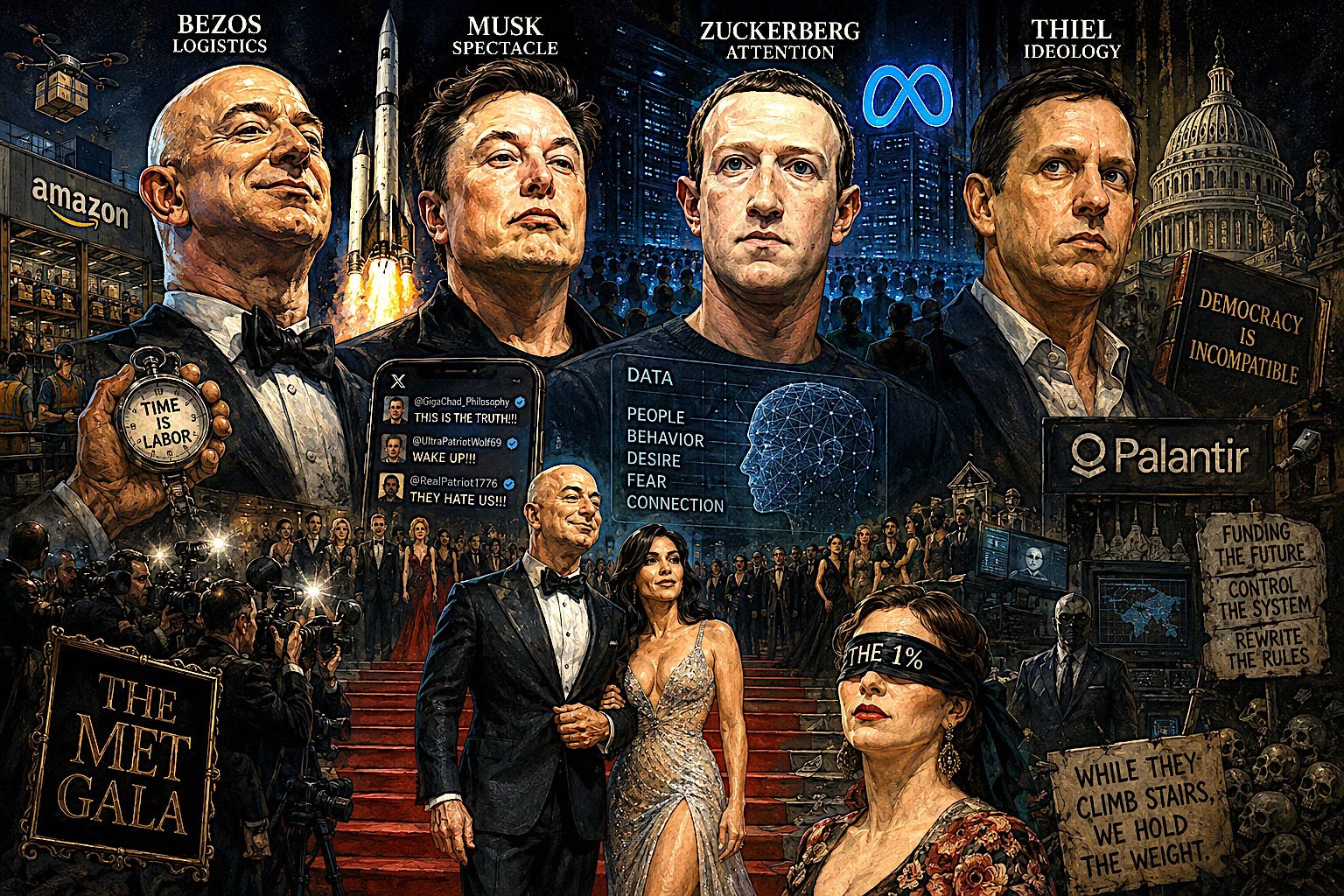
The Met Gala returned Monday night like a jeweled funeral procession for the American century, and there waddling up the marble staircase came Jeff Bezos, swollen with protein powder, compound interest, and the unmistakable glow of a man who has not heard the word “no” since the Bush administration. He looked less like a human being than a refrigerated pharmaceutical executive carved from warm candle wax. The tuxedo strained against him heroically. The neck had expanded another three inches since last season. Somewhere in America, a warehouse employee got written up for taking an eleven-minute bathroom break so this neck could continue evolving toward its final form.
The cameras erupted.
Photographers screamed his name with the desperate energy of medieval peasants witnessing a king distribute bread during a famine. Flashbulbs detonated across the staircase while Bezos grinned the grin of a man who knows every camera pointed at him was manufactured, shipped, warehoused, marketed, monetized, and algorithmically delivered inside a system he owns pieces of.
Lauren Sanchez floated beside him wrapped in enough fabric, diamonds, and strategic engineering to finance a regional hospital. Together they resembled a luxury escape pod launched from the dying atmosphere of late capitalism. They did not walk the carpet so much as audit it.
And the beautiful thing, the truly deranged thing, is that everybody played along.
Actors. Influencers. Fashion reporters. Men in tuxedos shaped like chess pieces. Women balanced on heels engineered by sadists. All orbiting the staircase while Manhattan flooded itself in champagne and moral surrender. The Met Gala has stopped pretending to be a charity event. It is Versailles with Wi-Fi. A yearly census of people who believe collapse is something that happens to other countries.
But Bezos is only one horseman.
The others haunt the perimeter like radioactive weather systems.
Elon Musk skipped the event, possibly because even he understands there are limits to how much psychic damage one republic can absorb in a single news cycle. Still, his presence lingered over the evening like the smell of burning circuitry. Musk exists now as a permanent hallucination projected directly into the bloodstream of the culture. Every hour brings another transmission from the command bunker. One minute he is reposting conspiracy theories from accounts named things like UltraPatriotWolf69. The next he is threatening governments, insulting advertisers, launching rockets, firing engineers, fathering children, or announcing plans to colonize Mars while his car company slowly transforms into a case study for what happens when the CEO becomes more volatile than the stock.
This is no longer business.
This is performance art funded by federal contracts.
Musk has transcended billionaire status and entered the realm of unregulated mythological creature. The man sleeps three hours a night, communicates primarily through memes, and governs public discourse from a social media platform that now resembles a bus terminal bathroom during a regional blackout. But never mistake the chaos for stupidity. Chaos is leverage. If the public spends every waking hour reacting to Elon Musk, then Elon Musk controls the rhythm of public attention, and attention is the only currency left with any real exchange value.
Then there is Mark Zuckerberg, who remains perhaps the most terrifying because he learned long ago that charisma is inefficient. Zuckerberg has spent twenty years transforming himself into the physical embodiment of a terms-of-service agreement. Blank expression. Dead calm. No readable emotional signature. Somewhere deep behind those eyes sits a machine counting human impulses like poker chips.
Three billion people volunteer their private lives into his system daily. Divorces. Birthdays. Political radicalization. Nervous breakdowns. Adulteries. Birthday cakes. Race riots. Cat photos. Revolutionary movements. Everything goes in. Nothing leaves without being converted into behavioral data.
The old robber barons stole oil, railroads, steel.
Zuckerberg figured out how to mine loneliness.
And while the public argues about social media addiction like nervous parents discovering cigarettes, Zuckerberg quietly purchases Hawaiian land and constructs a compound large enough to survive societal decomposition. He is not planning for the future. He is planning for the aftermath.
Which brings us to Peter Thiel, the vampire intellectual lurking behind the curtain with a glass of red wine and a constitutional crisis folded neatly into his jacket pocket.
At least Thiel has the decency to say what he believes out loud.
He looked at democracy and concluded it was inefficient. Most billionaires believe this privately. Thiel published essays about it. He funds candidates, surveillance companies, legal networks, and ideological infrastructure with the detached calm of a man assembling furniture. Palantir alone sounds less like a corporation than the central computer system from a fascist science-fiction film banned in Scandinavia.
Thiel does not want to dominate the existing system. He wants a replacement system. A cleaner one. Smaller. More obedient. A world managed by technical elites and protected enclaves while the public fights culture wars in the digital ruins.
And these men, despite the tabloid narratives, are not enemies.
They are different departments of the same empire.
Bezos controls logistics. Musk controls spectacle. Zuckerberg controls attention. Thiel controls ideology. Put them together and you have the full operating system for a civilization entering its late imperial hallucination phase.
The terrifying part is not secrecy.
The terrifying part is disclosure.
They keep telling everyone exactly what they are doing. They give interviews. They write essays. They fund projects openly. They buy newspapers, satellites, platforms, politicians, data streams, and survival bunkers in broad daylight while the public responds by asking whether the tuxedo looked flattering under the lights.
At one point actress Sarah Paulson described her outfit as “the one percent,” which may have been the most honest sentence spoken all evening. She wore a blindfold with the ensemble, a gesture balancing somewhere between satire and confession. The crowd applauded. Cameras flashed. Champagne flowed. Then the limousines carried everyone back into Manhattan while outside the velvet perimeter ordinary people continued performing economic acrobatics to afford groceries and rent in cities increasingly owned by investment firms and men with orbital ambitions.
History notices these things eventually.
Empires always believe they invented permanence right before discovering gravity still works.
And somewhere in Hawaii, Zuckerberg is reportedly building walls thick enough to survive whatever comes next, because unlike the others, he appears to understand that history is not a ladder. It is a trapdoor.
The billionaires keep climbing the staircase anyway.
Maybe they believe money changes the ending.
Maybe nobody around them has the courage to explain otherwise.
Or maybe the Met Gala is exactly what empires look like in the final act. Diamonds flashing under chandeliers while the foundation quietly catches fire beneath the floorboards.
Excellent piece.
Jeeze-us, I love your writing. If the illustration is to be believed, they all have the mini cleft dimple on their chins. On a more serious note, despite my general optimism about the potential of humanity to transform our current trajectory, I must admit your piece, scary as it is, accurately describes exactly what we are “up against.“ Sadly, these guys are not inventions (like bogeymen, invented to frighten children into good behavior.) They’re products of our culture; a culture where possessions count more than relationships, where anger is (often intentionally) misplaced and ignorance of the interconnected nature of all things prevails. Greed, anger and stupidity — the Buddha identifies these as the root causes of suffering and the obstacles to spiritual liberation. (3 poisons) Thank you for shedding light on these tragic figures… serves as a reminder to ponder deeply ways I /we can affect the changes we need to survive this era.