

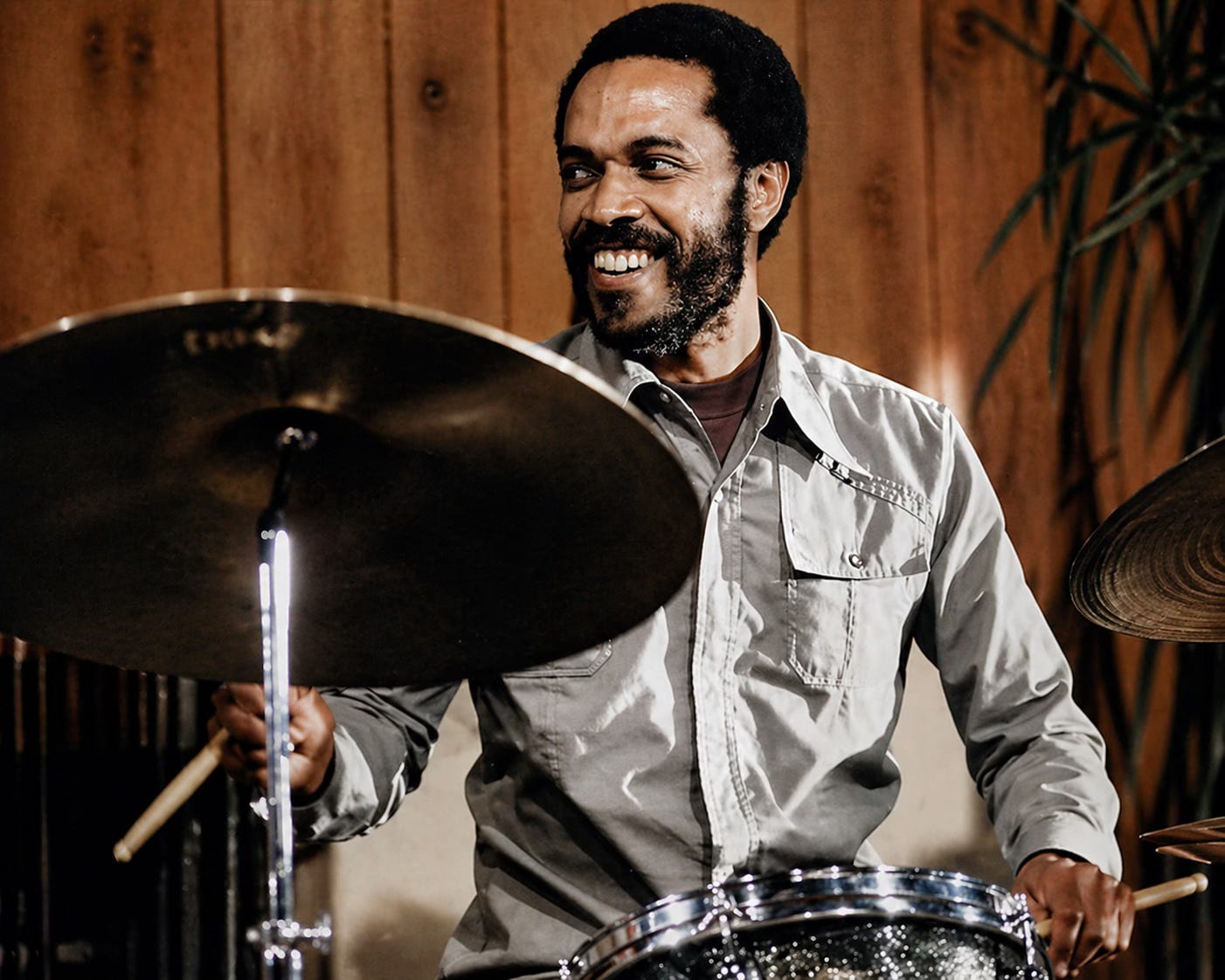
Musicians called him Smiling Billy, and the name was a plain description. Billy Higgins smiled behind the drums the way other drummers sweat. The smile was there every night, at every tempo, on every one of the roughly 700 records he made. Ron Carter, who played bass beside nearly everyone, called Higgins the drummer of the 20th century who put the music back into the drums. Then Carter said something simpler: “He made the music feel good.” That is the whole subject here. How does a drummer make music feel good, and why did everyone want him to do it for them?
I saw Billy play several times with Cedar Walton and Clifford Jordan at Sweet Basil in Greenwich Village. His enthusiasm was contagious, his swing irresistible. He lifted everyone on the bandstand and carried the whole club with him. You didn’t just listen—you were swept into the joy of it.
Start with “Lonely Woman.” It opens Ornette Coleman’s The Shape of Jazz to Come, recorded in 1959, and it still sounds unsettled. Coleman and Don Cherry play a slow, aching melody, close to a lament. Underneath them, Higgins plays fast. His cymbal runs at twice the speed of the horns, light and relentless, so the record moves at two tempos at once. The grief floats. The pulse drives. None of it should work, and it is one of the most beautiful records in jazz.
That is Higgins in one track. Coleman was asking musicians to give up chord changes and follow the melody wherever it went. To most listeners in 1959 the result sounded chaotic. Higgins kept time crisp enough for anyone to feel and loose enough to turn with every move Coleman made. He was the part of the revolution a skeptic could hold on to.
He came to it from Los Angeles, where he was born on October 11, 1936, and he came up in rhythm and blues. As a young man he played with Amos Milburn and Bo Diddley and backed Brook Benton, Jimmy Witherspoon and Sister Rosetta Tharpe. Keep that in mind. It comes back.
By 1957 Coleman was rehearsing his new music with Higgins and Cherry. In late 1959 the quartet arrived in New York for its legendary run at the Five Spot Café, and jazz split in half. Miles Davis dismissed Coleman. Leonard Bernstein championed him. Critics argued for years. Almost nobody argued about the drummer.
Around 1961, a drug arrest cost Higgins his New York cabaret card, which kept him out of the clubs and ended his time with Coleman. He went into the studio instead, and he stayed. He became the unofficial house drummer at Blue Note Records during the label’s greatest decade. He is on Dexter Gordon’s Go!, Herbie Hancock’s Takin’ Off, Jackie McLean’s A Fickle Sonance and Lee Morgan’s The Sidewinder.
Here is where the rhythm and blues comes back. Put on the title track of The Sidewinder. Higgins lays down a groove that owes as much to the bands of his youth as it does to bebop: a backbeat phrased by a jazz drummer. It helped make The Sidewinder a crossover hit, a Blue Note record that reached the pop charts. The same drummer who held “Lonely Woman” together made a jukebox record swing. That is range. Ornette Coleman on one side, a pop hit on the other, and then decades more with Cedar Walton, Pat Metheny and Charles Lloyd, plus sessions in rock and funk. He is often called the most recorded drummer in jazz history. Whatever the exact count, few players were wanted in so many rooms.
Why was he wanted? Listen for what he leaves out. He doesn’t bury a soloist under fills or stop the music to show you his hands. He listens, and when a soloist leans, he leans with him. The DownBeat writer Ted Panken described his cat-like reflexes and his command of dialogue, his gift for finding the right tone for every beat. Charles Lloyd, who played with him through his final years, called him a Zen master and said everybody who played with him got that ecstatic high. None of these musicians were describing technique. They were describing how it felt to sit next to him.
That feeling had a long run in Cedar Walton’s trio, which Higgins anchored from the 1970s into the late 1990s. It had a home, too. In 1988 Higgins and the poet Kamau Daáood founded the World Stage, a storefront in Leimert Park, Los Angeles, where young musicians came on Monday nights to learn by playing. Higgins brought major artists in to perform and teach, and he taught at UCLA as well. A man who spent his career making other musicians sound better spent his last chapter making them better.
In 1996 Higgins had a liver transplant. It failed, and he needed a second one within a day. He went back to work. He kept playing and teaching for five more years. When he died in Inglewood on May 3, 2001, of liver and kidney failure, he was 64 and waiting for another transplant.
Go back to “Lonely Woman.” This time, ignore the horns. Listen to the cymbal underneath them, quick and light and steady, holding up a song about loss. That is a man who found joy in the hardest music of his time and handed it to everyone on the bandstand. Listen long enough and you can hear him smiling.
In jazz, the right drummer is essential, whether in a trio or a big band. My late friend Freddie Waits called the drum kit “the multiple percussion instrument,” a description that captures its enormous possibilities. Swing is fundamental, but there are countless ways to make the music swing. The great drummers each find their own—and Billy Higgins had a sound and feel you could recognize no matter what he was playing.
Watch “It’s About Time” featuring Art Farmer, Cedar Walton, Ron Carter and Billy Higgins, recorded live at Sweet Basil in 1990.
Listen to “The Sidewinder” from 1963 featuring Lee Morgan on trumpet, Joe Henderson on tenor saxophone, Barry Harris on piano, Bob Cranshaw on bass and Billy Higgins on drums.
Next Tuesday: Shirley Clarke - First Then Forgotten
Shirley Clarke brought the rhythm, risk, and freedom of jazz to filmmaking, creating work that challenged how we see Black life, identity, and the uneasy relationship between a camera and its subject. From The Connection to Portrait of Jason and Ornette: Made in America, I look at a pioneering filmmaker whose originality helped push American cinema forward—and why a culture eager to celebrate male directors left her standing in the shadows.
I first really tuned-in to Billy on Hank Mobley's album Dippin'. In the early 1990's I had the great fortune to see him with Cedar and David Williams for several nights during their residencies at the Milestones Club in San Francisco.
Here are two radio recordings I made of that Cedar Walton Trio around the same time...
https://archive.org/details/cedar-walton-trio-1988-kjaz-sees-sunday-night
https://archive.org/details/cedar-walton-trio-1989-yoshis-berkeley-kjaz
And one of the Timeless All-Stars...
https://archive.org/details/timeless-all-stars-berkeley-jazz-festival-1989-kjaz
The fine young jazz drummer Hank Allen-Barfield told me "Billy Higgins is my favorite drummer ever!" So Billy's legacy lives on.
It’s such a pleasure to read jazz writing where the prose itself is coherent with the beauty of the music it describes.z