

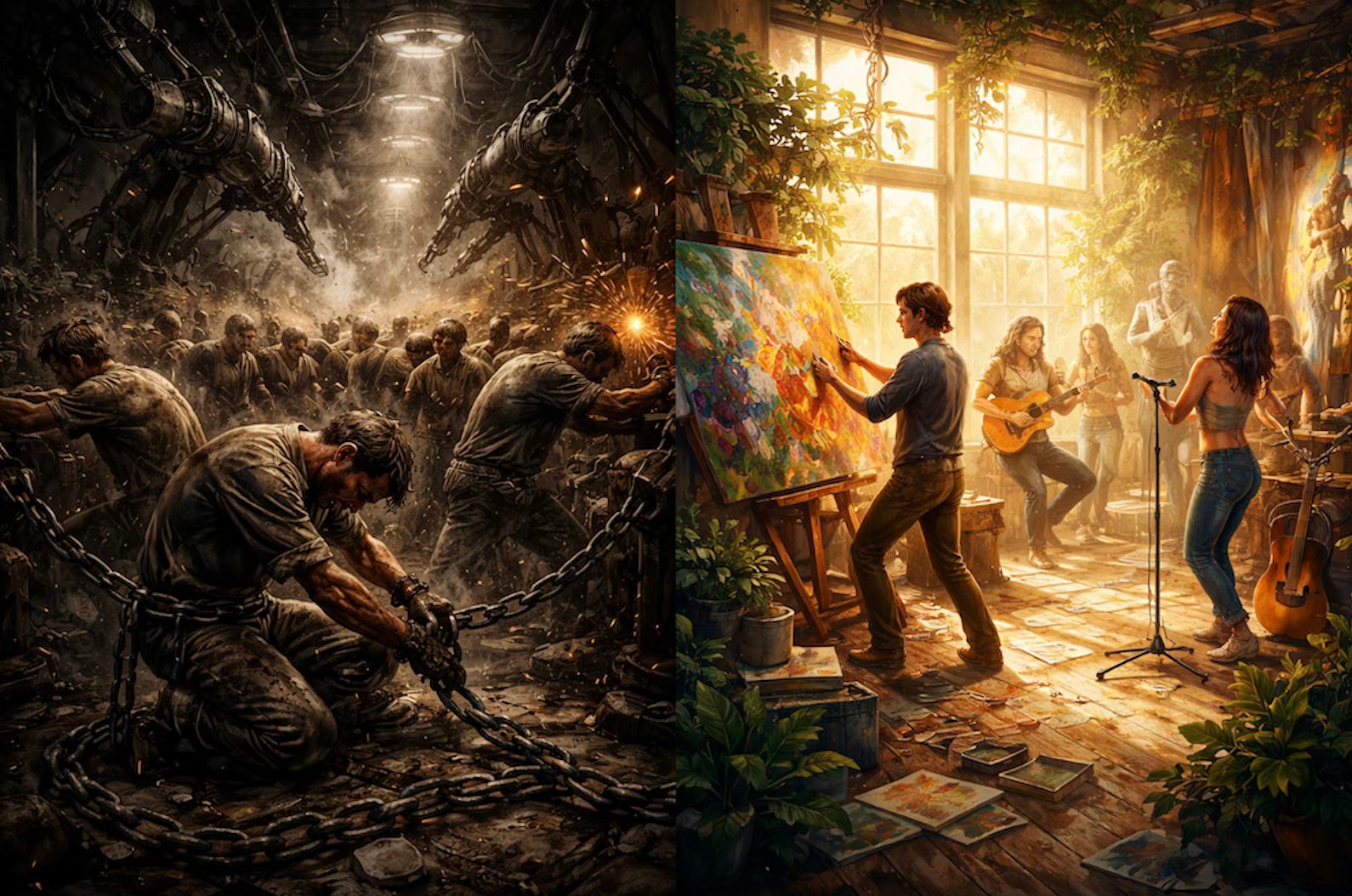
There is a question underneath the AI jobs conversation that almost nobody is asking. Everyone is focused on the disruption, the displacement, the frantic scramble to retrain and adapt and stay relevant. But the deeper question is this: what if the disruption is not the problem? What if it is the answer to a much older problem, one we have been living inside for so long we stopped being able to see it?
Let me back up.
New technologies rarely arrive as pure causes. More often they arrive as effects. A culture reaches a kind of readiness, builds up a pressure, creates a vacuum, and then a new medium or technology rushes in to fill it. The printing press did not invent the Protestant Reformation; the Reformation needed the press and called it into being. Television did not create the consumer society; the consumer society required television and conjured it.
So when I look at AI arriving at this particular moment in history, I do not think it is coincidental. I think we are at the end of something very long. The eight or nine century arc of capitalism, with its engines of abstraction, extraction, and colonialism, has been running out of road for decades. And if we are genuinely at the end of that era, then we are also, necessarily, at the end of the era of employment as we have known it.
And here is the thing I keep returning to: maybe that is exactly what needs to end.
For the entire lifespan of capitalism, human labor has been the axis around which everything else rotates. Not human beings. Human labor. The system was never designed to embrace people. It was designed to extract from them. Your worth under this arrangement has always been a function of your economic output. How much can you produce? How much of your finite time on earth can be converted into revenue for someone else? A person’s value, in the capitalist ledger, is almost entirely a function of their capacity to generate returns.
This is not a neutral arrangement. It is a profound distortion of what it means to be alive.
The parent sitting with a sick child generates no GDP. The elder passing down oral tradition to grandchildren produces no quarterly return. The artist making work that will not sell, the neighbor who fixes fences and shares food, the friend who talks someone through a dark night: none of these register in the system as having value. Only commodifiable labor counts. Everything else is invisible, or worse, sentimental.
Capitalism did not invent this reduction of human worth to productive output. But it perfected it. Over centuries, it built entire legal, cultural, and psychological architectures around the idea. We internalized the logic so completely that we began measuring our own worth in the same currency. We apologize for not being productive. We feel guilt about rest. We define ourselves by what we do for money rather than who we are in the world.
Now AI is coming for the jobs. Not the super-creative ones, not yet. Not the high-touch, deeply human ones. It is coming for the vast bureaucratic middle of modern economic life. The processing, the sorting, the scheduling, the approving, the monitoring. The machinery of managed existence. And the people who built that machinery are beginning to notice a problem.
So, we have been quietly written out of the equation.
And here, I want to make an argument that I know sounds strange: what if that is actually a gift?
What if this moment is comparable to a slave population being released by owners who no longer have use for them? The indifference is real. The dismissal is real. But so is the opening it creates. We were not born to be their employees. We were not placed on this earth to service their bottom lines. The extraction of human labor was never a dignified arrangement, even when it paid reasonably well. It was always a reduction of the full complexity of human life to a single, monetizable dimension.
When the system no longer needs us as workers or consumers, something extraordinary becomes possible. We get to stop defining ourselves by its terms.
That reframe is not a small one. It is total.
For centuries the operative question has been: what are you worth? Now, freed from that machinery, we can finally ask the question that should have been primary all along. What are you for? Not in the economic sense. In the human one. What brings you into full aliveness? What do you want to understand before you die? Who do you love, and how well are you loving them? What do you know that only you can teach? What can you make, grow, cook, build, heal, or sing?
These questions have always been the real ones. The system just had us convinced otherwise.
So what do we do right now, in this strange transitional moment, when the old world is visibly dissolving but the new one has not yet taken shape?
We begin by unlearning the deepest lesson capitalism ever taught us: that we are in competition with each other. We were never truly in competition. That story was manufactured to keep us from noticing that the people above us in the hierarchy had far more in common with each other than any of us had with them, and that our actual survival depended on mutual aid, not rivalry.
We begin to explore what mutuality actually means in practice. We experiment with new models of collaboration and cooperation. We build economies organized around trust and proximity rather than extraction and scale. We rediscover what communities knew before capital arrived to monetize the whole arrangement: that human beings thrive through reciprocity. That the deepest satisfactions in life, raising children, caring for the dying, making art, tending land, building friendships that actually hold, have never required anyone’s permission and have never generated anyone’s profit.
This is not utopian thinking. Every human society before industrial capitalism organized itself primarily around these values. We are not being asked to invent something new. We are being invited to remember something very old.
The path forward will be difficult. Transitions of this scale are always painful, and the people with the most to lose from the old order will not release it gracefully. The coming decades will require struggle, solidarity, and the willingness to build new structures before the old ones have fully collapsed.
But here is what I hold onto: the most important things we can do, care for each other, create meaning, cultivate wisdom, build communities that actually hold, have never required their permission.
Now, finally, we may have the time to do them.
Late Stage Capitalism\
2026
Is this late stage capitalism?
People watching endless commercials disguised
as content, watching hypnotized
as the reasons to stay home multiply Covid
the madhouse of freedom, that’s America
where Freedom is ridiculous
and everyone’s opinion
matters, such a big deal, (your opinion)
I can give you a break, (I can I can), I can let you
go on about nothing, walk the streets with a sign
saying nothing, late stage capitalism
manipulated and focused greed,
through the screens, on the devices
helpless to disengage (what am I doing?)
late stage
helpless to engage (I’m doing this is what I’m doing)
capitalism, schism, minimism, monism
monetism, hypnotism, religionism
late stage catechism
I’ve run out of ism, run out of my ism, don’t even say it
cuz I’m old and getting older at the same speed as
everyone else.
This is late stage capitalism.
I do think the end result of AI is most likely going to be catastrophic for us but I still absolutely love this message. Being able to dream up fiction and applications and prompt them to reality is the coolest thing ever IMO.
With the barrier of entry so low, I could totally see more and more free and secure OSS applications for the masses. That's my current dream for mutuality. It will be a very interesting ten years.