

In 1978, a UCLA graduate student made one of the greatest American films ever produced on leftover film stock with nonprofessional actors for under ten thousand dollars. For nearly thirty years, almost no one could legally see it. The story of Killer of Sheep is also the story of how America treats the lives it claims to honor.
Stan works in a slaughterhouse. He comes home exhausted in a way that goes past the body. His wife wants to reach him. He no longer seems sure how to reach her.
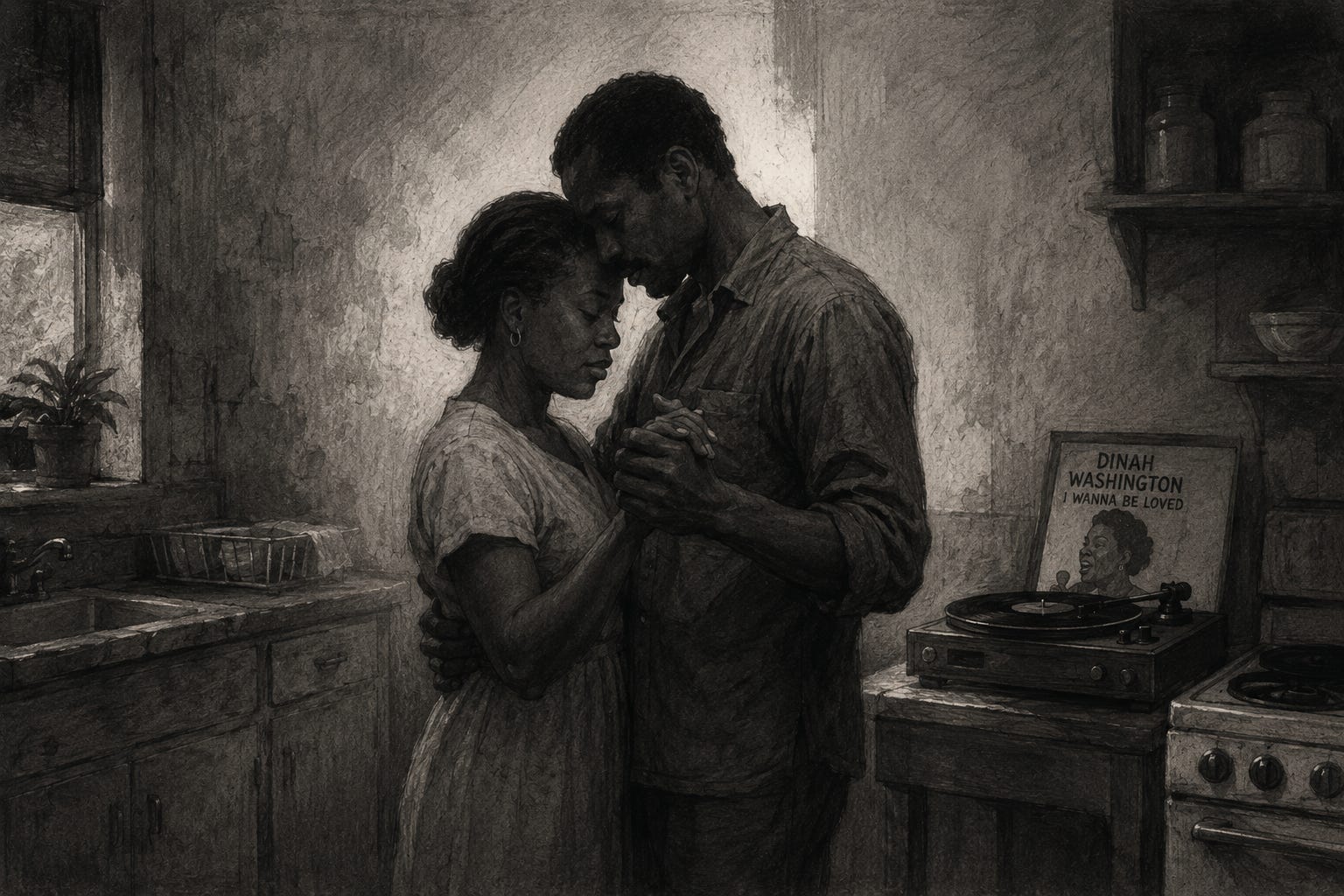
One evening they slow dance in their kitchen to a Dinah Washington record. They move carefully, almost tentatively, like two people remembering something they once knew by instinct. For two minutes they find each other again.
Then the song ends.
Nothing is solved.
That scene contains more truth about marriage, labor, exhaustion, and the effort required to remain close to another person than many films find in two hours.
Charles Burnett made Killer of Sheep while studying at UCLA, shooting on 16mm with nonprofessional actors and almost no money. He filmed people and places he knew. He never turns them into sociology.
That is what makes the film radical.
Burnett rejected the familiar ways American movies represented Black life. There is no gangster mythology, no blaxploitation fantasy, no sentimental story of poverty, no reassuring lesson designed for outsiders.
Instead, Burnett watches.
Children play in empty lots. Men come home from work. Neighbors appear in doorways. Couples argue. People joke, drift, wait, sit quietly. Watts is not used as a symbol. It is simply where these lives are taking place.
The film accumulates rather than advances. Moments gather. Faces gather. Silences gather. Eventually you realize Burnett has built a portrait without announcing one.
Shot in black and white, Watts becomes both industrial and strangely graceful. Railroad tracks, machinery, vacant lots, broken fences, unfinished structures. Children climb across rubble with the physical freedom of dancers. Adults move more slowly. Work has entered their bodies.
The comparison to Italian neorealism makes sense. Burnett shares De Sica’s interest in people whose lives are shaped by forces larger than themselves. Yet Killer of Sheep belongs completely to America, and specifically to Watts. De Sica had postwar Rome. Burnett had a neighborhood still living with the economic and social aftermath of the 1965 uprising.
Then there is the music.
Dinah Washington. Paul Robeson. Etta James. Louis Armstrong.
Burnett used recordings without clearing the rights, as student filmmakers often did when they expected their work to receive little commercial circulation. In most films, losing a song is inconvenient. In Killer of Sheep, removing the music would alter the film itself.
The songs carry memory, longing, sensuality, history, and cultural continuity. They speak when the characters do not.
During the kitchen dance, Dinah Washington is not background music. She is part of the marriage.
That artistic choice helped create the film’s emotional depth. It also helped keep the film largely unavailable for decades.
Critics and filmmakers recognized its importance early. Killer of Sheep circulated at festivals and developed a reputation among filmmakers. In 1990, the Library of Congress selected it for the National Film Registry.
Yet most Americans still had no practical way to see it.
There is something painfully appropriate about this. A film about people rarely given sustained attention became a film people were rarely given the chance to watch.
The music rights were finally cleared and a restored version received a theatrical release in 2007.
By then, what Burnett had done no longer looked like an isolated experiment. His influence had spread.
You see traces of his approach in filmmakers such as Barry Jenkins. Think of Moonlight, especially scenes where silence, gesture, water, music, and physical distance carry more meaning than dialogue. Jenkins trusts the audience to understand emotion without having every emotion explained.
Burnett had been doing that decades earlier.
His larger achievement lies there.
Killer of Sheep does not ask us to admire its characters. It does something harder. It gives them time.
Time to work.
Time to argue.
Time to play.
Time to be tired.
Time to love one another badly, tenderly, incompletely.
Burnett understood something filmmakers often forget. Ordinary life does not become meaningful when a writer imposes meaning on it.
Sometimes you only have to look long enough.
Killer of Sheep was there all along.
You can view Killer of Sheep on Netflix or Apple TV.
Listening: Charles Mingus & Eric Dolphy — Complete Live in Amsterdam
Thanks to YouTube, I just found what I believe is one of Charles Mingus’s greatest recordings, made with his greatest band. Live in Amsterdam, featuring Eric Dolphy, was recorded on April 10, 1964, at the Concertgebouw. It was the first night of the band’s European tour.
The sextet was Mingus on bass, Dolphy on alto saxophone, bass clarinet and flute, Johnny Coles on trumpet, Clifford Jordan on tenor saxophone, Jaki Byard on piano and Dannie Richmond on drums.
That lineup didn’t last long. A week later in Paris, Coles collapsed on stage during “So Long Eric” with a perforated ulcer and missed the rest of the tour. The group finished as a quintet. The first few concerts, in Amsterdam, Oslo, Stockholm and Copenhagen, are all we have of the complete band.
“So Long Eric” was Mingus’s goodbye to Dolphy, who had told him he planned to stay in Europe after the tour. He did stay, and on June 29, 1964, he died in Berlin, less than three months after this concert.
This band sits somewhere few Mingus groups ever reached, halfway between his tightly organized compositions and much freer improvisation. Dolphy’s bass clarinet on “Orange Was the Color of Her Dress, Then Blue Silk” and “Fables of Faubus,” and his flute and bass clarinet on “Meditations,” give the band a sound no other Mingus ensemble had. Clifford Jordan’s tenor offers a more linear voice next to Dolphy. Jaki Byard moves freely between stride, bebop, abstraction and the older styles, sometimes within a single chorus.
The revelation is “Ow,” the Parkeriana medley Mingus dedicated to Charlie Parker. The band plays fragments of Parker melodies while Dolphy solos over them, and it’s one of the freest solos he ever recorded, his work with John Coltrane included.
And the sound is impeccable. Sixty-two years later, it still sounds like the band is in the room.
Next Tuesday: The Thing That Eats Facebook
Leaving Facebook revealed how little of its performance and outrage resembled genuine human connection. Its true successor may not be another social network, but immersive technology that transforms presence, distance, and access—if computing power becomes cheap and widely distributed.