

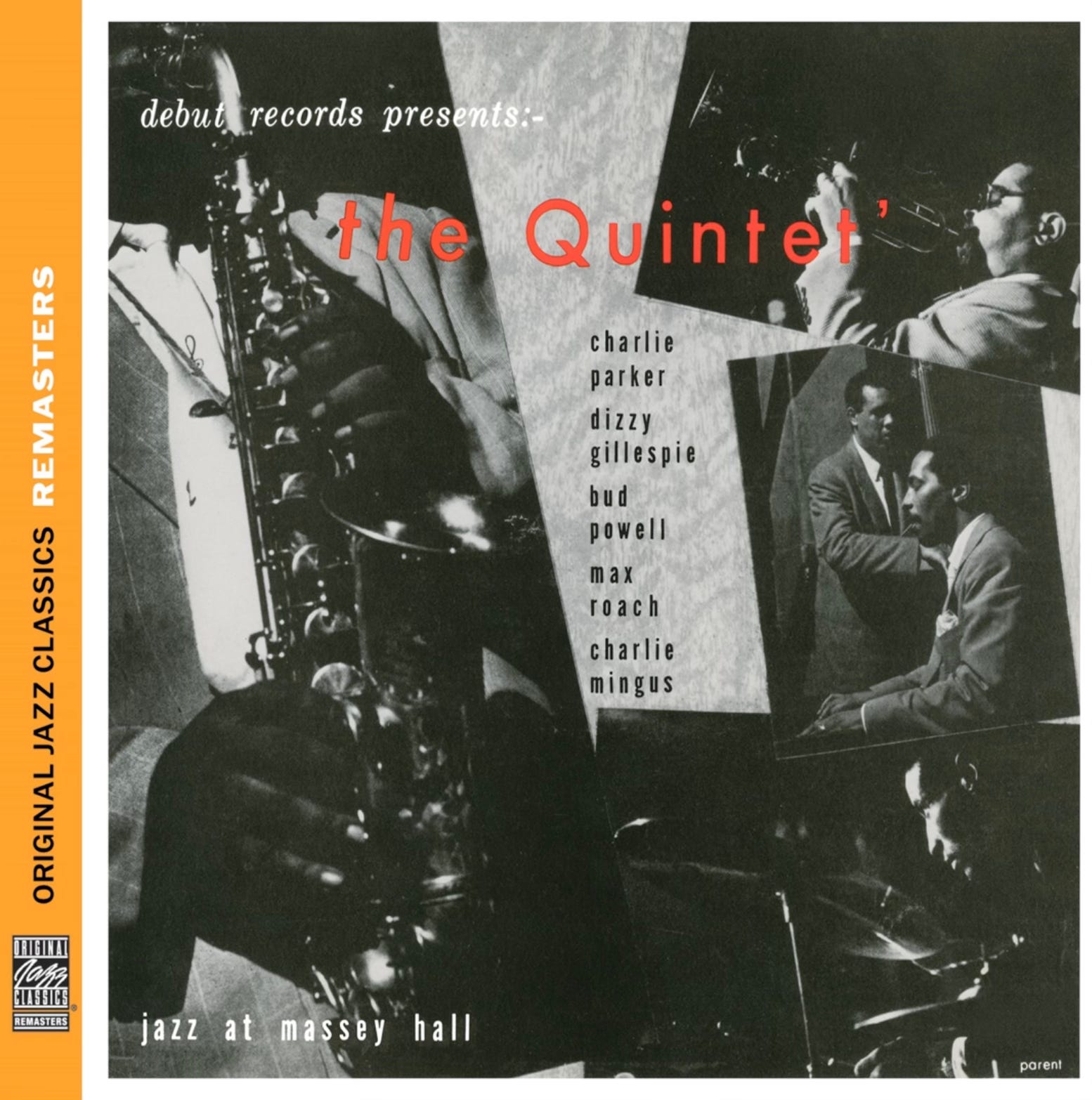
On the night of May 15, 1953, five men took a stage at Massey Hall in Toronto and, against every conceivable odd, produced what many consider the most extraordinary document in jazz history. The album that came out of that night has been in print ever since, bearing a tag that has never quite let go of the culture: “the greatest jazz concert ever.”
It was, by almost any measure, a concert that should not have happened — and certainly should not have sounded the way it did.
The New Jazz Society of Toronto had assembled a fantasy band: Charlie Parker, Dizzy Gillespie, Bud Powell, Charles Mingus, and Max Roach. These were the architects of bebop, the five men most responsible for transforming jazz from popular entertainment into a demanding, complex art form in the late 1940s. They had never recorded together as a quintet. The NJS, led by a young enthusiast named Dick Wattam who had driven to New York in January cold to sign all five, understood they were putting together something historic.
What they did not quite understand was how to sell it.
Wattam convinced his fellow NJS members that word of mouth alone would fill Massey Hall’s 2,765 seats. It did not. Then came the scheduling catastrophe: the Rocky Marciano vs. Jersey Joe Walcott heavyweight championship rematch was broadcast on television the same night. Boxing in 1953 was at its cultural peak, and jazz was not. The estimated audience that showed up ranged from 600 to 1,700 people, depending on who you believe. The hall was two-thirds empty. Even the musicians reportedly ducked out at intermission to catch the fight at a nearby bar.
The chaos predated the concert itself. At LaGuardia airport, the group discovered that only five of seven people had been booked on the pre-arranged flight. Parker and Gillespie were left to wait for the second plane. The hours-long delay brought their longstanding personal tensions to a breaking point. By the time they arrived in Toronto, neither was speaking to the other. This was not simply an artistic rivalry. By 1953, Gillespie was the disciplined professional, the showman who had built a career around precision and presentation. Parker was losing his battle with addiction — he would be dead less than two years later — and the distance between the two men had become personal and painful.
Parker arrived without a saxophone. Depending on the account, it had either been pawned or was under repair. He borrowed a Grafton plastic alto — a budget instrument that most serious players would not have touched — from a local music store. That horn, made of white acrylic, would produce the sound on more than half of what is now considered a masterpiece.
Bud Powell, the most harmonically inventive pianist of the bebop era, had just been released from a psychiatric hospital. The quintet had not rehearsed and had not even settled on a program until moments before taking the stage. When Gillespie and Parker vanished for over an hour at intermission, Max Roach held the restless, sparse audience in place with an extended drum solo.
And then something happened.
Parker, playing a plastic horn he had never touched before that night, opened “Perdido” with long, clean lines built from eighth notes, his phrasing fast and relaxed, placing repeated high notes against the rhythm section with small rhythmic shifts that created genuine tension. There was no compromise in the sound. The Grafton’s thinner tone was real, but the logic behind the notes was pure Parker — inventive, controlled, and completely alive.
Gillespie, who had spent the evening barely acknowledging his old partner, channeled the tension into performance. On “Salt Peanuts,” one of his own bebop calling cards, he pushed the tempo and exaggerated the famous rhythmic hits in the song’s vocal phrase, inserting short trumpet bursts, teasing the crowd with a pause before the band slammed back into the theme with sharp accents. You can hear people reacting in a hall that was mostly empty. It did not sound mostly empty.
Then there was Roach. When the concert reached the drum exchanges on “Wee,” he treated the kit not as a percussion instrument but as something closer to a melodic voice. The ride cymbal kept pulse with small variations in spacing; then he shifted into snare and tom figures, short phrases that answered the band. Each phrase fit the harmonic cycle even though the drums carried no pitch. It was the concept Roach had been developing since the early bebop years, and Massey Hall showed it in full flower — drums not keeping time, but talking.
The recording itself almost did not survive. Mingus had brought a portable tape recorder and captured the concert himself. When he listened back, he discovered his bass was barely audible. He later overdubbed new bass lines in a studio, and many reissues now include both versions. Parker could not be listed on the original album cover due to a contract dispute with another label and was billed as “Charlie Chan,” a reference to his wife Chan Richardson. The musicians were never fully paid. When Gillespie tried to cash his check back in New York, it bounced — repeatedly. Mingus released the recording on his own Debut label in December 1953.
It was the only time all five men ever recorded together. It was the last time Parker and Gillespie recorded together at all.
What sits at the center of this story, and what makes the album so enduring, is a particular kind of irony that jazz seems to generate more than any other art form. The conditions were miserable. The pay never came. The hall was nearly empty because a boxing match was on television. The most important alto saxophonist in the history of the music was playing a white plastic horn he had borrowed from a shop. Two of the five musicians were not speaking to each other.
And they played like that.
The recording was inducted into the Grammy Hall of Fame in 1995. It has never gone out of print. The mythology has only grown with time because the music fully supports it. You can hear, in those performances, something that goes beyond technical mastery into a kind of high-pressure improvisation that feeds on adversity rather than being diminished by it. Parker did not play carefully on a borrowed plastic horn. He played with the authority of someone who had nothing left to prove and everything left to say.
That is bebop at its core: music made under pressure, from players who had transformed an entire art form and were now, for one chaotic night in Toronto, making history in a room that was mostly empty. The tag stuck because the music earned it.
Listen to “Perdido” from Jazz at Massey Hall:
One of the first records I bought as a kid (yes, I was into bebop even then) and it stands the test of time. Bless Mingus for having the forethought to bring his recorder, a miracle it captured the concert as well as it did. It could be said the entire venture was miraculous. You set the stage perfectly, Bret. Thanks.
Another nice bit on jazz history of a serendipitous and extraordinary event. Gracias!