

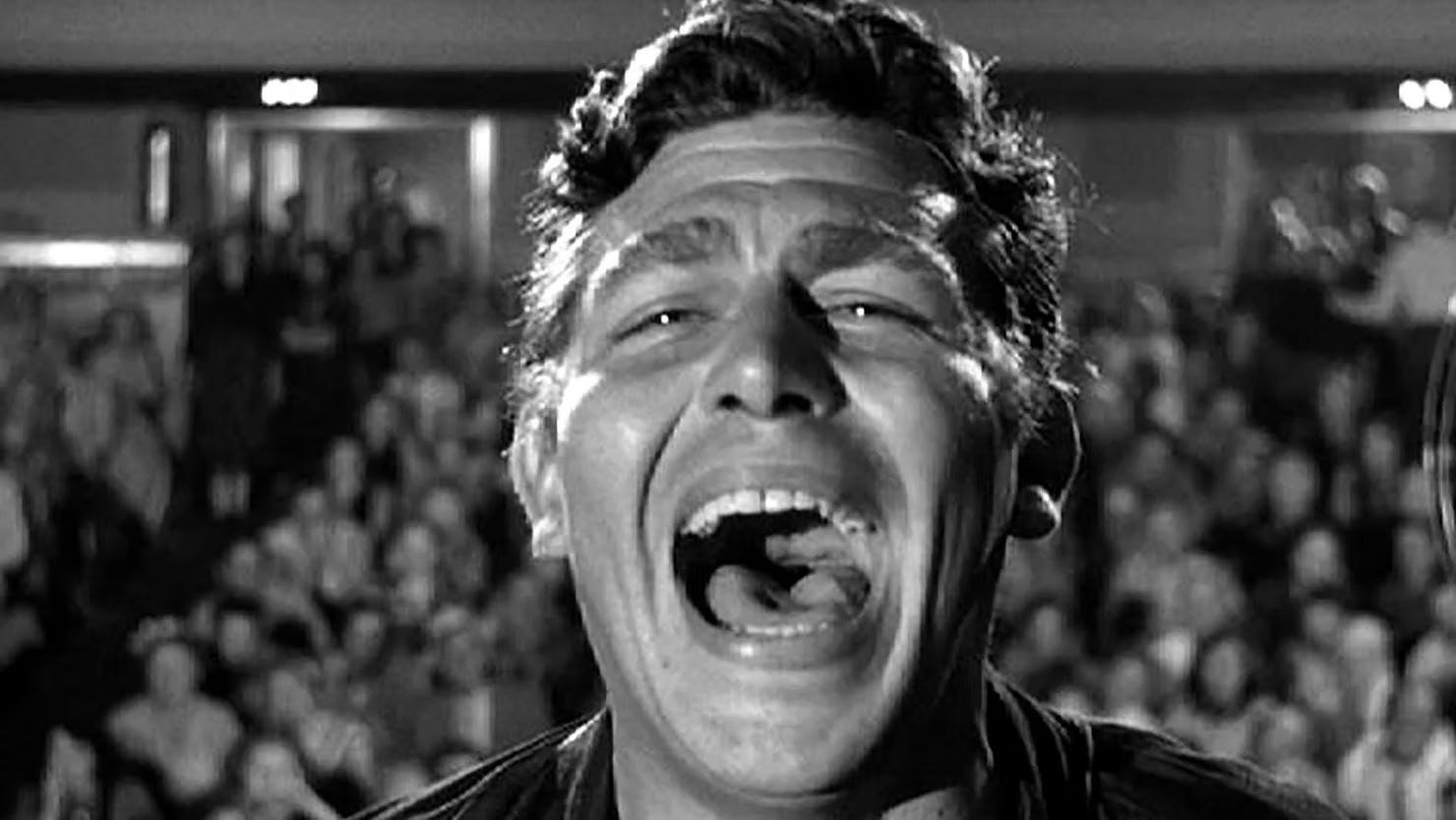
In 1957, Elia Kazan and Budd Schulberg made a film about a charismatic drifter who uses television to seduce a nation, and critics called it unrealistic. Nearly seventy years later, A Face in the Crowd plays less like a period piece than a document someone left behind after watching what was coming.
There’s a drunk in an Arkansas jail who’s about to become the most powerful man in America.
He can’t help himself. He’s funny, loose, dangerous, and magnetic in ways that make you lean toward him even when something in the back of your brain is sending signals you’re choosing to ignore. His name is Larry “Lonesome” Rhodes, and Elia Kazan put him on screen in 1957, which means the film has now spent nearly seven decades being more relevant than it was the year before.
If you haven’t seen it, stop reading, scroll down watch it first. If you have seen it, you already know what I’m about to say.
Kazan made A Face in the Crowd with screenwriter Budd Schulberg, fresh off On the Waterfront. Both men were carrying complicated personal freight — they’d each named names before the House Un-American Activities Committee, Schulberg in 1951, Kazan in 1952. Both were condemned by significant portions of the Hollywood left, and that condemnation followed them. When Kazan received his honorary Oscar in 1999, thanks to the intervention of Martin Scorsese, a substantial number of people in the audience sat on their hands and stared at the floor. Kazan wrote in his autobiography that what drove the making of this film was their anticipation of the power television would have in the political life of the nation. What they actually made was something darker and more personal than a political warning — a film built by two men who understood betrayal from the inside.
That knowledge gives the film a density that a simpler morality tale wouldn’t have.
Lonesome Rhodes is not just a villain. He’s a product. His raw, folksy charm makes him an instant hit on local radio, and the machine takes it from there — television, sponsors, politicians, handlers. As his power grows, so does his contempt for the audience that made him. He holds his followers in private disdain while publicly celebrating them as the heartland soul of America. The film understands something that most political films miss entirely: authenticity itself can be manufactured, and the more real someone seems, the more carefully that realness has been constructed.
When it was released in 1957, critics called it unrealistic. Too paranoid. Too on the nose. That’s worth sitting with for a moment — the scenario that seemed like exaggeration then is now just Tuesday.
Andy Griffith’s performance is the reason the film works at the visceral level. He had almost no film experience before Kazan cast him, and that rawness is inseparable from what he does on screen. There’s no technique getting in the way. He’s loose and unpredictable in a way that feels genuinely uncontrolled, which is exactly what the role demands. The specific thing he pulls off, and it’s extraordinarily difficult, is simultaneity — you can watch him be charming and contemptuous at exactly the same moment. The grin that doesn’t reach the eyes. The folksy warmth delivered with a predatory alertness underneath. Most actors play one layer and let you infer the other. Griffith plays both at once, which is more disturbing by an order of magnitude.
Kazan reportedly called it one of the finest performances he ever directed. Given that Kazan worked with Brando at his peak, that’s not a throwaway remark.
What haunts the film is knowing what came after. Griffith spent the next several decades deliberately burying this performance under Andy Taylor and Matlock — the gentle, trustworthy American — and apparently found the role disturbing enough that he had no interest in revisiting that territory. That choice tells you something about what he understood he had accessed in himself.
Patricia Neal is the film’s structural backbone, even though Griffith gets most of the attention. She discovers Rhodes in that Arkansas jail, recognizes something in him, and gives him his first platform. That initial recognition is crucial — Marcia Jeffries isn’t naive. She’s smart and ambitious, and she chooses him. The film implicates her judgment from the start.
What Neal tracks across the film is a specific kind of disillusionment — not the clean kind where you simply stop believing in someone, but the messier kind where you’ve invested your own identity in what you believed, so the unraveling takes you apart along with it. Marcia doesn’t just lose faith in Rhodes. She has to reckon with what it says about her that she created him, promoted him, and loved him. Her feeling for him isn’t just professional investment — she loves him, and that love persists past the point where she clearly sees who he is. Neal holds that contradiction without resolving it prematurely, which is the hardest thing to do in a role like this.
Her final act — turning on the microphone so the audience hears what Rhodes really thinks of them — is the film’s moral climax. It’s not a triumphant moment. Neal plays it as something closer to grief. She’s not saving democracy. She’s destroying something she built and loved, and the cost is visible on her face.
The comparison to Donald Trump gets made every time this film is discussed, and it holds up to a point. The billionaire performing as populist, the television personality who understands the medium as a tool of dominance rather than information, the contempt that surfaces in unguarded moments, the persona of success constructed over a private reality of failures. Rhodes and Trump share the same operating mechanism.
But the comparison reveals where the film’s imagination ran out. Rhodes is ultimately destroyed. The hot mic moment — caught mocking the very people who worship him — ends him. Schulberg and Kazan still believed in a rational audience that could be shocked back to its senses. That faith looks genuinely touching now, the faith of men who lived before the complete dissolution of shared reality.
Trump’s supporters processed every exposure, every revelation, every unguarded moment, and stayed loyal. The mask slipped repeatedly and it didn’t matter, because the audience had decided the mask was the point. What Kazan and Schulberg couldn’t anticipate was social media removing the last gatekeepers, so that the Lonesome Rhodes dynamic now operates at a scale and speed that makes 1957 network television look like a church bulletin.
The film identified a structural vulnerability in media democracy — that charisma plus television produces a kind of power that bypasses argument and rational persuasion entirely. What it couldn’t imagine was an audience that already knew, and didn’t care.
There’s one more layer worth naming, the one that makes the film genuinely uncomfortable rather than just prophetic. Lonesome Rhodes is also, at some psychological level, a portrait of the informer. Someone who tells the crowd what it wants to hear. Someone whose public warmth conceals private calculation. Someone who betrays the people who trusted him to protect and advance himself. Kazan and Schulberg both did exactly that before HUAC. Whether they were conscious of encoding that self-portrait into the film is unknowable, but the psychological logic sits there in every frame.
They made a film about the moral rot of a man who performs sincerity while operating from pure self-interest, and they made it from experience.
The drunk in the Arkansas jail is still on television. He just has better production values now, and nobody’s reaching for the off switch.
Watch A Face in the Crowd. Note: if you can’t watch this because it’s blocked in your country, it’s also available on Tubi in some areas: View on Tubi
Listening - Doug Carn’s Revelation
Revelation marks the peak of Doug Carn’s Black Jazz period, pulling together the spiritual jazz, gospel, soul, modal improvisation, and social consciousness he had been developing on Infant Eyes and Spirit of the New Land into one fully realized statement. Jean Carn’s voice is central to that achievement. On the Coltrane and McCoy Tyner pieces, she doesn’t sing as a frontwoman backed by a band; she contributes wordless passages and hymn-like affirmations that function as part of the ensemble itself. Their “Naima” makes the shift clear: Coltrane’s original is intimate and romantic, but Doug’s electric keyboards build a floating bed under Jean’s voice, turning the tune devotional and expansive.
Listen to Doug Carn’s Revelation
Watching: Orwell: 2+2=5
Raoul Peck is a Haitian filmmaker known for blending political history with personal and essayistic storytelling. He briefly served as Haiti's Minister of Culture in the mid-1990s and is best known for I Am Not Your Negro (2016), built from James Baldwin's unfinished writings, which earned an Academy Award nomination for Best Documentary Feature.
Netflix has his most recent film, Orwell: 2+2=5, released in 2025. Peck uses Orwell's own writing, drawing especially on his essays and "1984," to draw parallels between Orwell's warnings about totalitarianism, propaganda, and truth distortion and contemporary politics.
Mr. Peck brings a healthy dose of sympathetic rage to his exploration of Orwell’s worldview, and sensitivity to his life story. The rich selection of archival material is punctuated by new footage, clips from a fascinating cross-section of documentaries and dramas, including several screen iterations of 1984a nd Orwell’s novella Animal Farm, and outstanding graphics — notably a catalog of books that have been banned stateside and around the globe and a real-world Newspeak glossary that alone is worth the price of admission.
Next Tuesday
In Locked in the Projection Booth: My Year of Living Dangerously, I remember the week before high school graduation, in 1967, when I was nearly expelled for refusing to censor my first film.
Dear Bret (part 2)
Some victims never break the spell. Rational thought has left their building As I like to say, cult members don’t know they’re in a cult any more than fish know they’re swimming in water.
This, of course, applies to MAGA. The reason they “don’t know and don’t care”. is that surround-sound social media has taken them in, removed them to an actual fake reality. They don’t know what hit them. I didn’t. You mention Lonesome’s contempt for his followersSome victims never break the spell. Rational thought has left their building As I like to say, cult members don’t know they’re in a cult any more than fish know they’re swimming in water.
You mention Lonesome’s contempt for his followers. I had the pleasure of studying screenwriting with the phenomenal Robert McKee. One night, he defined a “hack writer” as one who looks down on his audience. I suppose this could apply to any occupation, including those of Lonesome Rhodes and Donald J Trump. .
Funny, it works perfectly if you substitute “Obama” for “Trump.”