

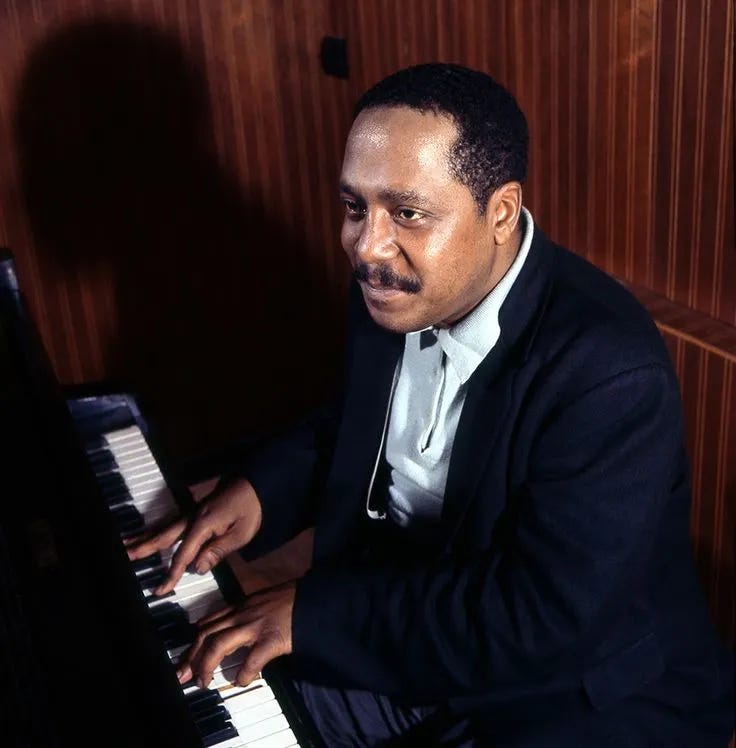
The tape from Birdland is hard to listen to, and not for the reason you’d expect. September 30, 1964. Bud Powell, back in New York after five years in Paris, working the club named for Charlie Parker, with John Ore on bass and J.C. Moses on drums. Francis Paudras, the French commercial artist who had more or less kept Powell alive in Paris and flown home with him that August, hid a microphone near the club’s piano mic and recorded the set. It surfaced later as Return to Birdland, 64.
At one point Powell stops in the middle of a solo and asks what tune he’s playing.
Some history, because the tape makes no sense without it. In January 1945, Philadelphia police arrested Powell and beat him around the head. He was 20. Nearly everyone who knew him drew a straight line from that night to everything after: Creedmoor and Pilgrim State, electroshock, heavy medication, drinking, the gradual loss of the speed and sureness that had made him Bud Powell in the first place. The clubs booked him regardless. His name drew.
The name came from what he did to the instrument. Long right-hand lines at tempo over sparse left-hand jabs, harmonic nerve nobody at the keyboard had shown before. Parker is said to have called him just “the piano player.” Put on Evans, Hancock, Tyner, almost anyone since 1950, and you’re hearing Powell, filtered once or twice.
So the hard part of the Birdland tape isn’t the fumbling. It’s the stretches where the fumbling clears and the old phrasing comes through, a few bars at a time, then goes under again.
He’d just turned 40 that week. He stayed in New York when the run ended, though Paudras wanted him back in Paris. He died in Brooklyn on July 31, 1966, of tuberculosis, malnutrition, and alcoholism, two months short of 42.
Watching - Twelve Angry Men
Twelve Angry Men started as live television, a Reginald Rose teleplay from 1954, and you can feel the DNA. One set, real time, actors who have to get it right as it happens. Henry Fonda co-produced the film version himself, hired Sidney Lumet, who had never directed a feature, rehearsed the cast for two weeks as if it were a play, and shot the thing in about three weeks. It lost money. 1957 audiences wanted CinemaScope and color, not twelve sweating men arguing around a table in black and white. The movie had to wait for television, of all places, to find its audience, which given where it came from has a certain justice to it.
The famous technical stunt still works on me every time. Lumet and his cameraman began with normal lenses shot at eye level and, as the deliberation wears on, moved to longer lenses and dropped the camera lower, so the ceiling starts pressing into the frame and the men’s faces crowd each other without your quite registering why. By the last half hour that jury room is a cell. The cameraman, incidentally, was Boris Kaufman, who won an Oscar for On the Waterfront and whose brother was Dziga Vertov, the great Soviet avant-garde documentarian.
There’s no cutting away, that’s the discipline. No flashbacks, no scenes of the accused, no courthouse corridors. So every flipped vote has to be earned in the room, out of testimony re-examined and tempers giving way, and the script mostly earns them. Not always at the same level. A couple of the conversions come easier than they should. Doesn’t matter much when the hard ones land: Lee J. Cobb’s Juror 3 held up alone at the end by nothing except his rage at his own son, or the moment during Juror 10’s bigoted tirade when, one by one, the others stand up and turn their backs, and Lumet just lets the room go quiet around him.
Fonda’s Juror 8 gets remembered as the hero, and people misremember what he actually does. He never claims the kid is innocent. He says, over and over, that he doesn’t know, and neither does anyone else at the table, and that not knowing is the whole point of the exercise. His weapon is the question nobody else wants to sit still for. Meanwhile the heat does half the writing: shirts soaking through, the broken fan that suddenly works, the rain when it finally comes.
Then the verdict, and Lumet’s last trick. After ninety minutes of tightening, he cuts to a wide-angle shot of the courthouse steps, open air, room to breathe. Two jurors, Fonda and the old man, exchange names, the only names we ever get, and walk off in different directions into the city. That’s it. That’s the ending. Names, weather, strangers again.
Listening - Grover Washington, Jr.: Inner City Blues, Mercy Mercy Me
Grover Washington, Jr. earned his reputation as one of the most fluid and soulful saxophonists to come out of the CTI/Kudu stable, and this Chateauvallon performance shows why. Playing alongside a rhythm section as formidable as Bob James, Ron Carter, and Jack DeJohnette would expose a lesser player, since each of those three was capable of pulling the music in unpredictable directions. Washington doesn’t just keep pace, he pushes back, weaving long, unbroken phrases that shift between gritty blues inflections and the kind of harmonic sophistication that made him equally credible in straight jazz and R&B circles.
What made him such a compelling improviser was his sense of pacing. He rarely rushed to prove his technique, letting tension build across a solo so that when he did unleash a run of notes, it landed as release rather than showmanship. That instinct, restraint married to raw power, is what separated him from the more technically flashy saxophonists of the era, and it’s exactly what an all-star rhythm section like that one would have demanded from a soloist: someone who could match their interplay without getting swallowed by it. Washington’s willingness to take real chances in that setting, stretching phrases against DeJohnette’s shifting time and Carter’s harmonic curveballs, is a good measure of how serious a musician he was, well before the smoother, more commercial sound he became known for later in the decade.
Listen:
Next Tuesday - Evil Comes with Free Cholesterol Medication
There’s a rumor moving through the republic, an escaped lab virus: the decent die young, the monsters refuse to leave. Every generation watches a polished predator hit eighty-five while teachers, nurses, and neighbors disappear twenty years early, worn down by mortgages and impossible jobs. The universe seems to have developed a taste for cruel jokes — kale smoothies for one man, a state funeral for another who spent seventy years poisoning rivers and lying through capped teeth.
I saw Grover W at the Village Gate right around the time "Inner City Blues" came out...He played with as much ferocity as any saxophonist Ive ever heard!!!!!
That event where he sustained what was likely a traumatic brain injury (TBI) that went largely untreated occurred while he was trying to defend Monk from police harassment during an after-hours “bust”. There are so, so many layers to that whole event and story….