

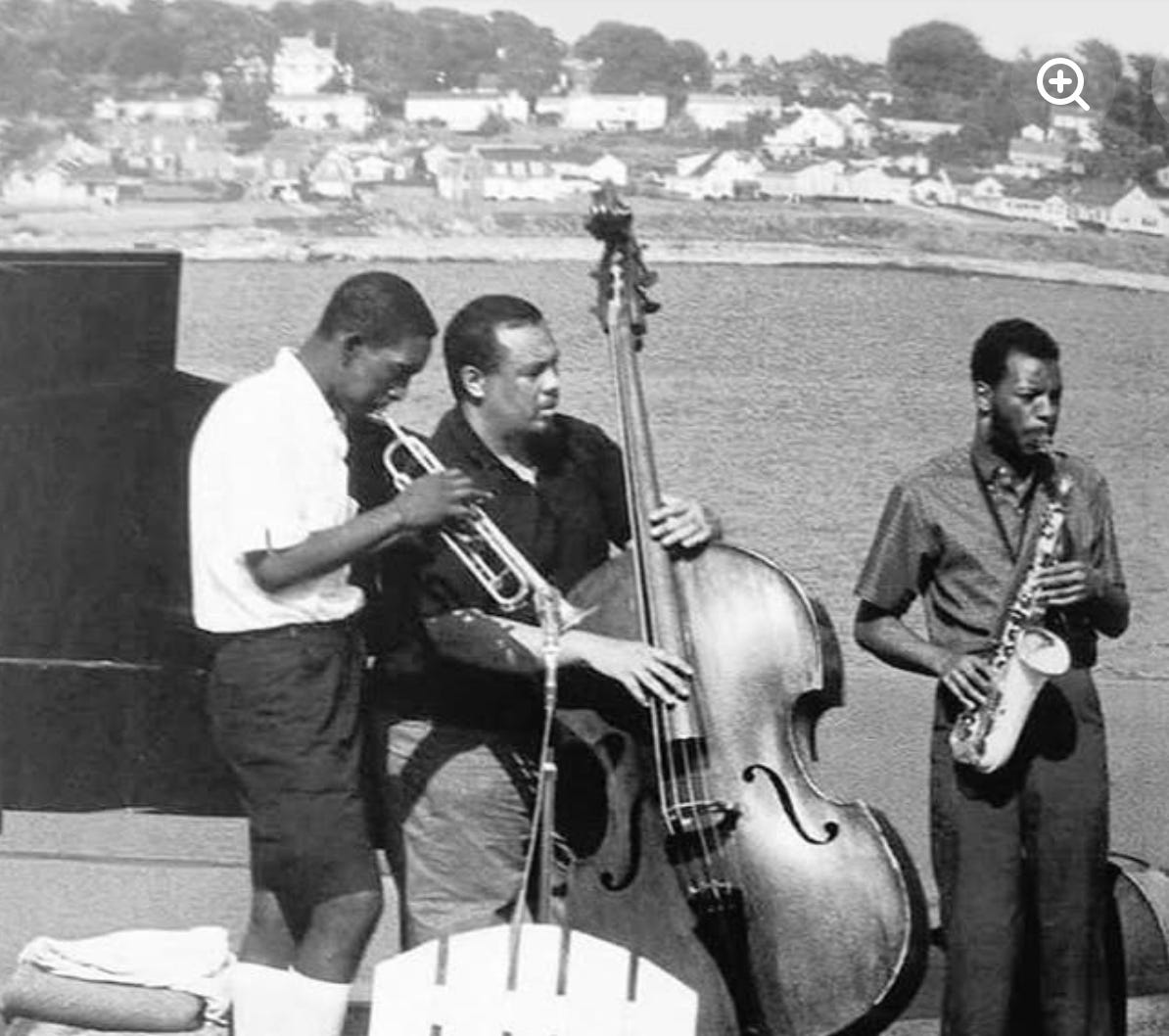
In 1960, while the official Newport Jazz Festival collapsed into riots, Charles Mingus and Max Roach organized a breakaway event that asked a question the music industry has never honestly answered. Who does the music belong to? This is the story of three days in Rhode Island that exposed a contradiction still running through jazz, and every other art form, right now.
Newport, Rhode Island, 1960. The official jazz festival was collapsing into chaos. Crowds overran the city. Fights broke out. Police shut the whole operation down after riots erupted downtown. Meanwhile, a few miles away, a group of musicians had organized their own festival, on their own terms, and were playing some of the most uncompromising jazz anyone had heard in years.
The Newport Rebels Festival lasted only a few days. It left behind an album, a legend, and a set of questions that never got answered.
The rebellion had been building long before the bottles started flying. Charles Mingus and Max Roach, the two figures most responsible for organizing the breakaway event, had watched jazz festival culture develop throughout the 1950s with growing fury. What they saw was a familiar pattern. Black musicians, the people whose genius had invented and sustained this music across decades, were being positioned as entertainment for wealthy white audiences while promoters, sponsors, and cultural gatekeepers controlled the money, the programming, and the image of the music itself.
Mingus was not a man who tolerated that quietly. He was combative by nature, idealistic to a fault, constitutionally suspicious of authority, and completely unwilling to perform the role of the grateful, obedient entertainer. He viewed jazz as serious art, as political expression, as social criticism pressed into musical form. The idea of it being sanitized into background atmosphere for society events and corporate sponsors was an offense he refused to absorb in silence. Roach shared the anger, though he expressed it differently. Together they decided that if the official festival would not treat musicians with dignity, musicians would build something of their own.
What they created was not just a competing event. It was an argument.
The argument went something like this. Jazz musicians, particularly Black jazz musicians, were the reason anyone came to Newport in the first place. The music drew the crowds, generated the prestige, attracted the press. Yet the artists themselves exercised little control over programming, received modest payment relative to what the festival generated, and were expected to show up, perform brilliantly, and disappear without complaint. The festival culture of the late 1950s had developed an uncomfortable resemblance to an older American arrangement, one where Black labor created value that flowed upward into other hands.
The Rebels Festival gathered artists who understood this and refused it. Ornette Coleman was there, just beginning to reshape what jazz could even mean harmonically. Eric Dolphy brought his extraordinary, angular vision of what an instrument could say. And Roy Eldridge was there, a trumpeter whose career stretched back to the 1930s, who had spent decades playing brilliantly in venues where he was sometimes required to use the service entrance, where he could perform for white audiences but could not sit among them, where his music was welcome and his presence was not. He had not forgotten any of that. Neither had anyone else on that stage.
These were not fringe figures or malcontents. They were central to the history of the music, and they had chosen the rebellion over the institution.
The music reflected the moment. Jazz in 1960 was moving fast, fracturing into new languages faster than critics and audiences could absorb them. Hard bop had already deepened and darkened the bebop revolution. Free jazz was arriving, terrifying to some, liberating to others. The Rebels Festival made no attempt to present the safe, accessible version of the music that festival audiences might have preferred. It embraced the difficult and the experimental. If the official festival wanted polish and palatability, the rebels offered the opposite as a deliberate act.
The album that came out of the rebellion, Newport Rebels, carries that atmosphere. It does not sound like a prestige recording designed to impress critics or sell to the mainstream. It sounds like musicians playing for each other and for anyone willing to actually listen, which is a different thing entirely.
The official festival, meanwhile, was not experiencing a great weekend. The chaos that descended on Newport in 1960 reflected something larger than bad crowd management. American culture in the late 1950s and early 1960s was under enormous pressure from every direction. The civil rights movement was intensifying. Postwar prosperity had created new audiences and new money but had not resolved the old contradictions about who this society actually served and recognized. The riots that shut down Newport were not really about jazz. They were about everything else that was about to break open across the decade.
The Newport Jazz Festival survived. It returned, it persisted, it eventually became an institution durable enough to outlast several generations of controversy. The Rebels Festival became a footnote, a legendary gesture that proved for three days that musicians could organize on their own terms. But the rebellion did not alter the underlying architecture of power. The music industry continued to function exactly as it had before.
This is the hard part of the story. The Newport Rebels demonstrated that another arrangement was possible. Musicians could control their own presentation, set their own terms, invite their own audiences, and play whatever the music demanded rather than whatever the market would comfortably absorb. They did this brilliantly, defiantly, and then it ended. The contradictions remained. The problem persisted.
Decades later, the structure shifted but not the equation. Streaming platforms now sit between musicians and audiences exactly as festival promoters did in 1960. They control access, set the terms, curate what gets heard, and extract the significant share of what the music generates while the people who make it negotiate from positions of structural weakness. The faces changed. The architecture did not.
What happened to the Newport Rebels? What happened to Mingus and Roach’s insistence that musicians deserved control over their own work? The answer is that nothing happened. Spotify did not read that album and learn a lesson. The music business did not reorganize itself around the dignity of artists. Individual musicians and small collectives continue to find ways to maintain some authority over their work. They always have. It has never been enough to change the system itself.
Jazz has always carried this tension inside it. Music built under conditions of exclusion and exploitation, transformed into something that outlasted both. At Newport in 1960, for a few days in someone’s backyard, musicians refused to let the institutions that packaged their work decide what they would play. They asserted control. They played like the music belonged to them.
It did. But that ownership was temporary. The system that tried to control the music in 1960 adapted, evolved, and continues to function in essentially the same way today. Musicians still find moments of rebellion. The rebellion still never sticks.
The question the Newport Rebels asked remains unanswered not because no one has tried to answer it. Musicians have tried repeatedly across decades. The question remains unanswered because the people who profit from controlling the music have more power than the people who make it.
Listen to the Newport Rebels Full Album
Alto Saxophone – Eric Dolphy
Bass – Charles Mingus, John "Peck" Morrison
Drums – Jo Jones, Max Roach
Piano – Kenny Dorham, Tommy Flanagan
Tenor Saxophone – Walter Benton
Trombone – Jimmy Knepper, Julian Priester
Trumpet – Benny Bailey, Booker Little, Roy Eldridge
Vocals – Abbey Lincoln
..............................................................
Mysterious Blues
Cliff Walk
Wrap Your Troubles In Dreams
Tain't Nobody's Bizness If I Do
Me And You
..............................................................
Recorded - November 1 and 11, 1960.
Watching - Naked City - The TV show
Naked City was a detective/crime drama that ran from 1958 to 1963 on ABC television. It followed the cases of NYPD detectives working street-level investigations in New York City. The show was notable for its gritty, realistic approach—it shot on location in actual New York neighborhoods rather than in studio sets, which was distinctive for television at the time.
The series starred Paul Burke and Horace McMahon as detectives and had a rotating cast of supporting players. It’s considered a precursor to the more naturalistic cop shows that came later. The title “Naked City” comes from the idea of exposing the raw, unglamorous reality of the city and its crimes. The great director Jules Dassin made a Hollywood movie with the same title and theme in 1948 that provided the inspiration for the series.
Someone colorized many of the episodes and has posted them on YouTube. I’ve been watching them and enjoying seeing that version of New York, depicting the city at the time I first began seriously visiting. And also, the guest stars are New York actors getting their first break in television, many of whom would go on to stardom including Dustin Hoffman (who looks about fifteen on the show), James Caan, Robert Duval, Martin Balsam, Robert Redford, Jack Warden, Eli Wallach and Gene Hackman.
The episode where Hackman plays a reporter, was particularly well written by Stirling Silliphant, who helped create this show, and another of my favorites, Route 66. This is the story of one of the detectives on the show witnessing the execution of a man he arrested and was titled “Prime of Life.” It’s about the value of life, exploring a subject most tv shows of the era would prefer to avoid.
The episode featured a memorable closing line: "Until a man faces the finality of death, he cannot understand the preciousness of life."
Next Tuesday - The America I Did Not See
I missed why seventy million Americans voted for Trump—not understanding the real pain of factory closures, wage stagnation, and rapid cultural change. Trump didn’t solve these problems; he named enemies and offered belonging. My failure was judgment instead of understanding. The deeper question: what systemic failures created the desperation that made his message work? Those forces remain, and another populist could emerge smoother and more calculated.
When I saw that pic of Mingus and Ornette it stopped me in my tracks. What? I thought...did that actually happen? I can't imagine how that would have sounded. Of course, Dolphy and Mingus had done a lot of work together. Bret strikes again. I'm running to the Naked City episodes. I watched this when I was a kid. There are eight million stories in the naked.....
Very interesting article.