

Kitty Bruce died in May at seventy. She was eight when she lost her father, and she spent most of her life afterward keeping his archive together so the rest of us could still hear him. This post is for her.
I found Lenny at thirteen, the same year I found bebop, and it took me decades to understand why the two arrived together. My friend Mark Kaplan, already a serious tenor player, and I memorized whole routines off the records, “The Palladium” above all. I’ll come back to that.
Bruce called himself an oral jazzman, which sounds at first pass no different from self-branding, the kind of thing a comic said in 1959 to seem current. He meant it as a description of how he worked. The ideal, as he described it, was to walk onstage the way Bird walked to the microphone, with no set list and no destination, and blow, whatever came, in the order it came.
You can check this against the tape. Listen to the Curran Theater recordings from November 1961. He opens on capital punishment, wanders into a bit about a Jewish man explaining Passover to his Black neighbor, breaks mid-sentence into a judge who sounds the way Edward G. Robinson sounded, and eventually gets back to capital punishment from an angle I still can’t diagram after sixty years of listening. I’ve tried describing these sets to people who haven’t heard them and it never works, which I suspect is the point, or at least the proof. An act with loose joints can be summarized. This can’t.
Albert Goldman’s biography traces the method to the strip clubs of the San Fernando Valley in the mid-1950s, where nobody in the audience had come for comedy and there was accordingly nothing to protect. Goldman writes that Bruce, who until then had been a mediocre mimic with a conventional act, shed his restraints in those rooms and began to blow with the freedom of the modern jazz players he’d started spending his nights around. Blow was the word Goldman chose because it was the word Bruce used.
It helps to remember what stand-up was at the time. A comic had an act that he’d tested on the road and then essentially froze, and the delivery might breathe a little from night to night but the material didn’t move. Bruce regarded that model about the way the beboppers regarded the late swing bands, as something that had traded its nerve for a salary. He’d also absorbed the musicians’ vocabulary so thoroughly that it stopped being slang in his mouth and became the terms of the argument. When he called somebody square he meant a person who had at some point quietly agreed to stop noticing things, and most of what he did onstage amounted to noticing things out loud at high speed in front of witnesses.
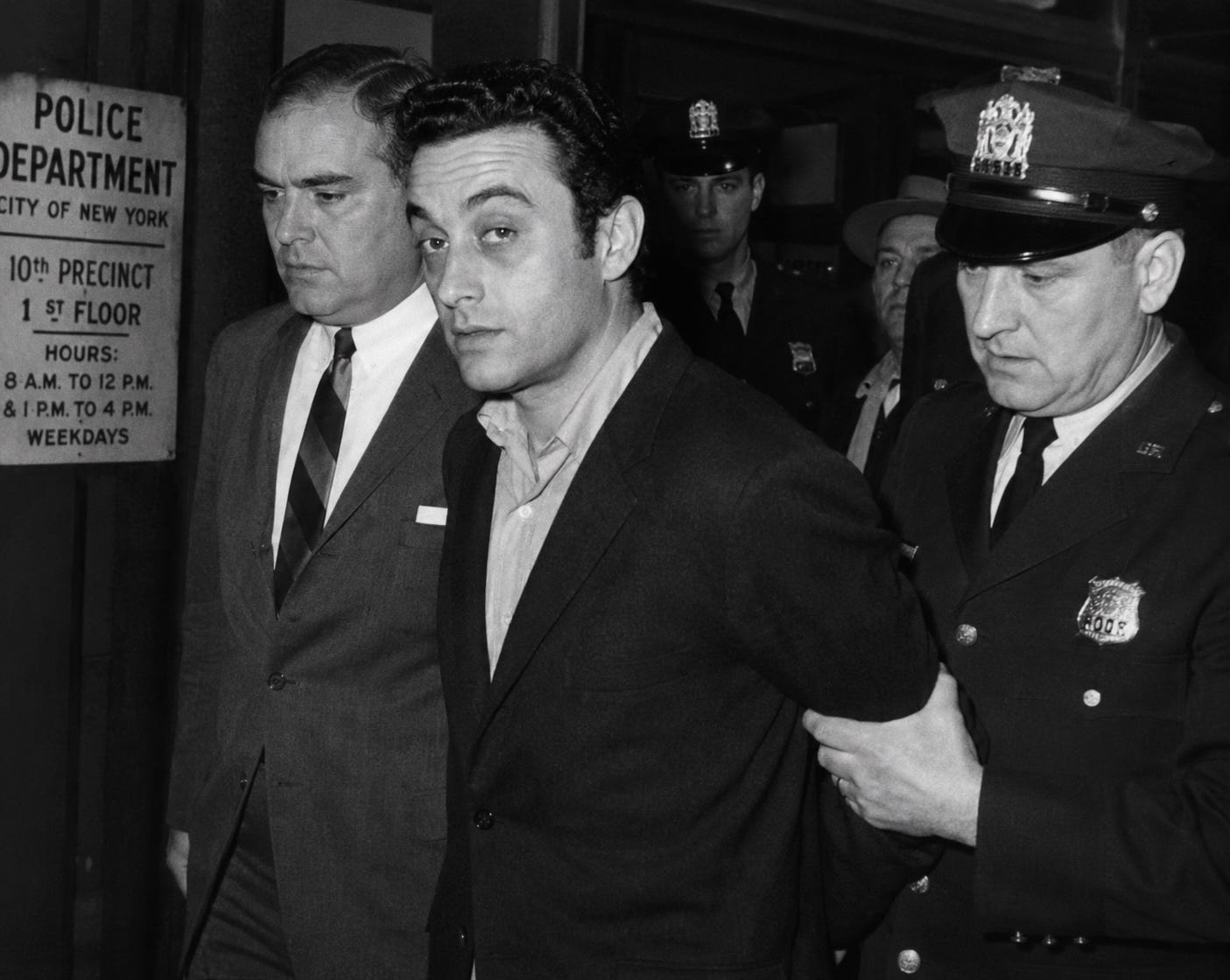
He wasn’t visiting that world, either. He was involved for years with Annie Ross, whose singing ran on the same exposed intelligence, and he worked rooms where bebop was the house music. When the San Francisco police arrested him for obscenity in 1961 it happened at the Jazz Workshop, and I’ve always thought the address tells you something the charge doesn’t. The charge concerned one word. But the word had been circulating in American mouths for a few centuries without landing anyone in night court, and I’ve never been able to believe it was really the word. A man improvising in public about religion, race, sex, and the police, in whatever order his head produced them, was a newer kind of problem, and the obscenity statute happened to be the tool lying closest to hand.
The fullest statement of what he thought comedy and jazz had in common is the television pilot he produced in 1959, The World of Lenny Bruce. The booking alone makes the argument: Buddy Rich, Sweets Edison, Lambert, Hendricks and Ross, and a quartet of Cannonball Adderley, Bill Evans, Philly Joe Jones, and Teddy Kotick, who had played bass with Parker himself. Bruce had the band improvise off great paintings and then waded in. There’s a stretch where the quartet plays “Au Privave” while Bruce and Philly Joe trade riffs about Bela Lugosi. Watch how the drummer listens to him. And how Lenny plays money. The pilot aired once on local New York television and no network touched it.
The Parker comparison gets drawn constantly, usually on the grounds that both men improvised, both used heroin, and both died young, Parker at thirty-four in 1955, Bruce at forty in August 1966, on his bathroom floor in Hollywood. I’d rather not make the drugs part of the aesthetics; addiction killed plenty of comics with frozen acts too. The difference worth dwelling on is that nobody ever prosecuted Parker for the content of a solo, while Bruce was arrested again and again for the content of his talk, and the trials took his bookings, his money, and eventually his attention. By the end he was standing onstage reading aloud from his own court transcripts, which the audiences hadn’t paid to hear. You could say the legal system succeeded where it usually fails, in that it actually managed to make him boring, for stretches, before it made him dead.
About “The Palladium.” BrotherMark and I traded its sections back and forth the way we traded Bird heads, and what I understand now, and couldn’t have said at thirteen, is that we were memorizing camera moves. The bit cuts between the comic dying onstage and the view from the wings and the manager and the band, scene to scene, the way a film cuts. “Father Flotski’s Triumph” works the same way. We just knew that whatever was on the comedy records was also on the jazz records, and we spent that year trying to get closer to wherever it was coming from. I’m apparently still at it.
Listening - Weather Report: Unknown Soldiers
The Weather Report track I hand people who think fusion means noodling is “Unknown Soldier,” from I Sing the Body Electric, 1972. Strange album to begin with: one side studio, one side carved out of a live Tokyo concert, as if the band couldn’t decide yet which animal it was. The studio side is where “Unknown Soldier” lives, and it’s Zawinul’s piece, and it doesn’t behave the way jazz records behaved in 1972. It barely behaves the way this band behaved.
It opens as a kind of dirge, spare, slow, the theme carried as if at a funeral pace, and for a while you’re not sure anything is going to happen. Then the thing loosens into collective playing, everybody moving at once, nobody stepping forward in the old way, and near the end there are voices, crowd sounds, chanting, and the title stops being decorative. Zawinul spent his boyhood in Vienna during the war. I don’t know how directly that fed the piece and I’m wary of critics who claim to, but a man who was eight years old under the bombing didn’t need to research the subject.
About that “nobody stepping forward”: Zawinul had a line he gave interviewers for years, that in this band we always solo and we never solo. Bandleader talk, usually. Bandleaders say things. The annoying part is that the records bear him out. Since bebop, a jazz performance had meant a hierarchy, the horn out front, the rhythm section holding the floor, everyone waiting his turn. Weather Report just declined the arrangement. Listen to “Unknown Soldier” trying to locate the soloist and you keep coming up empty; the foreground keeps dissolving and reforming somewhere else.
The pedigree is the part everyone knows. Zawinul and Shorter both came out of Miles’s electric bands, In a Silent Way, Bitches Brew, and the easy version of the story makes Weather Report a continuation of all that. I’ve never fully bought it. Miles’s electric music stayed rooted in the blues however abstract it got. Zawinul and Shorter, with Miroslav Vitous on bass in those first years, headed somewhere more composed, more orchestral, less sweat and more architecture. Whether that was an advance or a trade depends on which of their records is playing and, frankly, on my mood.
They’d become enormous later, Jaco, “Birdland,” arenas. That’s a different band and a different argument. In 1972 they were still mostly a rumor with two LPs, and “Unknown Soldier” is the sound of them finding out what the rumor was about.
Listen to “Unknown Soldiers” by Weather Report:
Watching - The Sweet Smell of Success at 70
Alexander Mackendrick’s 1957 film about a Broadway gossip columnist and the press agent who grovels for his favor didn’t age into a period piece. It aged into a diagnosis.
J.J. Hunsecker, played by Burt Lancaster with a stillness that reads as menace, makes and breaks careers from a newspaper column. Sidney Falco, Tony Curtis at his most desperate, will do anything to get an item planted. Clifford Odets and Ernest Lehman wrote the dialogue as a knife fight conducted in the form of conversation. Lines don’t build to a point; they cut and move on. Nobody in the picture says what he means, and everybody understands exactly what’s been said.
What holds up isn’t the nightclubs or the fedoras. It’s the mechanism. Hunsecker never needs to write a lie. He decides whose career lives, and the machinery around him does the rest. Swap the column for a platform and the film describes the influence economy with more precision than most things written about it since. The gossip column was the feed, first draft.
Here’s the part film writers usually skip and I can’t. The band on the nightclub stand is real. That’s the Chico Hamilton Quintet backing Steve Dallas, the young guitarist courting Hunsecker’s sister, and Hamilton himself gets a few lines of dialogue. This wasn’t a generic jazz combo hired to fill the frame, either. Hamilton’s group in 1957 was one of the odder and more beautiful bands on the West Coast: Fred Katz’s cello up front where a piano would normally sit, Paul Horn on flute and reeds, Carson Smith on bass, chamber jazz before anyone had agreed on the term. Horn would later become famous, or notorious depending on your shelf, for recording flute meditations inside the Taj Mahal, but here he’s still a hard-working West Coast player, and you can hear it.
Martin Milner, of course, couldn’t play. The guitar you hear is John Pisano, the quintet’s actual guitarist, and the guitar you see is mostly Milner, because James Wong Howe shot the close-ups so the two could be cut together without embarrassment. That’s of a piece with everything Howe does in this movie. His black and white Manhattan, all sharp angles and smoke, a city built for people to disappear into, still resembles nothing else from the period. A man that meticulous wasn’t going to let a faked solo break the spell.
I’ve sometimes wondered whether Mackendrick understood what he had in that bandstand. The whole picture is about manufactured reputation, items planted, careers arranged, and the one thing in it nobody fakes, hand-doubles aside, is the music. Maybe that’s an accident of casting. I doubt it, but I can’t prove otherwise, and the film works either way.
Seventy-plus years on, the suits changed and the method didn’t. And on the nights the movie’s cruelty wears on me, there’s always the band.
Next Tuesday - Bud Powell Comes Back To Birdland
Bud Powell’s final performance at Birdland in the mid-1960s was not a comeback. It was a confrontation, the man who had invented bebop piano returning to the cathedral of the music he built, diminished by a police baton, electroshock treatments, and two decades of institutional abandonment. Even so, the genius was still audible, which turned out to be the most devastating part.
Bret, do you remember the expression "Moldy Fig"? I'll bet you do. BTW, this is wonderful historiography and I thank you for the public service you continue to deliver.