

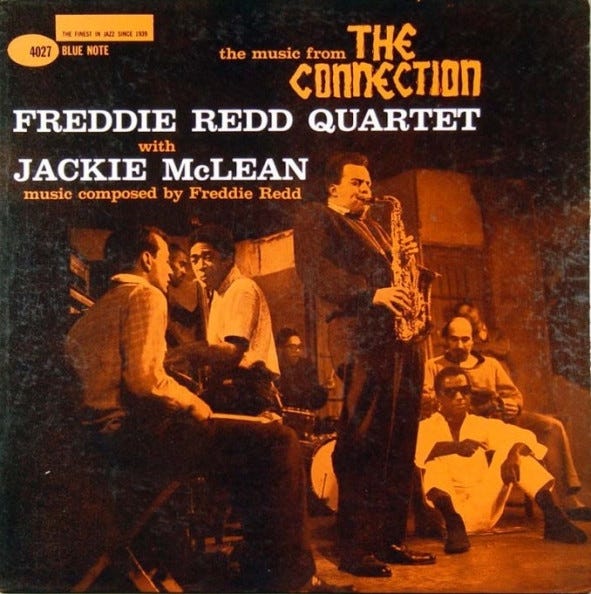
Freddie Redd died in the spring of 2021. He was ninety-two, which surprised people who assumed he’d been gone for decades, and the obituaries mostly had one album to talk about. Fair enough. It’s some album.
The story behind it is stranger than the record’s reputation suggests. In 1959 Jack Gelber wrote a play called The Connection for the Living Theatre, about junkie jazz musicians sitting around a room waiting for their dealer, and the production’s gimmick, or its honesty, was that the band onstage was real. Redd wrote the music and played it live, eight shows a week, with Jackie McLean beside him on alto, both of them acting a little and playing a lot, in front of audiences who’d come expecting a play and got something closer to surveillance. Nobody involved needed research for the subject matter. When Shirley Clarke filmed it in 1961, the discomfort survived the transfer, and Blue Note put out The Music from The Connection with the working band.
I think the nightly grind is the secret of the record. Most jazz albums document a band two or three days into knowing the material. This one caught a book of tunes that had been played hundreds of times in dramatic context, to silence, to walkouts, to whatever a 1959 Off-Broadway crowd did when confronted with the thing itself. The music came out lean. Hard bop by then had its signals, the gospel changes, the backbeat shout, the cathartic closer, and Redd’s score mostly declines them. “Who Killed Cock Robin,” “Music Forever,” “Melanie.” That last one is the one I’ve returned to for years and I still can’t fully account for it. Sparse but not unfinished, sad but dry-eyed. McLean’s tone helps; there was always something in his sound that refused to be pretty, and Redd kept writing him rooms where that refusal made sense.
As a pianist Redd is harder to describe, which may be part of the commercial problem. Some Monk in him, the willingness to leave a note sitting somewhere odd and let it sit. Powell’s fingerprints too, as on every pianist of that generation. But he didn’t have Monk’s strangeness or Powell’s velocity, and he doesn’t seem to have wanted either. Musicians rated him. Musicians rating you has never once paid a rent.
The rest of the catalog is thin and good. “Shades of Redd” from 1960 puts McLean next to Tina Brooks, a tenor player who’s his own whole essay in obscurity, dead at forty-two with four Blue Note sessions to his name, and the two-horn writing on that date is some of Redd’s best. “Redd’s Blues” sat unissued for years. I’ll resist calling these lost masterpieces, because they aren’t; they’re strong records by a distinctive composer, which ought to be enough, and in a saner accounting it would be.
Why the career stalled is not much of a mystery and I won’t dress it up. Heroin took years out of him at exactly the wrong times. He spent long stretches in Europe, off the American radar. And the music itself made a poor legend: no famous quintet, no documentable innovation you can pin a chapter to, no early death, and then, almost comically, no death at all for another sixty years. He just kept turning up. There’s footage of him in his late eighties playing club dates, the tunes from “The Connection” still in the book, the touch lighter but recognizably his.
Somebody who knew him told an interviewer he was among the gentlest men in the music. I never met him, so I pass that along at face value. What I can vouch for is “Melanie” at midnight, which after all these years still sounds less performed than remembered, and I notice that’s the second time I’ve failed to say it better than that.
Listen to Music From The Connection
Your tributes do a lot for an often underappreciated genre, and teach me about musicians I wasn't familiar with.
Thanks for this. Shirley Clarke’s movie of The Connection is currently on The Criterion Channel