

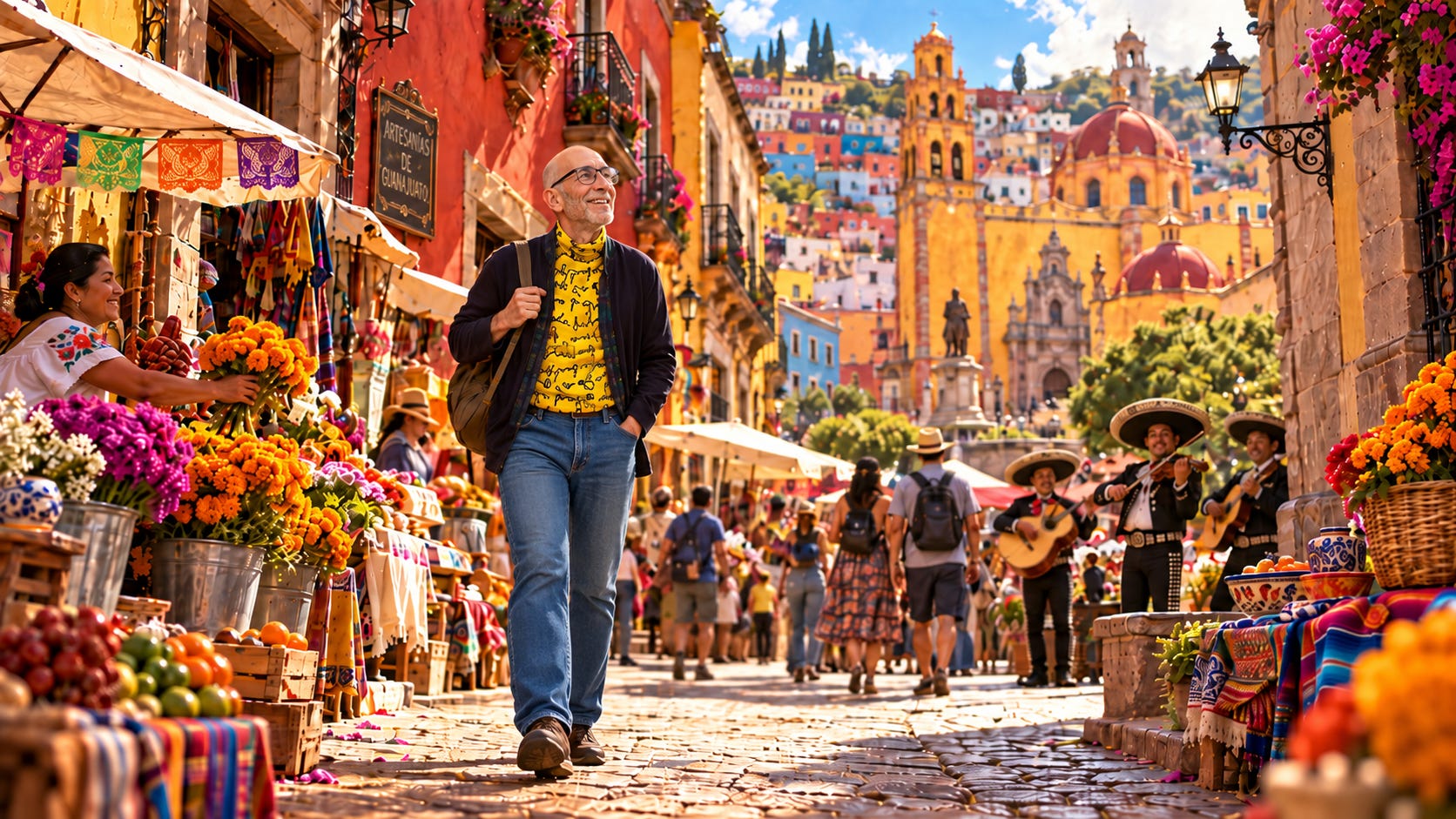
I am seventy-seven years old, which means I have had plenty of time to collect bad habits. One of them was worrying.
I got good at it. I worried about money when I had none, then worried about money when I had some. I worried about work, deadlines, doctors, banks, insurance companies, plumbing, cholesterol, passwords, taxes and people who said, “Your call is important to us.”
I lived in the United States most of my life. West Hartford, New York, Tucson, other places in between. I worked as a journalist for decades. Journalism is a profession built around the idea that something has gone wrong and you need to find out what it is before five o’clock. That trains you.
Then I got older. I had heart surgery. I had cancer. Parts of me have been removed, repaired, replaced or improved by people with better tools than God had available in the original workshop.
Eventually I wound up in Guanajuato.
I have been here four years now, and I did not come here looking for wisdom. I came here because life brought me here. That has been enough.
Guanajuato is a ridiculous city. I mean that affectionately. The streets go up when they should go down. You walk somewhere for fifteen minutes and discover you are directly underneath where you started. The city seems to have been designed by someone who had a personal grudge against straight lines.
There are tunnels everywhere. Motorcycles come through alleys wide enough for one nun and a grocery bag. Cars enter streets where no reasonable person would take a bicycle. The drivers do not seem concerned. Neither do the pedestrians.
I remain concerned for everyone.
Then there are the sounds. The gas truck has a song. The water truck has another song. Someone sells vegetables through a loudspeaker. Someone else sells mattresses. A man comes through sharpening knives and blows a whistle that sounds like a bird having a nervous breakdown.
The dogs bark. The church bells ring. Fireworks explode for birthdays, saints, weddings, football victories, funerals and private events I never learn about.
Sometimes they begin at six in the morning.
I have asked why. This was a mistake.
There is always an explanation, but the explanation usually leads to another explanation, and twenty minutes later I still do not know why somebody fired a rocket outside my window before breakfast.
Mexico is not quiet. Mexico is alive at high volume. Most days, I love it.
Near the Jardín, I often see an old man walking a little girl to school. I assume she is his granddaughter. She usually looks half asleep. He carries her backpack. Sometimes she drags behind him. He waits. She stops to look at a dog. He looks at the dog too. Then they move another twenty feet.
Nobody is performing kindness. Nobody is making a point. He is walking his granddaughter to school.
That is all.
There are scenes like this everywhere. Three construction workers sit on a curb eating lunch. A woman sells tamales before sunrise. Somebody drives past with six chairs tied to the roof of a Volkswagen. A man carries a ladder twice the length of his truck, secured with what appears to be string.
Nobody around him looks alarmed. I am alarmed enough for the entire neighborhood.
People here improvise. They fix things. They make do. They laugh when things go wrong. This took me some time to understand. I come from a country where something goes wrong and somebody immediately wants to speak to a supervisor.
Here the supervisor might be somebody’s cousin. He might come tomorrow. He might come Thursday. He might already know your neighbor.
By the time he arrives, somebody else has fixed the problem.
I spent a lot of my life believing efficiency was a moral virtue. Get there faster. Finish sooner. Make the call. File the story. Catch the flight. Solve the problem.
Then I came to Mexico and learned about “ahorita.”
Ahorita means now. Or soon. Or later. Or not today. Or possibly never.
You learn through context, except when there is no context. This is good for an old journalist. Journalists do not surrender easily. We believe there is always another phone call.
Mexico has taught me there is sometimes another beer.
People here are also different with one another. I hesitate to make broad claims because somebody will always find the exception, and they should. Mexico has plenty of cold people and America has plenty of warm ones. I am talking about what I see.
People touch more. They stand closer. They remember things. A cashier might remember what you bought last week. A taxi driver might ask where you are from, how long you have lived here, whether you are married, whether your children visit, whether you like Guanajuato and why you have not tried the mole at the place his cousin likes. By the end of the ride, he knows more about you than your cardiologist. Then he tells you where to eat.
This is not networking. Nobody says, “Let’s connect.” Thank God.
I spent many years around journalists, actors, directors, filmmakers and musicians. A lot of conversations had another conversation hiding underneath them.
Who do you know? What are you working on? Who is producing it? Who is publishing it? What comes next?
I participated fully. I was good at it.
Jazz musicians helped cure me of some of that. Musicians understand something journalists forget. Sometimes you are there because you are there. You listen. You talk. You eat. You hang out. Nobody has to monetize the afternoon.
That feeling exists here all the time.
People sit. This is another radical Mexican activity. They sit in doorways, on benches, outside shops, in the Jardín. Old men sit together and talk about whatever old men discuss in every country on earth. Health. Politics. Who died.
I am now old enough to qualify for the meeting.
Death is closer here too. Not in a morbid way. In a practical way. Dead relatives remain in homes in photographs. Families visit graves. Children go with them. Candles appear on sidewalks. Flowers stay around. The dead are not removed from the conversation as quickly.
I once stopped at a little memorial on a sidewalk. A photograph, flowers, a candle. There were thick layers of wax underneath it. Somebody had been relighting that candle for a long time.
People walked past. A woman carried groceries. A motorcycle went by. Somebody nearby was making tacos.
Nobody lowered their voice. Nobody turned the street into a cathedral. The dead person was still part of the neighborhood. That made sense to me.
I have written obituaries most of my life. Some were assignments. Some were people I knew. Some were people I loved.
Journalism teaches you how to handle death professionally. Confirm the age. Check the spelling. Call the family. Get the quote. File the story. Then move on.
At seventy-seven, death is no longer theoretical. You start losing friends, colleagues, musicians you knew, people you assumed would always be somewhere. You also start doing arithmetic you did not do at forty.
Ten years from now sounds different. So does five.
This does not make me sad all day. Quite the opposite. Ordinary things start to matter more. A good cup of coffee matters. My partner laughing in the next room matters. The cats sleeping where they are not supposed to matter. A walk through Guanajuato matters.
Even the hills matter, though I curse them. Guanajuato has an unreasonable number of hills. At my age, every street becomes a cardiology exam. You look up and think, surely there is another way.
There is not another way.
You climb. Halfway up, a woman twenty years older than you passes carrying groceries. This is humiliating. You pretend to be admiring the architecture. I have examined a great deal of architecture this way.
I do not want to turn Mexico into some spiritual alternative to the United States. Mexico has violence, poverty, corruption, family fights, bad government, disappearing plumbers, angry neighbors and people staring at phones.
It is a country. That is exactly why I love it. I do not need it to be perfect. I am too old to believe in perfect countries. I need a place where I feel alive. I found one.
The world feels unstable now. Wars. Politics. Climate. Technology moving faster than most of us understand. People seem angry. Governments seem confused. Every screen tells you what to fear before breakfast.
Then I walk outside. Somebody is selling strawberries. A dog is asleep in a doorway. A woman is sweeping the sidewalk. Teenagers are laughing too loudly. A truck is blocking the street. Nobody knows when it will move. A church bell rings. Then somebody sets off a firework for a reason I will never learn.
And I think, this is a good place to be old.
This is a good place to wake up. This is a good place to have survived long enough to appreciate it.
I do not know how many years I have left. Nobody does. I know I am grateful to be spending some of them here.
Grateful for Guanajuato. Grateful for Mexico. Grateful for the Mexican people who have made room for an old American journalist and filmmaker, with bad Spanish, too many opinions and a lifelong habit of asking questions.
Tomorrow morning I may see the old man and the little girl again. She will drag behind. He will carry the backpack. They will stop for a dog.
I will keep walking. Slowly.
There are hills.
Listening: Lee Morgan - TomCat
Lee Morgan’s Tom Cat stands out for its timing and its band. Recorded in August 1964, it pairs Morgan’s melodic trumpet with Jackie McLean’s biting alto and Curtis Fuller’s trombone, backed by a truly all-star rhythm section: McCoy Tyner, Bob Cranshaw, and Art Blakey (his last recording as a sideman). The three horns give the music weight and texture, while Tyner and Blakey bring unusual firepower to the rhythm section. The title track channels The Sidewinder’s loping groove into richer horn writing, and Tyner’s “Twilight Mist” provides a lyrical counterweight, revealing Morgan’s warm, almost vocal tone.
Despite that chemistry, Tom Cat remained unreleased until 1980, missing the chance to establish its reputation alongside Morgan’s better-known Blue Note albums. Michael Cuscuna, who oversaw its eventual release, considered it among Morgan’s finest sessions, with some of his strongest writing. That sixteen-year delay helps explain its relative obscurity: an inspired record became a discovery for collectors rather than a celebrated part of Morgan’s original run.
Next Tuesday: The Film America Preserved and Wouldn’t Let You See
In 1978, a UCLA graduate student made one of the greatest American films ever produced on leftover film stock with nonprofessional actors for under ten thousand dollars. For nearly thirty years, almost no one could legally see it. The story of Killer of Sheep is also the story of how America treats the lives it claims to honor.
"I once stopped at a little memorial on a sidewalk. A photograph, flowers, a candle. There were thick layers of wax underneath it. Somebody had been relighting that candle for a long time.
People walked past. A woman carried groceries. A motorcycle went by. Somebody nearby was making tacos.
Nobody lowered their voice. Nobody turned the street into a cathedral. The dead person was still part of the neighborhood. That made sense to me."
I love this, very bittersweet. It makes sense to me too.
Another enjoyable read. If we are lucky enough to get "old" some of us become more sensitized to the smaller elements around us that at a youthful age, we believed could "wait" until later. That "later" is now.