

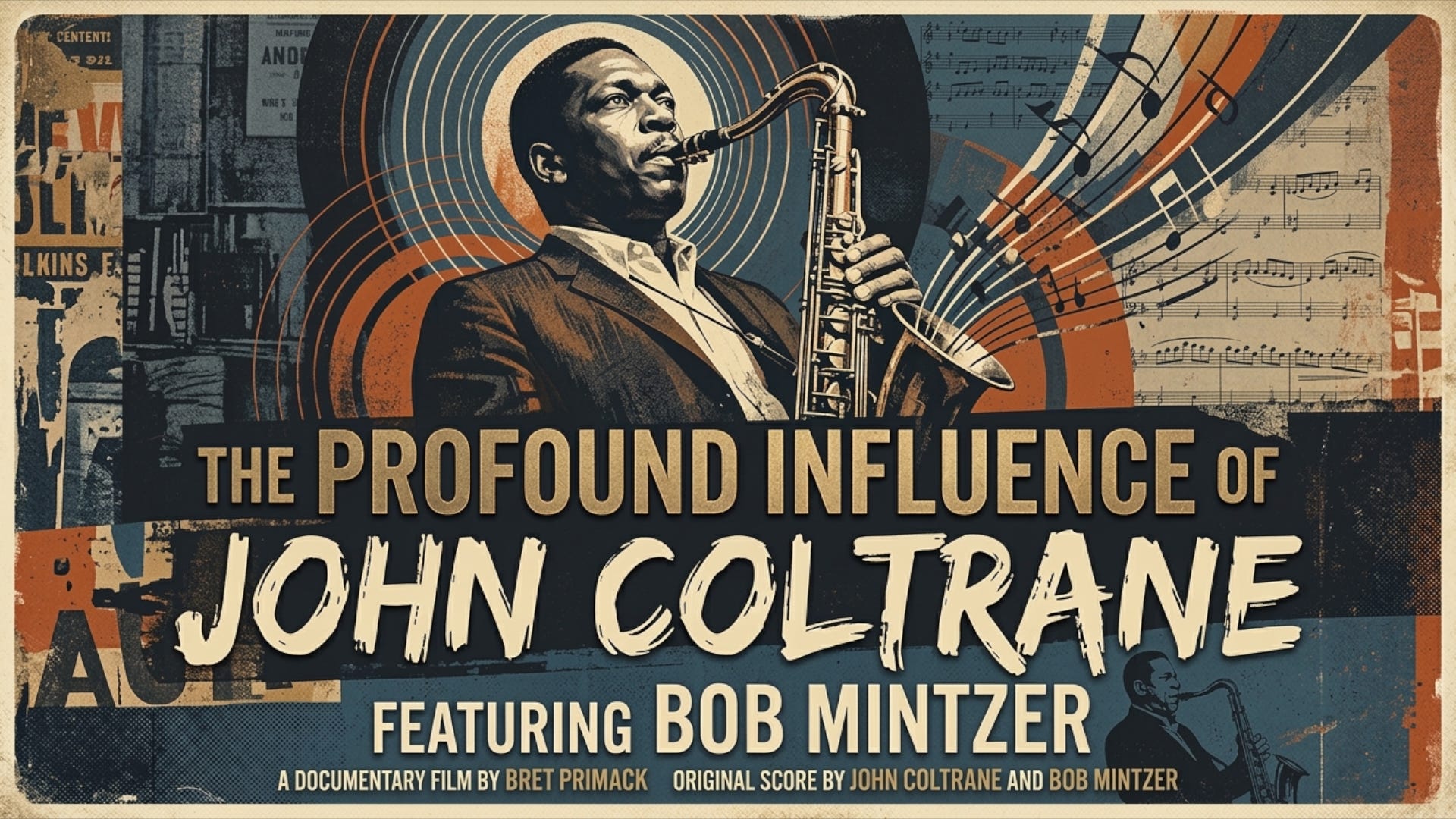
Last year, I wrote How John Coltrane Changed My Life: A Jazz Journey. This year, as we celebrate the 100th anniversary of Trane’s birth on September 23rd, I’m producing ten short documentaries exploring how he shaped the lives of musicians and writers.
The first features my friend Bob Mintzer. I’ve made a number of videos with Bob over the past fifteen years, and he’s everything you’d want in a collaborator — generous, tireless, and genuinely one of the most talented musicians I know.
For those unfamiliar with his work: Bob Mintzer is a New York-born tenor saxophonist, composer, arranger, big band leader, and jazz educator. He built his reputation through big bands and fusion groups, and for three decades has been a member of the Grammy-winning ensemble Yellowjackets. Early in his career he played alongside Tito Puente, Buddy Rich, and the Thad Jones/Mel Lewis Orchestra. He’s written hundreds of big band arrangements, appeared on over a thousand recordings, led his own Bob Mintzer Big Band to a Grammy for large jazz ensemble, and ran the Saxophone Program at USC. He’s currently leading the WDR Big Band, as well. His charts are performed by professional and student bands around the world.
Here’s something most people don’t know: Bob lives in Los Angeles on a street called Canyon Cove, in a house whose previous occupant was Arnold Schoenberg. Born in Vienna in 1874 and later an American citizen, Schoenberg became one of the defining figures of 20th-century classical music. He dismantled the foundations of Western tonal harmony, developed atonality — music without a fixed key center — and invented the twelve-tone technique, a compositional system built on all twelve notes of the chromatic scale arranged in a specific sequence, ensuring no note repeats until the others have been heard. It reshaped modern classical music entirely. I imagine Bob and Arnold would have had some remarkable conversations across that kitchen table.
This series is a natural extension of my book. There’s no shortage of films and biographies about Coltrane’s life — and I love Trane, but I have nothing to add to that record. What interests me is something less documented: the way he changed other people. These films are about his influence, and in that sense, they tell another side of his story.
I’ll be posting a new one every few weeks. Up next is Su Terry, an extraordinarily creative musician currently based in Ecuador — another old friend. Everyone in this series is, actually. A few names to look forward to: Joe Lovano, Lewis Porter (who wrote the definitive Coltrane biography), Dr. Denny Zeitlin, and writer Bob Blumenthal, who saw Trane perform live three times in the mid-sixties.
These films are a labor of love, but they’re time-consuming to make, so I’ll be cutting back to two posts a week going forward.
This is actually the first film I’ve produced in two and a half years. It’s a little rough around the edges, but I’m finding my footing again. I did use AI in the production — tastefully, I hope — and so far, no one has accused me of making AI slop, so I’ll take that as a win.
There will never be an AI Coltrane. Let me be clear about that. The world is full of extraordinary musicians right now, creating music that matters, music that moves people — but none of them are John Coltrane, and none of them ever will be. Not as an artist. Not as a human being. Not as a soul who seemed to be reaching for something just beyond the edge of what music could hold.
His sound does something to me I cannot put into words. It doesn’t just reach me — it finds me. It locates something I didn’t know was there and pulls it to the surface. Every time I return to him, I go somewhere deeper. The music doesn’t open up because it’s getting simpler. It opens up because I am.
No algorithm will ever do that. No model trained on every note ever recorded will ever conjure what Coltrane was, because what he was couldn’t be separated from his searching, his suffering, his faith, his hunger. He wasn’t producing music. He was becoming it — right in front of us, in real time, for the whole of his short life.
That’s not a template. That’s a person. And we only got one.
I’ve started a Coltrane blog, which features a wide array of multimedia content. Please check it out: Coltrane Code
Take a look at The Profound Influence of John Coltrane:
Me too Bret, from when I was a child. That sound just cuts straight to my soul.
Looking forward to the project, thanks!