

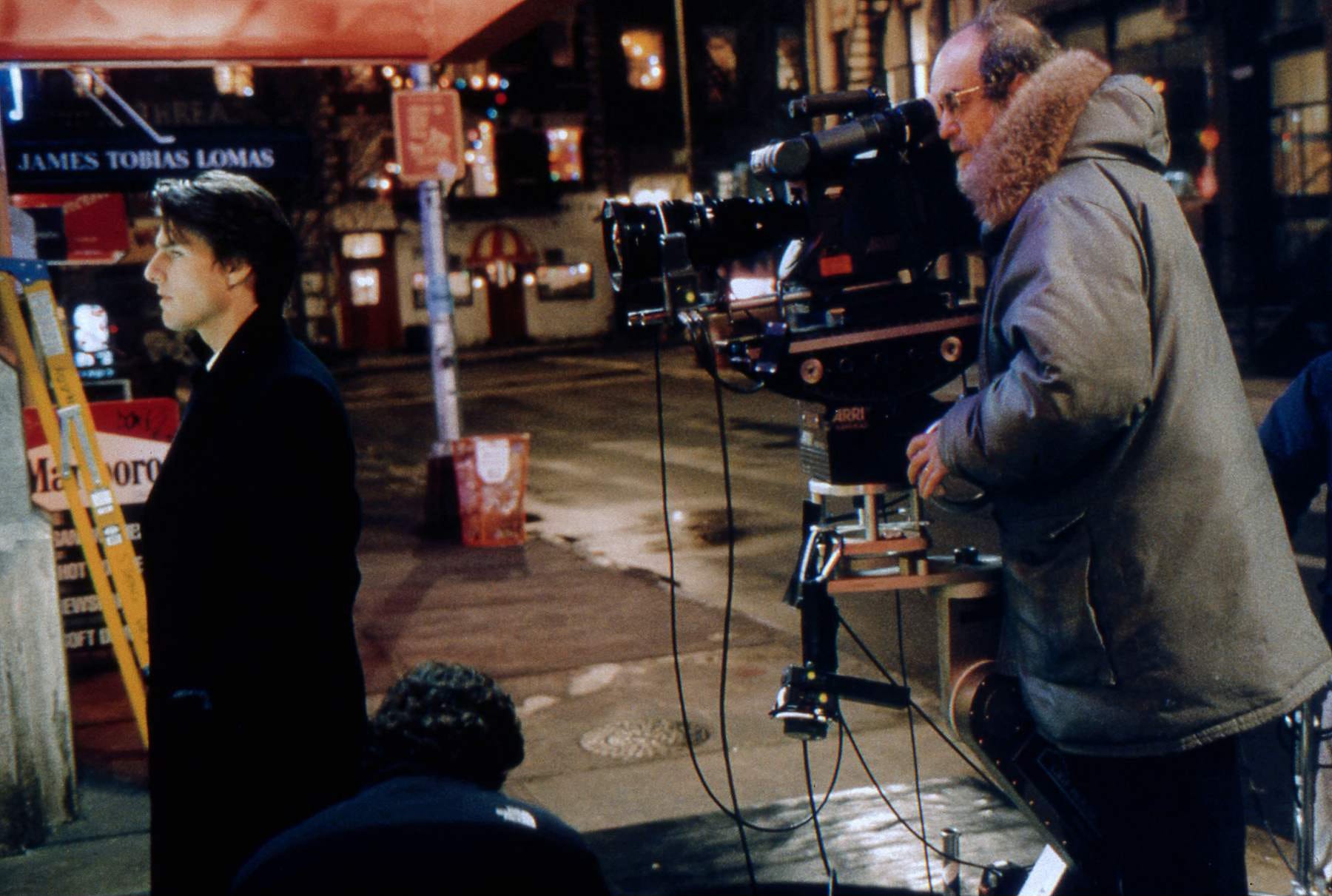
Stanley Kubrick died six days after delivering his final cut of Eyes Wide Shut to Warner Bros. He was seventy years old. His heart gave out, they said. The timing has haunted people ever since, and not without reason. Because what Kubrick put on screen in 1999 was not, as the press claimed, an erotic thriller about a jealous husband and a wandering wife. It was something far more dangerous: a portrait of how the ultra-wealthy have always operated in the shadows, and what happens to the young women who get caught in that world.
Jeffrey Epstein made the subtext impossible to ignore.
A Story That Predates Epstein by a Century
Here is the first thing you need to know: Kubrick did not invent this story. Eyes Wide Shut is based on Arthur Schnitzler’s 1926 novella, Traumnovelle, or Dream Story, a work Kubrick optioned in 1970 and spent nearly three decades developing. The novella already contained a masked sex party, a woman sacrificed to protect an intruder, and a costume shop owner who offers his teenage daughter for sex. Schnitzler was writing about the Viennese upper class before World War One. The sexual predation of the powerful was not a new story in 1926. It was not a new story in 1999. And Kubrick knew it.
That is precisely why the source material drew him in for thirty years. Not because it was salacious. Because it was true.
What Kubrick Actually Built
Kubrick was not a journalist. He did not have a list of names. But he was among the most precise and obsessive filmmakers who ever lived, a man who personally selected every mask worn during the orgy sequence, who chose the Venetian carnival aesthetic to evoke centuries of aristocratic anonymity, who shot the ritual scene at Mentmore Towers, a nineteenth-century English estate built for the Rothschild family.
Nothing in a Kubrick film is accidental
The world he constructed in Eyes Wide Shut is one where a physician, Bill Harford, exists on the edge of real power without understanding it. He is educated, respected, comfortable. He knows rich people. He thinks he is close to the center of things. Then his wife Alice, in a moment of unsettling honesty, tells him she once came close to destroying their marriage for a man she barely knew, and something cracks open in him.
What follows is less a plot than an initiation. Bill stumbles into a world that has always existed around him, one of masked ceremonies, of women who appear and disappear without explanation, of a power structure that can threaten a man into silence with a single unmasking. When he finally confronts Victor Ziegler, the wealthy patron who connects his two worlds, Ziegler explains it to him with calm contempt: the woman who sacrificed herself to save Bill was already gone. The whole thing was theater, Ziegler says. Or maybe it wasn’t. The point is that Bill will never know. And that is how it is supposed to work.
Scholar Arthur Versluis describes this as political gnosis, a revelation that behind the wealth and glamor of the American elite lies initiation into a corrupted secret network. He specifically notes the film’s depiction of human trafficking, of young women used for sexual exploitation by men who face no consequences because their money insulates them from accountability. The film does not show underage girls. It does not need to. The structure it reveals is the same structure.
The Epstein Mirror
In July 2019, Jeffrey Epstein was arrested on federal sex trafficking charges. He had spent decades running a network that funneled young girls, many of them minors, to the most powerful men in the world. He had already been convicted once, in 2008, and received a sentence so lenient it became a national scandal in itself. He had connections to presidents, princes, tech billionaires, financiers, and celebrities. He owned an island. He owned a private jet. He had a house in New York, a compound in New Mexico, a flat in Paris, and a townhouse in Manhattan that was one of the largest private residences in the city.
He was found dead in his cell in August 2019. The official ruling was suicide. Not everyone believes it.
When Newsweek and other major outlets began directly comparing Eyes Wide Shut to the Epstein case, they were not reaching. The architecture of the film maps almost perfectly onto what Epstein ran. A wealthy gatekeeper who controls access. Young women provided to powerful men. A world sealed off from ordinary scrutiny by money, by legal protection, by the threat of ruin to anyone who talks. And at the center of it all, not some cartoonish villain but men who move through polite society, who attend charity galas and shake hands with politicians, whose public lives are defined by philanthropy and prestige.
Bill Harford is any of us who got close enough to glimpse it and then was sent home.
The Pattern Is Ancient
The exploitation of young women by wealthy and powerful men is not a modern invention. It is not even a feature of capitalism specifically, though capitalism has refined and institutionalized it. It runs through every civilization with a ruling class. Roman senators. Medieval lords. Nineteenth-century industrialists who kept chorus girls and factory workers in parallel forms of bondage. The Viennese bourgeoisie Schnitzler wrote about in 1926. The Manhattan financiers Kubrick updated them into in 1999.
What Kubrick understood, and what the Epstein scandal confirmed with brutal clarity, is that the mechanism is always the same. Money creates access. Access creates opportunity. Power creates silence. The young women who enter that world are rarely there by genuine choice. They are there because poverty, ambition, coercion, or predatory grooming put them there. And when something goes wrong, the weight of the entire structure comes down to protect the men at the top.
The girl in Eyes Wide Shut who “redeems” Bill at the orgy, who offers herself in his place, who turns up dead afterward in circumstances that are never explained: she is not an abstraction. She is every young woman who entered Epstein’s orbit and found that the price of the world she was being shown was her body and her silence.
What the Film Cannot Say
Kubrick made a film about this world, but he made it as a dream. The title itself signals the condition he was diagnosing. Eyes wide shut. We are standing in front of it. We can see it, if we choose to see it. Most of us choose not to.
The orgy scene at Mentmore Towers is choreographed to feel both specific and unreal. The masks create anonymity. The ceremony has weight and ritual, the passwords, the central authority figure, the slow procession of participants. But it is also lit and staged to feel slightly wrong, like a memory or a hallucination. Kubrick gave himself and his audience plausible deniability. This is a dream, the film suggests. This is a man’s paranoid projection. Perhaps none of it really happened.
That ambiguity was both artistically honest and strategically necessary. A film that claimed to directly document elite sex trafficking in 1999 would never have been made, distributed, or seen. Kubrick found a way to tell the truth by wrapping it in enough unreality that no one could sue him for it.
He finished it. He died. Warner Bros. digitally obscured parts of the orgy scene for the American theatrical release without his approval, a decision that Roger Ebert and other critics found indefensible. The cuts were made to avoid an NC-17 rating, officially. Draw your own conclusions.
Seeing It Clearly Now
The Epstein case did not change what Kubrick made. It changed what we are able to see in it.
Eyes Wide Shut is a film about the oldest racket in the world: the powerful taking what they want from the young and the vulnerable, shielded by wealth, by ritual, by the complicity of everyone around them who understands the rules and stays quiet. Schnitzler saw it in Vienna in 1926. Kubrick saw it in New York in 1999. It took us until 2019, until an island and a flight log and a dead man in a Manhattan jail cell, to see it as clearly as they did.
It was never a conspiracy theory. It was always just reality.
And the title was always the point. Eyes wide shut. That is not an accusation aimed at the powerful. It is aimed at the rest of us.
I'd call Eyes Wide Shut Kubrick's one certifiable failure. I believe he died before he could make or approve the final cut, and Tom Cruise took the helm. I've seen it a few times because I like Kubrick - a lot, and I'll probably see it again because it seems important to check my perceptions against a genius, but the movie just doesn't hold for me. As for the message, thanks for pointing it out. I've gotten so caught up in the film making I've missed the forest for the trees. And, as to Trump/Epstein, it's entirely within the realm of possibility that a madman would start a war in order to deflect attention from his crimes, and that the cabal that is US government circa 2026 would go along with it. I hope we eventually see a reckoning.
I kind of hate this movie. The people I knew who were obsessed with it, who told me I just had to watch it, were usually abusers in my experience. What was so amazing about this movie. I lived it. I grew up with ritual abuse and trafficking. I remember all kinds of parties and events and rituals, including parties in big houses when I was a preteen. As an adult, I remember rich looking trafficking houses adjacent to the adult industry. I remember parties in the hills. But you all didn't watch this movie because you cared about the women and girls. You all think you see the truth now that you have stopped denying that this shit happens in real life because the Epstein files finally forced you to. You don't even see how misogynistic this movie itself still is.