

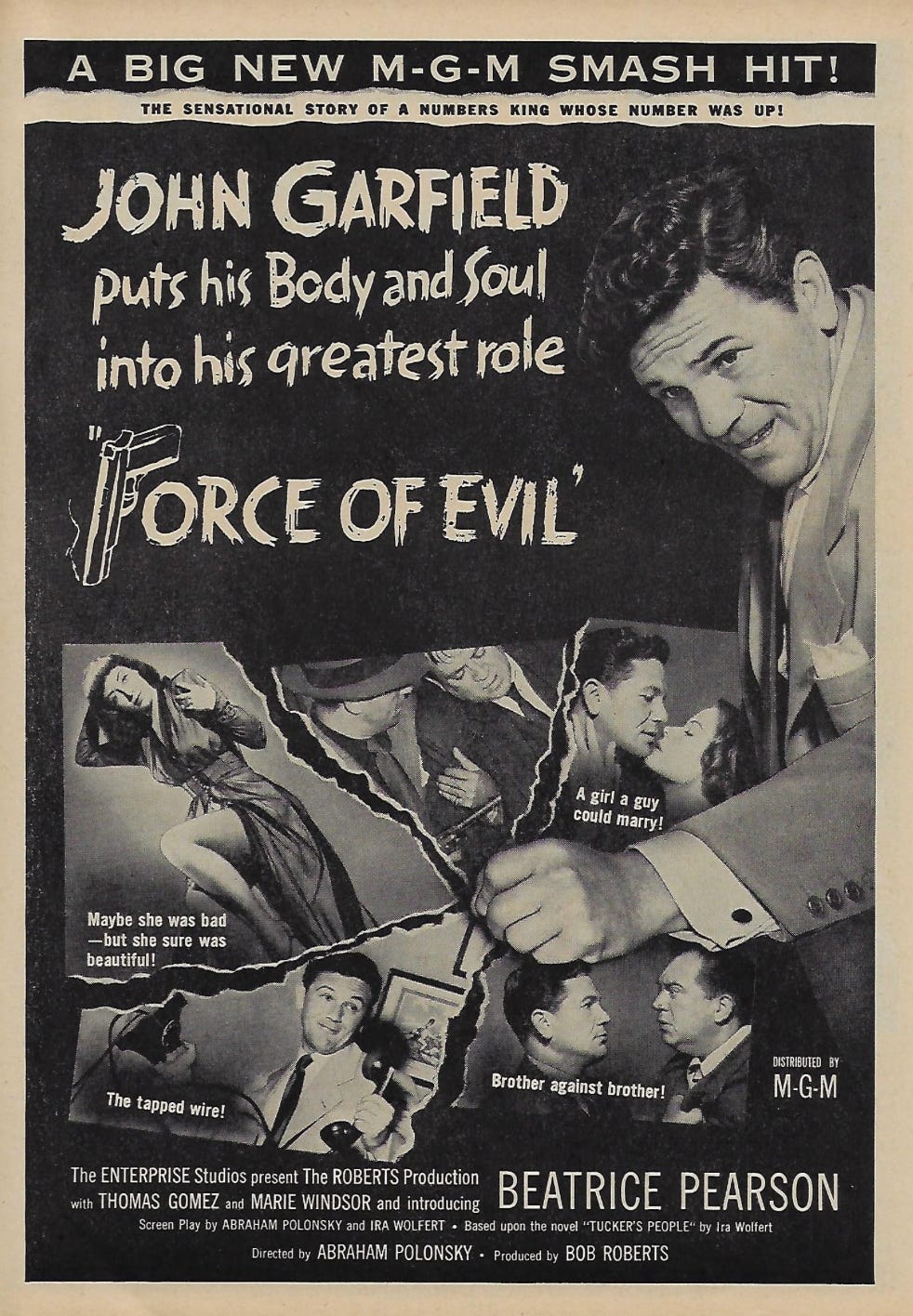
According to its creator, Force of Evil is capitalism itself. Abraham Polonsky feared for a society that valued money above all else believing such a system would invariably lead to unbridled greed and corruption.
Released in 1948, Force of Evil is nominally about the numbers racket, two brothers, a crooked lawyer, and a scheme to bankrupt every small-time gambling operation in New York. But that description is bureaucratic camouflage. The film is really about America as a criminal conspiracy whose members have forgotten they joined. Nearly eighty years after its release, it still speaks a truth most Americans would rather not hear: its indictment of America remains as urgent today as it was in 1948.
John Garfield plays Joe Morse, a Wall Street lawyer with sharp suits, fast talk, and the fatal confidence of a man who thinks intelligence makes him fireproof. Joe works for Ben Tucker, a gangster planning to monopolize the city’s numbers banks. The scheme is beautiful in the way a guillotine is beautiful: efficient, symmetrical, and horrifying once you notice where the head goes.
The trouble is Joe’s brother Leo, played by Thomas Gomez. Leo runs a small numbers bank. He is already a criminal according to the law, but not according to the emotional arithmetic of the film. He knows his employees. He worries about them. His crooked business retains some residue of human obligation. Joe proposes to rescue Leo by crushing him, absorbing his little operation into Tucker’s syndicate and calling the catastrophe progress.
That is the poison at the center of Force of Evil: Joe loves his brother. He genuinely believes he is helping him. Polonsky understands that evil rarely arrives announcing itself as evil. It arrives with projections, efficiencies, economies of scale, and a smart young attorney explaining that resistance is sentimental. Joe does not descend into corruption. He translates corruption into professional language until it sounds like common sense.
And the language! The characters do not merely speak; they chant, jab, circle, and confess. Polonsky’s dialogue has the pressure of blank verse trapped in a telephone booth. A business proposition becomes a prophecy. A threat sounds like scripture. Everybody appears to know that doom is coming, but nobody can stop negotiating long enough to leave the room.
The city itself joins the racket. George Barnes photographs Manhattan as a vertical empire of polished stone and moral vacancy. Offices loom like temples built for a god who accepts only cash. Staircases plunge toward judgment. The final descent to the Hudson River is among the great passages in American film noir: Joe traveling downward through the physical city and into the truth he has spent the whole picture converting into abstractions. At the bottom lies not a balance sheet but a body.
That is why the picture still bites. It refuses the comforting fantasy that organized crime is an infection attacking legitimate business from outside. Tucker’s syndicate does not oppose capitalism; it perfects its most predatory instincts. Consolidate the market. Eliminate the independents. Purchase the officials. Rename coercion as inevitability. Crime and commerce become indistinguishable except that the criminals are occasionally more candid.
This was dangerous territory in 1948, and soon the authorities came collecting.
On April 23, 1951, Garfield appeared before the House Un-American Activities Committee. He denied being a Communist and declined to identify supposed Communists in the film industry. He tried to preserve both his career and his refusal to become an informer. It was an impossible performance before men who had already decided that innocence without betrayal was guilt.
Two days later, on April 25, Polonsky faced HUAC. He invoked the Fifth Amendment and refused to name names. Congressman Harold Velde branded him a “very dangerous citizen”—which, translated from the dialect of congressional panic, meant a citizen unwilling to purchase his own safety with somebody else’s ruin. Hollywood blacklisted him. Force of Evil became his last directing credit for two decades. He continued writing through fronts and without credit, including work on Odds Against Tomorrow, but did not receive another screen credit until Madigan in 1968. His directing career resumed with Tell Them Willie Boy Is Here, released in 1969.
Garfield’s story was shorter and crueler.
Born Jacob Julius Garfinkle on New York’s Lower East Side, he had dragged himself from poverty and street fighting into the Group Theatre, then into Hollywood stardom. He brought the street with him. Before Brando became an earthquake and James Dean became a shrine, Garfield put working-class resentment on the screen without cleaning it up for company. He seemed to act with his whole nervous system.
He had also been born with a damaged heart. It kept him out of military service despite his attempts to enlist, though he entertained troops, supported war drives, and sold bonds. None of this protected him when the blacklist machinery selected him. No evidence established that Garfield had been a Communist, but evidence was not the currency of the spectacle. Names were. Confession was. Submission was.
After his testimony, the major film offers vanished. His last movie, He Ran All the Way, appeared in 1951 with a title that now sounds like an epitaph. He returned to Broadway in Golden Boy, playing a boxer whose talent becomes entangled with money—the kind of role that must have felt less like fiction than surveillance.
The pressure intensified. Garfield attempted to clear himself without sacrificing friends or his wife, Roberta, who had once belonged to the Communist Party. According to later accounts, the FBI confronted him with a file on her and offered him an escape route through denunciation. He refused. The man who played Joe Morse would not make Joe Morse’s bargain.
On May 21, 1952, Garfield died of a heart attack. He was thirty-nine. His heart condition was real and longstanding, so it would be reckless to issue a medical verdict declaring that HUAC killed him. But the persecution, unemployment, investigations, threats, and strain formed the atmosphere in which that damaged heart finally stopped. The Harry Ransom Center’s account says the stress of HUAC was believed to have contributed to the fatal attack; Garfield’s daughter later remembered him as devastated by the blacklist. Around 10,000 mourners reportedly came to say goodbye.
So watch Joe Morse descending those enormous stone steps again. He is walking toward his murdered brother, but history has placed other bodies down there. Garfield is among them: a magnificent actor driven out of the industry at thirty-eight and dead at thirty-nine. Polonsky is there too, artistically buried alive for refusing to inform.
Force of Evil predicted today’s American nightmare. A large institution corners individuals, converts fear into cooperation, demands betrayal as the price of survival, and calls the process lawful.
The racket always has a respectable office. Today that is the Oval Office, with its advisors, its lawyers, its machinery of coercion dressed in constitutional language.
The racket always says it is protecting America. What it really does is consolidate power and transfer wealth upward—to the people who run it, who benefit from it, who sleep soundly while the bill accumulates.
And somewhere below, beside the dark river, lies that bill.
When does it come due?
You can view Force of Evil on YouTube. Here’s the trailer:
Next Tuesday: Celebrating Sonny Rollins
On Saturday, September 19, a Celebration of the life and music of Sonny Rollins will be held at the Church of the Saint Devine, in New York, a fitting location for one of New York’s favorite sons. I was asked by the Jazz Foundation of American and the Rollins family to create a video for the event. Next week, you can view the video on this blog, along with my thoughts about the late Saxophone Colossus.
Listening: Marcus Miller - Hannibal
I’ve known Marcus since the late 70s, when Mr. Miller and his friend, drummer Kenny Washington, played with pianist Walter Bishop, Jr.’s group. A decade later Marcus played with Miles and they were collaborators, most notably the album Amandla which features Marcus’ composition, “Hannibal.”
Today Marcus Miller is one of the most influential electric bass players, producers, and composers in modern jazz and fusion. Born in 1959 in Brooklyn, he's known for pioneering the slap bass technique in jazz and contemporary music.
His work with Miles Davis—particularly on Amandla—is considered crucial to understanding that era of Davis's music, where he was integrating electronic sounds and contemporary production into his jazz foundation.
Twenty years later, in 2009, Marcus played “Hannibal” with his quintet at the Auditorium Maurice Ravel in Lyon, France: Marcus Miller (b),
Christian Scott (tp), Alex Han (as), Frederico Gonzales Pena (keyboards), and Ronald Brun, Jr (dm).Miles would be proud.
Listen:
What we have is crony capitalism, the inevitable result of a large society with big business and big government. A small society with a very small government that could not do favors for business interests would work better. Maybe Sweden circa 1960. But the problem is people romanticize socialism as something other than the monster it is. And liberals destroy everything they touch in the long run. (The EU, the UK, the Anglosphere). I think the human race is a failed species.
Watched this last night. Man, we've come a long way and haven't moved an inch all at the same time.