

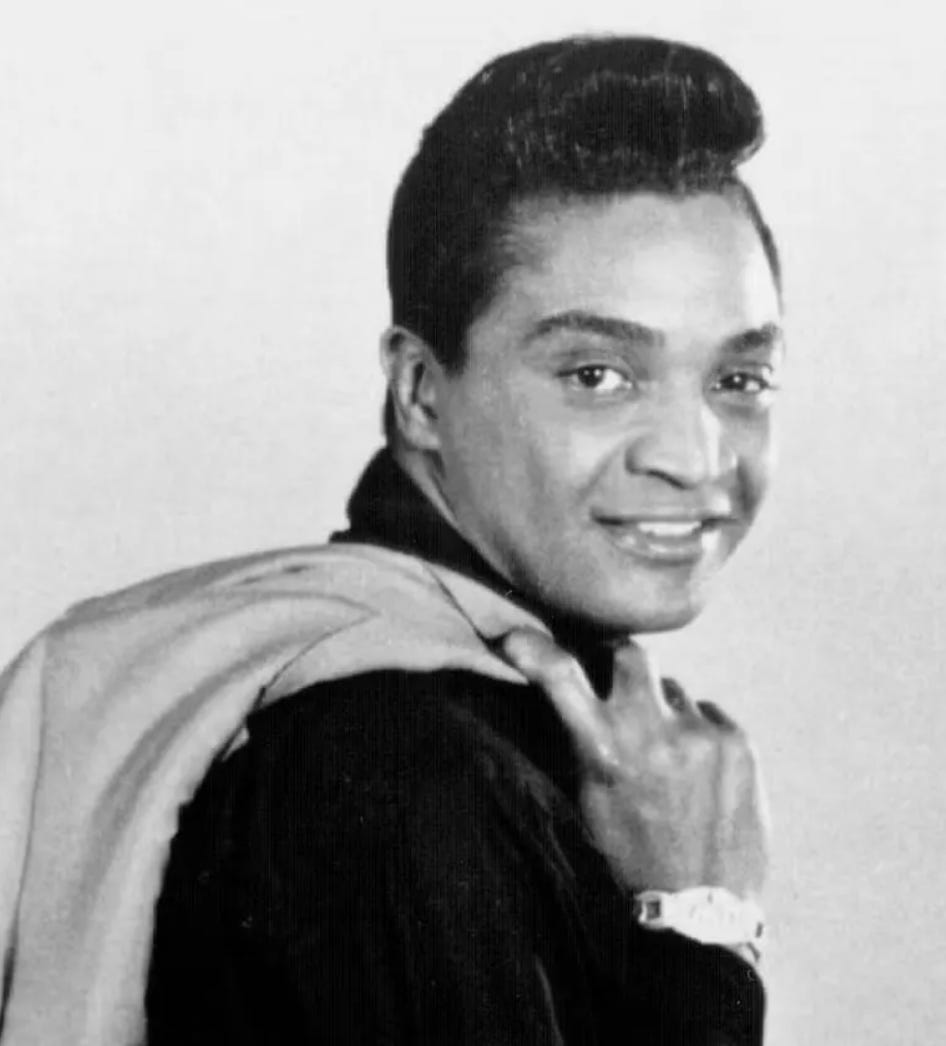
The first thing you notice is the body.
Jackie Wilson does not merely enter a song. He attacks it. He drops to his knees as if struck by lightning, springs back up before gravity can file the paperwork, spins across the stage without losing a syllable, and then—somehow—finds enough oxygen to drive a love song straight through your ribs. The man is immaculate and unhinged. Gospel fire in a sharkskin suit. A prizefighter armed with a microphone.
They called him Mr. Excitement because “The Human Detonation Device” would not fit on the marquee.
Watch the footage now and you can see the future arriving in real time. James Brown is in there. Michael Jackson is in there. Generations of soul singers, rock frontmen, and pop idols are waiting inside those knee drops and impossible pivots. Wilson changed not only how American music sounded, but how it moved.
Then America did what it so often does with Black genius: it swallowed the invention, paid everybody standing near the inventor, and misplaced the receipt.
The record business of the 1950s and ‘60s was not a carnival but a protection racket designed to look like opportunity. Here’s how it worked: A label signed an artist for a percentage of sales—usually 3 to 5 percent of wholesale revenue, sometimes less. Before the artist saw anything, the label subtracted studio costs, production, marketing, promotion, and distribution. Then came the manager’s cut—typically 15 to 25 percent of gross earnings, taken off the top before calculation. Then the booking agent, taking another slice. Then the lawyer. By the time money reached the performer, it had passed through so many hands that its relationship to the fortune the voice had generated bore no resemblance to the original sum.
I once interviewed Al Kooper who co-founded Blood, Sweat and Tears, and wrote most of their early hits. I asked him if he was still collecting royalties and he laughed. He told me that the way the contracts were written, he still owes Colombia Records money. Every time they reissue those greatest hits recordings, the artist get charged again for the production.
Wilson had hit after hit. “Lonely Teardrops” in 1958 rocketed up the charts and blasted through the barricades separating rhythm and blues from respectable white radio. “To Be Loved” followed. Then “(Your Love Keeps Lifting Me) Higher and Higher” in 1967—one of those records that sounds less like it was recorded than uncorked. These were not accidents. Wilson was helping design the architecture of soul music: ecstasy welded to anguish, church testimony fused with nightclub sexuality, absolute control performed as total abandon.
And yet, with each success, Wilson’s actual bank account remained thin.
The solution was always the same: tour more. The machine required fresh blood, and Jackie Wilson was expected to provide it nightly. Venues booked him two, three, sometimes four shows a week. His body became a product with an inventory that needed constant replenishing. He traveled by bus between cities, performed in smoke-filled clubs where the air itself seemed designed to wear down a human voice, then traveled again. The money that came in from these performances was supposed to compensate for what the record industry had taken. It rarely did.
In 1961, during an argument in a New York apartment, Wilson was shot. The bullet entered his stomach and nearly killed him. He survived. Then he went back to work.
Of course he did. In America, survival for a performer is mistaken for consent. If the artist returns to the stage, the industry assumes the wound has healed. Nobody asks whether the stage is the only place left to go. Nobody considers that for a man with mounting medical debt and a family depending on his income, the stage is not a choice but a requirement.
Wilson kept performing. He kept moving. He kept selling tickets that generated money that flowed through the same channels, reaching him diminished.
Then came the event that no choreography could survive.
In 1970, Wilson’s sixteen-year-old son, Jackie Jr., was shot and killed during a robbery at the family home in Detroit. The body of this boy who carried his father’s name lay in a hospital. The funeral arrangements required payment. The grief required space to breathe. But the touring schedule had already been booked. The promoters had already sold tickets. The venues expected their show.
Wilson continued performing. Not because he wanted to. Because the machine had already been fed and would not allow a pause.
On September 25, 1975, Wilson stood onstage at a nostalgia show in Cherry Hill, New Jersey. He was singing “Lonely Teardrops,” the song that had helped make him immortal. He was forty-one years old. His body, which had spent more than two decades as an instrument of precision and revelation, was exhausted in ways no audience could see.
Then his heart stopped.
Some people in the crowd reportedly thought the collapse was part of the performance. Why wouldn’t they? Jackie Wilson had spent years teaching audiences that the human body could fall, twist, tremble, and rise on command. They waited for him to spring back up.
But this time he did not rise.
CPR kept him alive, but the oxygen deprivation caused severe brain damage. Mr. Excitement—the man whose body had served as both instrument and revelation—could no longer perform or speak coherently. The voice that had driven love songs through ribs could no longer form words.
What followed was not a gentle fade but a grinding institutional aftermath. Wilson spent the next nine years in facilities, his body present but unreachable. The disputes over his money continued even as he lay incapacitated. Managers and lawyers argued about contracts and royalties. The industry that had extracted everything from his motion now hovered around his stillness, still calculating percentages.
He received no settlement. No buyout. No dignity clause written into his contracts that might have provided security when his body finally failed. He remained, as he had always been, a resource that had been fully consumed.
Wilson died in January 1984, broke and only forty-nine years old.
There is no clean moral here, no sentimental fade-out where opening chords wash away the ugliness. Posthumous honors cannot reimburse a stolen life. Wilson entered the Rock and Roll Hall of Fame in 1987, three years after his death—a correct verdict delivered by a court that had adjourned too late.
His story is bigger than one artist’s misfortune. It is the American entertainment industry rendered as an X-ray: Black brilliance burning at the center while managers, labels, imitators, and institutions gather around the glow. Michael Jackson called Wilson a profound influence. James Brown studied him. Elvis Presley admired him. But American culture has a peculiar accounting system: the artists who carry an innovation into the largest marketplace become immortal, while those who forged it are reduced to trivia questions.
Jackie Wilson gave popular music a new body. He taught it to drop to its knees, spin through pain, leap toward ecstasy, and come down perfectly on the beat.
The culture kept the moves.
It should remember the man.plainly.
View Jackie Wilson singing “Lonely Teardrops”
Listening - Facing You - Keith Jarrett
Keith Jarrett was on tour with Miles Davis in 1971 when ECM’s Manfred Eicher suggested he come into the studio on a day off to record his first solo piano outing, Facing You. With Miles, he was playing all electric instruments, and to my ears, the music came alive. I got to hear him live several times with that incarnation of Miles’ groups. But after a couple of years with Miles, he never really played electric again.
After Facing You, he began playing more solo concerts, including The Köln Concert (1975) his best-selling album and the best-selling solo piano recording in history. Created under difficult circumstances on an inferior piano, it became a classic because of its melodic flow and emotional immediacy. He basically invented: start-to-finish spontaneous improvisation with zero prepared material.
Facing You features shorter studio improvisations. It’s intimate, lyrical, and one of his most accessible recordings. Jarrett’s improvisational voice is present throughout. The music blends jazz, classical influences, gospel, folk, and lyrical melody into a highly personal style. For many longtime Jarrett listeners, Facing You remains one of his most balanced studio recordings, combining memorable compositions with the spontaneous feeling that became his signature.
Listen to Facing You.
Watching: Ben Hecht and the Kiss That Killed the Ordinary Noir
When Kiss of Death arrived in 1947, it looked like another crime drama. Based on Eleazar Lipsky’s novel Stoolpigeon, it followed a familiar story. A thief turns informant after personal tragedy, struggles with his conscience, and seeks redemption. Director Henry Hathaway gave the film documentary realism by shooting in New York locations, and Victor Mature delivered a restrained performance. On paper, nothing suggested a classic.
Ben Hecht changed that.
Working with Charles Lederer, Hecht added one unforgettable creation who barely existed in Lipsky’s original story. Tommy Udo serves almost no plot function beyond terror. He doesn’t need a motive. He doesn’t seek revenge or profit. He simply erupts into violence because he feels like it.
Hathaway later said the notorious scene in which Udo pushes a woman in a wheelchair down a staircase came directly from Hecht. Hecht envisioned Udo as an unpredictable addict, someone who “will shoot you or stab you, they’ll do anything.” No backstory explains his behavior. That absence of logic is exactly what makes him frightening.
Every other character in Kiss of Death operates through bargains. The prosecutor exchanges leniency for testimony. Nick Bianco risks everything to protect his daughters. The film revolves around transactions. Udo stands outside that system. He cannot be reasoned with because he isn’t playing by the same rules.
Richard Widmark’s chilling performance, especially the famous giggle, became legendary. Yet Widmark was filling a shape Hecht had already designed. Udo appears briefly, disappears for much of the film, yet dominates every scene after his introduction. That is exceptional screenwriting. Hecht understood that a villain doesn’t need constant screen time. One unforgettable act leaves the audience carrying the fear for the rest of the movie.
This instinct runs through Hecht’s best work. Menace comes from specificity, not repetition. A vague threat fades. A wheelchair tumbling down a staircase never does. The image lingers because it is concrete and unexpected.
The Academy recognized Widmark with an Oscar nomination, while Hecht’s structural brilliance faded into the background. Yet Tommy Udo remains one of cinema’s greatest villains because Hecht understood a simple truth. One character who refuses every rule is enough to transform an ordinary noir into an unforgettable one.
Next Tuesday: The Oral Jazz Man
Lenny Bruce called himself an oral jazzman literally: he improvised onstage the way Charlie Parker soloed, unscripted and uncensored, shaped by the audience’s pressure rather than aimed at pleasing it. He picked up this method in mid-1950s strip clubs, absorbing it from the modernist jazz musicians around him, then used it to blow apart stand-up’s safe, scripted form the way bebop had blown apart swing. His 1961 arrest came not at a comedy club but at San Francisco’s Jazz Workshop, and it exposed the real difference: Parker got away with playing too fast for comfort, but Bruce, talking just as honestly about religion, sex, race, and power, found that language could be prosecuted in ways a saxophone couldn’t. Both men died young from total commitment to their art; only Bruce was arrested for it, and he kept blowing anyway.
I knew very little about him, thanks for this. Looks like Elvis copped a lot of his s____.
His live performance of Danny Boy is The One for me.
https://www.youtube.com/watch?v=sS9xhiudphU