

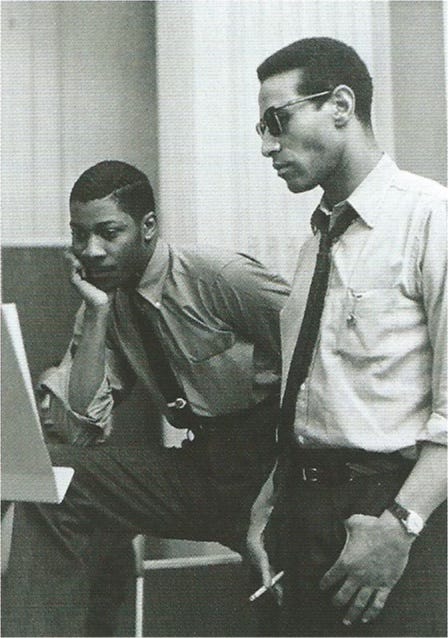
Booker Little died in 1961 at twenty-three, before most people knew who he was. That remains one of jazz history's most consequential losses, and one of its least discussed.
Memphis, Tennessee has given jazz some of its most vital voices, but none more heartbreaking in what was left unfinished than Booker Little. Born there in 1938, he arrived in the music at precisely the moment when hard bop was beginning to crack open into something wilder and more searching. He was present at that threshold, one hand reaching back toward the lyrical tradition, the other pointing into unmapped territory. And then, in October 1961, at the age of twenty-three, he was gone. Kidney disease took him, uremia most likely, and the cruelest part is that many of the people around him did not fully understand how sick he was until near the end.
What he left behind in those few years of recorded work constitutes one of the most unjust silences in jazz history.
The word underheard gets used casually, but in Little’s case it carries real weight. Here was a trumpeter who had already developed a voice so distinctive that it defied the dominant influences of the era. In the late 1950s and early 1960s, a young trumpet player had two enormous gravitational forces to navigate: Miles Davis on one side, Dizzy Gillespie on the other. Nearly everyone bent toward one or both. Little did not. He carved out something that belonged entirely to himself, a sound that was lyrical but tense, emotionally raw but intellectually constructed, precise without ever turning cold. His phrasing had a quality of fragility threaded through urgency, as though he understood, even in his early twenties, that nothing was guaranteed.
That originality alone would make him remarkable. But it was his partnership with Eric Dolphy that pushed his work into genuinely essential territory.
Dolphy, who would himself die tragically young in 1964, was among the most restlessly inventive minds in jazz at the time, a musician who could move between the alto saxophone, bass clarinet, and flute with complete mastery, always finding new ways to stretch a musical idea past its comfortable edges. When he and Little played together, something rare happened: two musicians of equal imagination and equal seriousness found a shared language that was freer than hard bop but never abandoned emotional depth. Their collaboration on “Far Cry” captures this beautifully. The interplay is conversational in the deepest sense, two voices thinking out loud together, pushing each other toward discoveries neither might have reached alone.
Then there is “Out Front,” Little’s 1961 album and arguably his fullest statement as a leader. The record is astonishing when you consider his age. There is nothing tentative about it, no sense of a young musician still finding his way. The compositions are structurally ambitious, the playing is assured, and the emotional range moves from tenderness to something close to anguish without ever losing coherence. “Out Front” is the work of a mature artist, which makes it simultaneously thrilling and devastating. This was not a promising early effort. This was a fully formed creative vision. It simply ran out of time to unfold.
His associations tell the story of a musician operating at the highest level of the music. Max Roach, one of jazz’s supreme intellects, recognized something in Little and made him a key voice in his ensemble, appearing on “Percussion Bitter Sweet.” John Coltrane, already deep into his own transformation, shared space with him on “Africa Brass.” These were not casual connections. Musicians of that stature chose their collaborators carefully, and the fact that Little moved in that constellation says everything about where he stood.
So the question that jazz listeners and musicians have circled for decades is inescapable: what would he have become?
The 1960s were about to explode. The free jazz revolution that Ornette Coleman had sparked was gathering force. Coltrane was moving toward his most radical period. Miles Davis would soon begin the long journey toward fusion. The entire architecture of jazz was being rebuilt, and Booker Little was positioned, by temperament, by training, and by association, to be one of the central voices in that rebuilding. His willingness to explore freer structures, combined with his grounding in genuine lyricism, was exactly the combination that the music needed and would hunger for throughout that decade.
Would he have followed Dolphy into the furthest reaches of avant-garde expression? Would he have found a way to bridge the free players and the more traditionally rooted musicians, the way only a handful of artists managed to do? Would he have led his own bands into territory we can barely imagine? These questions have no answers, and that is precisely the injustice.
There is a particular grief that attaches to artists who die before their arc completes. It is different from mourning a long life fully lived, as we just did with Sonny Rollins, who was 95 when he passed. With Booker Little, you are not mourning what was. You are mourning what was forming, the half-built cathedral, the novel with pages torn out, the conversation interrupted in the middle of a sentence that was heading somewhere extraordinary.
His recordings stand as evidence of a genuine original, someone who heard the music differently and had the technique and the courage to translate that hearing into sound. “Out Front” alone should be in every serious jazz collection. The work with Dolphy at the Five Spot, documented on “Live! at the Five Spot,” captures two musicians in that rare state of mutual discovery, feeding each other ideas faster than either could have produced alone.
But perhaps the most honest tribute to Booker Little is simply to listen, and to hold the silence that follows with some awareness of what it contains. That silence is not empty. It is full of music that was never made, collaborations that never happened, albums that exist only as the faintest shadow of possibility. Uremia stole all of it in 1961.
He was twenty-three years old. He had already changed the way the trumpet could sound. He was just getting started.
Listen to “Fire Waltz” by pianist Mal Waldron, from Eric Dolphy and Booker Little Quintet at the Five Spot - Fire Waltz (1961). Personnel: Booker Little (trumpet), Eric Dolphy (alto sax), Mal Waldron (piano), Richard Davis (bass), and Ed Blackwell (drums).
Listening - Night Train - Maynard Ferguson
“Night Train” is a blues locomotive designed to be simple. Jimmy Forrest’s original, made famous by Oscar Peterson and then Ray Charles, is a groove vehicle, not a showcase piece. It earns its power through repetition and momentum. Taking that into a Maynard Ferguson big band context risks either crushing the blues feeling under too much arrangement or letting the band just coast. What pianist and arranger Mike Abene understood, and what makes the track land, is that the arrangement serves the pocket rather than escaping it. The band’s weight becomes the train itself rather than commentary on it. Ferguson’s trumpet doesn’t try to domesticate the blues or transcend it; he rides it.
The album holds up sixty years after its release, for a related reason: it’s a farewell without sentimentality. This was the end of one of the great working orchestras in jazz, and nobody appears to be treating it that way. There’s no valedictory self-consciousness. The band, augmented by some superb studio players, plays like it expects to show up next week. That unselfconsciousness is what gives recordings longevity. The ones that know they’re historic usually sound it in the wrong way.
The other thing working in the album’s favor is the rhythm section. Richard Davis on bass and Mel Lewis on drums are not Ferguson band regulars; they’re first-call New York studio musicians at the peak of their powers. That rhythm section could make anything breathe.
Listen to “Night Train” - from The Blues Road by Maynard Ferguson, arranged by Mike Abene with an alto solo by Charlie Mariano:
Watching - The World Cup
The championship game of the 2026 World coming is coming this Sunday at 3pm EST.
The World Cup happens once every four years, so every tournament carries weight a regular season game can’t match. Players get one shot every four years to define their career on this stage — that raises stakes for everyone watching.
National stakes without the messiness of real nationalism most of the time. You get to feel tribal, loud, and emotionally invested in a group of strangers because they’re wearing your country’s shirt. It’s identity and belonging without much personal cost.
The format rewards drama. Single elimination knockout rounds mean one bad half can end a great team’s tournament. That unpredictability is what makes the group stage matter and the knockout rounds unbearable in a good way.
Low scoring raises the value of every goal. Because scoring is rare, each goal is an event, not a routine occurrence. That’s part of why celebrations are so extreme and why a single moment can decide a match.
Global simultaneity. Billions of people are watching the same 90 minutes at the same time, which is increasingly rare in a fragmented media world. That shared experience amplifies the emotion of it.
Next Tuesday: Don’t Fear AI, Fear Those Who Own It
The robots aren’t the problem. We are.
Every technology gets sold as salvation, then handed to the people with the most money and the least conscience. AI won’t be different. It doesn’t create greed, tribalism, or the hunger for control, it just amplifies what’s already there, at a scale that makes Facebook look like a mimeograph machine.
The real question isn’t whether AI becomes conscious and turns on us. It’s who controls it, what they want, and what happens when that conflicts with what the rest of us need.
Thanks for highlighting one of the most overlooked talents in jazz history. As you share, all the right people knew about Booker Little and for all the right reasons.
Oh to the heights he might have scaled!!!
My first Dolphy album was Far Cry. This track is INSANE! Dolphy's on fire. I think of him as THE GREEATEST of them all. Xcept for Bird.