

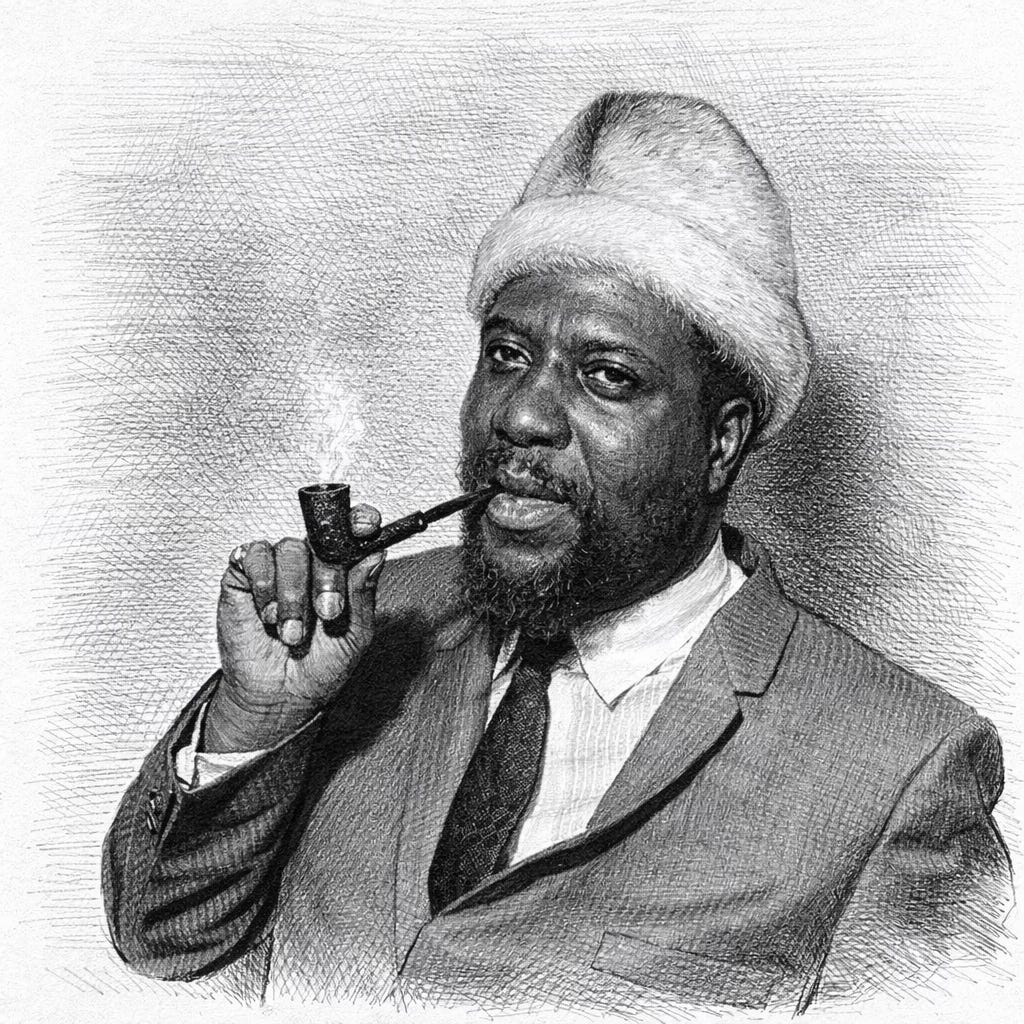
Thelonious Monk is one of the most fascinating figures in jazz history, and his idiosyncrasy and importance are deeply intertwined.
His piano technique was immediately striking. He used a flat-fingered approach, striking keys with his fingers nearly parallel to the keyboard, which was considered “wrong” by classical standards. This produced a percussive, angular sound quite unlike the fluid legato style of most jazz pianists. He would also do peculiar things mid-performance: stand up from the piano and dance in small circles while other musicians soloed, then sit back down with perfect timing.
His sense of space and silence was radical. Where other pianists filled musical space, Monk left deliberate gaps — rests that felt almost confrontational. Notes would land just slightly “off” from where you expected them, creating a lurching, surprising rhythmic feel that many listeners initially found baffling.
His compositions were full of dissonance, flatted seconds (minor ninths played together), and unexpected harmonic turns. He seemed to actively resist musical smoothness. Even his melodies had an angular, almost awkward quality that was entirely his own.
He was also a deeply private and eccentric personality, prone to long silences in conversation, unpredictable behavior, and an otherworldly detachment that made him a genuinely mysterious figure.
As a composer, Monk’s catalog is extraordinary. Pieces such as “Round Midnight,” “Straight No Chaser,” “Blue Monk,” “Well You Needn’t,” and “Ruby My Dear” have become permanent fixtures of the jazz repertoire, played by virtually every serious jazz musician since. His melodies are so distinctive that they resist being smoothed out; they force performers to engage with his logic rather than impose their own.
John Coltrane spent nearly a pivotal year in Monk’s quartet, from 1957 to 1958, and the experience functioned less as a sideman gig than as an intensive graduate seminar in harmonic architecture. Monk would routinely teach Coltrane his compositions by playing the melody with one hand while voicing the underlying chords with the other directly against Trane’s horn, so that Coltrane could physically feel the harmonic relationships. It was immersion learning at the highest level.
What Coltrane absorbed from Monk went straight to the foundation of what he would later build. Monk’s willingness to stack dissonances, to treat the flatted second not as an error but as a color, opened a door for Coltrane into the upper partials of chord structures. The sheets of sound that Coltrane developed on ballads and burners alike owed something essential to Monk’s demonstration that tension did not need to resolve immediately, that harmonic ambiguity was not a problem to be solved but a texture to be inhabited. Monk showed Coltrane that you could live inside a chord rather than simply pass through it.
Monk was also a central figure in the birth of bebop in the early 1940s at Minton’s Playhouse in Harlem, where he, Charlie Parker, Dizzy Gillespie, and Kenny Clarke essentially invented the genre through late-night jam sessions. His harmonic language, those crunchy, dissonant chord voicings, expanded what jazz piano could sound like and deeply influenced pianists including Herbie Hancock, Chick Corea, and McCoy Tyner.
Perhaps most importantly, Monk proved that jazz could be profoundly compositional, that a jazz musician could sustain a completely personal, non-negotiable aesthetic universe. Every note he played was unmistakably Monk. That uncompromising individuality became a model for what artistic integrity in jazz could look like, and no one absorbed that lesson more completely than Coltrane, who went on to build his own sovereign musical world, one in which Monk’s fingerprints are audible at nearly every turn.
Watch the Thelonious Monk Quartet Live in Poland, 1966 with Monk on piano, Charlie Rouse on tenor, Larry Gales on bass and Ben Riley on drums.
Thanks for more jazz education, Brett. I love hearing that Monk was a mysterious figure given to long silences, more proof for me that behind so many intense artistry lies deep introspection, something we have chalked off over the centuries as eccentricity, and yet is is this very "eccentricity" that sets genius above the rest of us.
I interviewed Monk’s son
T. S. in the ‘90s. I remember him telling me that Monk was the only person in jazz who could not be imitated. He said that your job in jazz is to be yourself, and no one did that better than Monk.
I believe his title “Ugly Beauty” best expresses his uniqueness.