

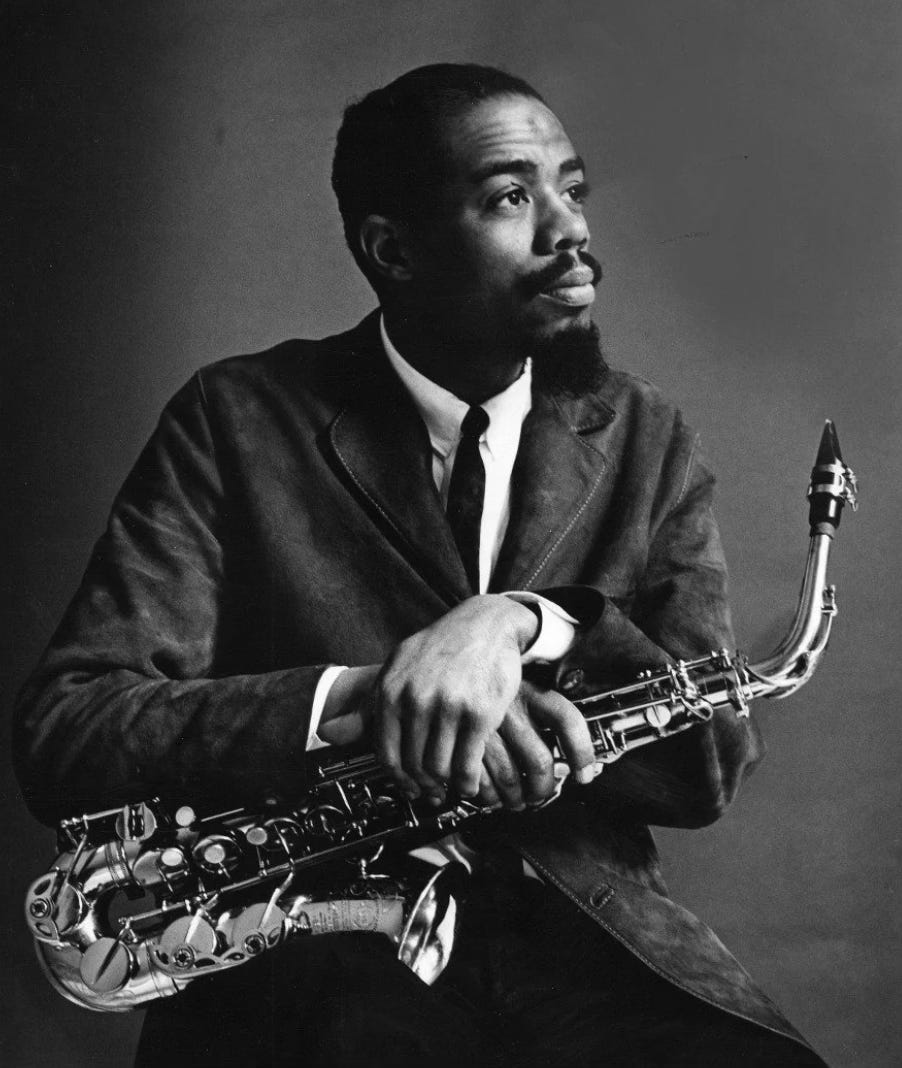
There is a moment in many Eric Dolphy recordings when the music seems to leave the room entirely — when a phrase curls upward beyond any conventional scale, when a bass clarinet growl descends into something almost feral, or when a flute line scatters like startled birds. And then, impossibly, it all coheres. The music comes home. That is the Dolphy experience: the sensation of the ground dropping away, and then solid earth beneath your feet again.
In a career tragically cut short at thirty-six, Eric Dolphy produced one of the most singular bodies of work in jazz history. He was a composer, an improviser, and a triple instrumentalist of extraordinary range. He expanded what each of his instruments could say, collaborated with the greatest minds of his era, and left behind a sound so distinctive that even today — sixty years after his death — no one has quite replicated it. What he sought was nothing less than a new language, one that had room for every bird call, every ache, every human voice that had ever tried to say something that words couldn’t hold.
Eric Allan Dolphy was born in Los Angeles on June 20, 1928, into a family that encouraged music from the start. While other young players learned to make their horns sing in accepted ways, Dolphy was drawn to the extreme registers, to the timbres that sounded strange or unsettled, to the pitches that fell between the cracks of the piano keyboard.
He studied music formally in Los Angeles and later served in the Army, playing in military bands where his technical gifts were obvious even if his aesthetic restlessness was out of place. After his discharge, he worked the club scene in L.A. before heading to New York in the late 1950s, where the avant-garde was fermenting and the city was hungry for players willing to push.
What set Dolphy apart from the beginning was his absolute command of three distinct instruments:
Alto Saxophone — His most expressively raw voice, jagged and searching, capable of extraordinary speed and searing emotional intensity. His phrasing was angular and unpredictable: he would leap across intervals that other players wouldn’t dream of, land on tones that seemed wrong and then feel inevitable.
Bass Clarinet — Almost single-handedly brought this instrument into jazz as a solo voice, plumbing depths that felt ancient and new at once. The instrument had been a novelty at best; Dolphy made it into a protagonist, using its woody darkness to evoke something pre-rational — myth, or grief, or the sound of deep water.
Flute — Introduced microtones and breath effects rarely heard in jazz, creating a floating, atmospheric quality unlike any contemporary. Musicians who heard him for the first time often described the sensation of hearing something genuinely new, as though a previously unknown species had announced itself.
His harmonic concept drew on a wide range of influences. He absorbed bebop thoroughly, studied 20th-century European classical music, was fascinated by birdsong as a compositional source, and listened deeply to non-Western music. The result was a style sometimes described as belonging to the “New Thing,” or free jazz, but which was really something more personal and more disciplined than that label suggests. Dolphy was never randomly free. Every deviation from the expected had a purpose.
The Meeting with Coltrane
In the world of early-1960s jazz, there was no more consequential partnership than the one between Eric Dolphy and John Coltrane. The two men were different in temperament — Coltrane was slow-burning, meditative, monumental; Dolphy was more mercurial, darkly playful, prone to sudden flights — but they recognized something essential in each other almost immediately.
The relationship that mattered crystallized in 1961, when Coltrane invited Dolphy to join his working group. This was not a casual addition. Coltrane was pushing away from his hard bop mastery toward something more expansive and spiritually charged. He needed a musical interlocutor of the highest order — someone who could follow him anywhere, and who had enough of their own to push back. Dolphy was that person.
The collaboration produced an immediate and highly publicized controversy. A Down Beat magazine review called their live performances at Shelly’s Manne Hole in LA as “anti-jazz.” Coltrane and Dolphy responded publicly and calmly, explaining their intentions and methods. It was a remarkable moment: two musicians at the frontier of the art form, taking the time to articulate exactly what they were doing and why.
What the recordings from this period reveal is an extraordinary musical dialogue. On the Live at the Village Vanguard sessions of 1961, their interplay has the quality of a conversation between two people finishing each other’s sentences and then taking those sentences somewhere neither had anticipated. Dolphy extended the vocabulary of the group in ways that made the music bigger without making it louder.
The friendship was genuine. Coltrane spoke of Dolphy with consistent reverence, describing him as one of the most complete musicians he had ever known. For his part, Dolphy credited the collaboration with pushing him to think more deeply about how freedom could be achieved not by abandoning form but by bending it past its previous limits. They were each other’s most demanding audience.
Respected Across Every Boundary
What is striking, looking back at the testimonies of musicians who knew or played with Dolphy, is how consistently the same qualities are mentioned: his total lack of ego about music, his generosity as a collaborator, his insatiable curiosity, and his humanity. He was not a difficult man. He was warm, gentle, and deeply serious about music in a way that made others feel that their own seriousness was validated.
Charles Mingus — not famous for his patience with mediocrity — kept Dolphy in his group for an extended period and wrote music that seemed designed to showcase him. He recognized in Dolphy something that transcended technical skill: a willingness to be fully present in the music, to mean every sound, to never coast.
Ornette Coleman, whose own harmolodic system was in many ways the theoretical cousin of what Dolphy pursued, admired him deeply. Both men insisted that emotion and personal expression were more fundamental than harmonic convention, and both paid the price in critical incomprehension before the world caught up. They recognized in each other a shared commitment to sincerity — the sense that the music must always be telling the truth, even if the truth is uncomfortable or strange.
Younger musicians revered him for different reasons. He was unfailingly kind to players learning their craft, willing to talk about music for hours. Bobby Hutcherson — the vibraphonist who appears on Out to Lunch! and was in his early twenties at the time — described the recording sessions as feeling like a master class as much as a record date. Dolphy created an environment in which every musician felt both challenged and completely free.
Out to Lunch!, recorded in February 1964, stands as Dolphy’s definitive statement as a composer and bandleader — and quietly, one of the most influential albums in jazz history. Its asymmetric rhythms, wide-interval melodic writing, use of silence and space, and refusal of conventional resolution all became part of the DNA of creative music in the decades that followed. Musicians who have never heard of Dolphy are playing ideas he first articulated here.
He died in Berlin on June 29, 1964, of complications arising from diabetes that had gone undiagnosed. He had been playing concerts in Europe, was scheduled to stay and work with European musicians, and was by all accounts in excellent spirits. He was thirty-six years old.
The musician who perhaps felt the loss most acutely was Coltrane, who had been planning further collaborations and who would go on, before his own death in 1967, to push in directions that Dolphy’s presence might have shaped differently. Whether Coltrane’s increasingly ecstatic and formally open music would have been modulated by Dolphy’s more linear intelligence is one of jazz history’s great unanswerable questions.
What is answerable — what the recordings make irrefutably clear — is that Dolphy was one of those artists who genuinely extended what was possible. Not by discarding the tradition but by listening to it so deeply that he found the doors within it that no one had noticed. The intervals between the familiar notes. The sounds that language almost has words for. The music, as he said himself, that disappears into the air.
It disappears, but it has never really gone. Every musician who plays with total honesty, who follows a musical idea past the point where it feels safe, who insists that expression is more important than approval — every one of them is playing in a tradition that Eric Dolphy helped to make. The voice between the notes is still speaking.
November 24, 1961, Baden-Baden, West Germany for German television, with John Coltrane, here’s Eric Dolphy’s solo on “Impressions.
What a beautifully written piece, befitting the greatness of Eric Dolphy. You know, people either hear it or they don’t. When you do, you realize how astonishing and emotionally honest and unique it was the way Eric heard sound. As you said, like no one else.
My favorite album with Eric is Blues and the Abstract Truth. Oliver Nelson, a genius in his own right, assembled this brilliant cast and wrote the most incredible music for them that somehow allowed each musician to be themselves and yet be cohesive. That only happens when the musicianship is on a supreme level. Here’s Teenie’s Blues - Dig!
https://youtu.be/JHLir4XibmU?si=nUILAq3i-DDLLH8y
Dolphy was the sound and all of the textures imaginable coming from a total perspective of his Own Inner Rhymic Pulse. 🎷 He was and always will be my hero.