

UPDATE June 10, 2026:
Chuck Redd won! D.C. Superior Court Judge Tanya Jones Bosier dismissed the Kennedy Center’s lawsuit against him last Friday, ruling that the Center failed to prove there was a legally binding agreement for Redd to perform at the Christmas Eve concert.
The dismissal was granted under Washington’s Anti-SLAPP laws, which are designed to prevent meritless lawsuits intended to silence opposing viewpoints on matters of public interest.
The core issue was simple: the Kennedy Center claimed Redd had signed a contract to perform, but the judge found it “undisputed” that he had not signed the agreement. She also noted the Center hadn’t lost any revenue since the concert was free, and that the entire event was canceled because multiple artists pulled out, so the Center incurred no costs for staff or other performers.
Redd’s attorney Lisa Banks called it “political retribution, pure and simple,” and said the court correctly saw it as such in dismissing the case with prejudice.
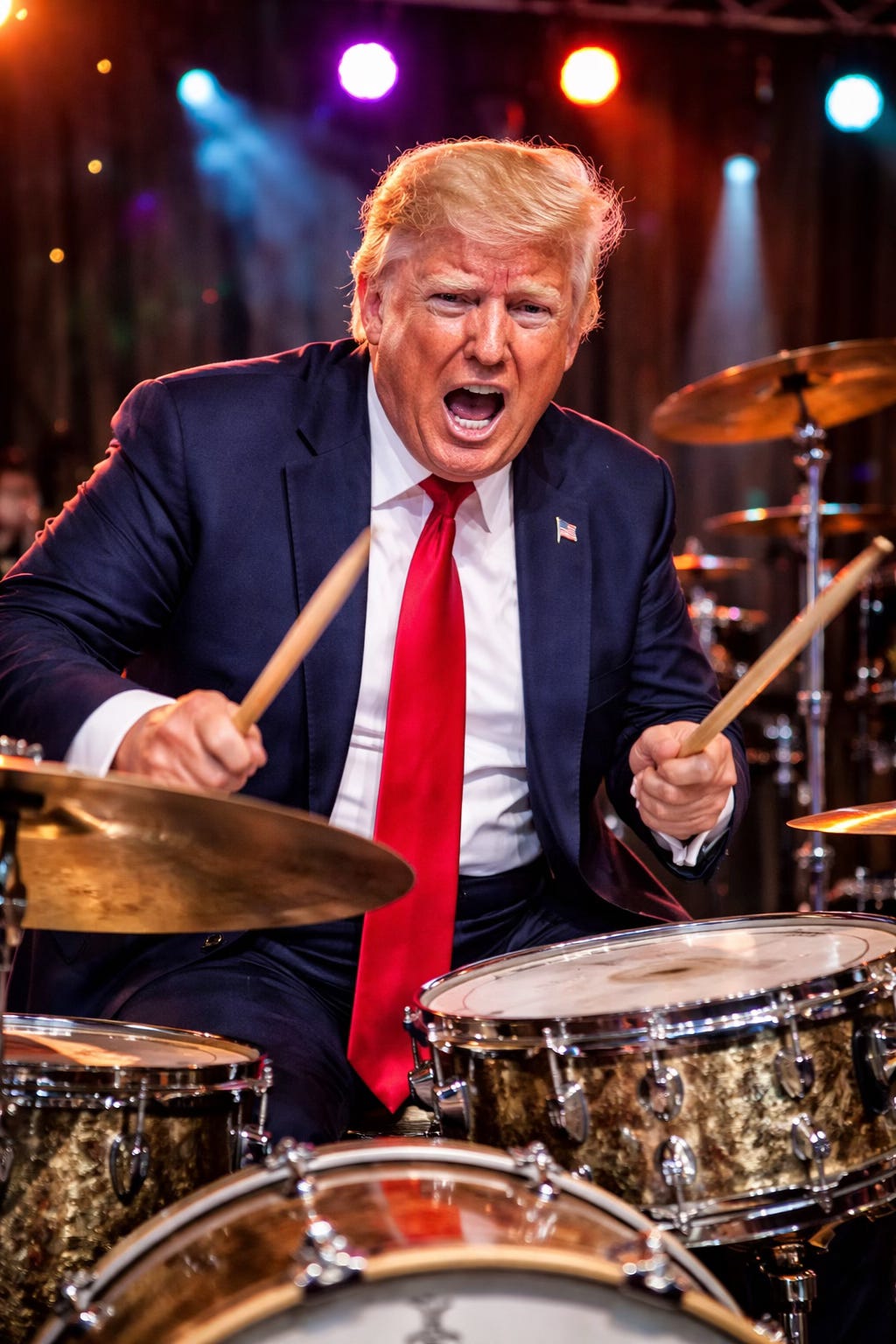
Poor Chuck Redd. The accomplished Washington DC drummer and vibraphonist has found himself in the crosshairs of Donald Trump’s ever-expanding enemies list, targeted not for his artistry but for refusing to participate in what amounts to presidential vandalism.
Trump’s obsession with domination extends far beyond policy into every corner of American cultural life. His compulsive need to stamp his name on institutions he has no right to claim reveals a man driven by ego and an insatiable appetite for control. The Kennedy Center stands as just the latest victim of this branding mania, illegally rechristened the “Trump Kennedy Center” in defiance of both law and decency.
Trump’s relationship with music has always been tellingly shallow. Jazz, that most American of art forms, created through collaboration across racial lines and rooted in improvisation and freedom, remains utterly foreign to him. His musical vocabulary extends only to the bombast of Lee Greenwood’s jingoistic anthems and Kid Rock’s calculated provocations, with occasional nods to Kiss. At Mar-a-Lago events, Trump fancies himself a DJ, spinning tracks from the Village People and Queen, groups whose members would likely recoil at the association. He understands music only as soundtrack to his own glorification, never as art with meaning beyond his immediate gratification.
Chuck Redd has been leading the annual Kennedy Center Christmas Eve jazz jam session for nearly twenty years, a beloved tradition that celebrates the music and the season. When he withdrew from this year’s festivities rather than perform in a venue bearing Trump’s illegally affixed name, he committed an act of artistic conscience. Musicians, after all, don’t want to perform in what amounts to a crime scene.
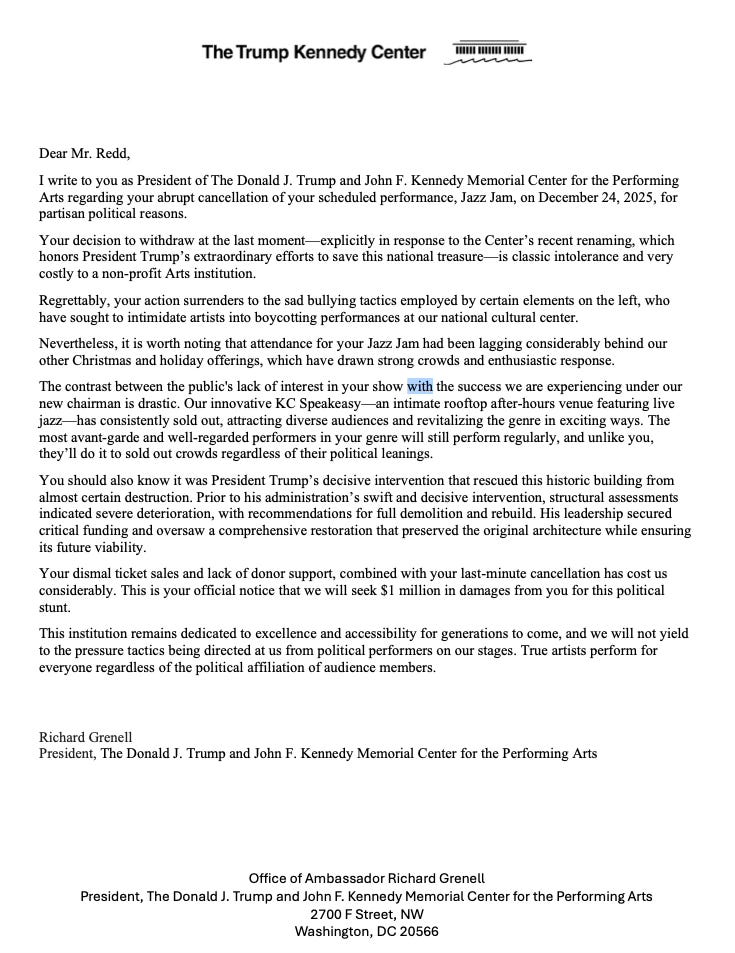
But Trump’s regime does not tolerate even the mildest form of resistance. His enforcers, led by Richard Grenell, the hatchet man now heading the Kennedy Center board, have threatened to sue Redd for one million dollars. Let that sink in: a million-dollar lawsuit because a musician chose not to perform. This is not governance. This is retribution, pure and simple, the kind of vindictive punishment Trump has promised to rain down on anyone who dares to defy him.
Grenell’s letter to Redd drips with the characteristic bad faith of Trump’s operation: “The left is boycotting the arts because Trump is supporting the arts, but we will not let them cancel shows without consequences. The arts are for everyone, and the left is mad about it.” This inverts reality with such audacity it almost demands admiration for its shamelessness. Trump is not supporting the arts. He is colonizing them, annexing cultural institutions to serve his brand and his ego. The arts may be for everyone, but Trump believes everything should be for Trump.
This lawsuit threat reveals everything about Trump’s authoritarian instincts. He cannot simply accept that an artist chose not to participate. He must punish. He must destroy. He must make an example. Every act of resistance, no matter how small or personal, must be met with overwhelming force. This is the pattern of a man who views power not as responsibility but as weapon, who sees every interaction as zero-sum, every disagreement as betrayal.
The legal argument against Redd may well founder on basic contract law. Performance contracts contain implied covenants of good faith and fair dealing. When the Kennedy Center unlawfully renamed itself, it arguably breached those covenants. More fundamentally, as my attorney noted, performing in the Kennedy Center under its illegal name could constitute aiding and abetting a crime. The renaming itself is vandalism, a defacement of a national institution. Any artist who lends their talents to legitimizing that vandalism becomes complicit in it.
Consider the parallel: if vandals were spray-painting buildings and you performed concerts to encourage them, promoted their activities, told others to join in, you would be aiding and abetting vandalism. The principle applies here. Trump has spray-painted his name across the Kennedy Center without authority to do so. Musicians who perform there under that stolen banner become part of the crime.
But the legal arguments, however sound, miss the deeper point. Trump’s lawsuit threat against Chuck Redd exemplifies his fundamental approach to power: total control, zero tolerance for dissent, and punishment for anyone who fails to bow. This is not about protecting the arts or ensuring access. This is about dominance and revenge.
Trump has always been transparent about his love of retribution. He promises it openly, celebrates it publicly, pursues it relentlessly. The lawsuit against Redd serves multiple purposes in Trump’s calculus. It punishes one man who dared to say no. It intimidates countless others who might consider similar acts of conscience. It demonstrates to his followers that he will fight for them against the cultural elite, even when the fight is entirely of his own making. And perhaps most important to Trump’s psychology, it allows him to dominate someone, to make them suffer consequences for defying him.
This is governance by vendetta. This is leadership as endless grievance. Trump cannot let go of any slight, cannot forgive any resistance, cannot tolerate any space that refuses to submit to his will. The Kennedy Center must bear his name. The musicians must perform. The institutions must kneel. And anyone who refuses must pay.
Chuck Redd’s quiet act of principle has exposed all of this. By simply declining to perform, he has forced Trump and his operatives to reveal their authoritarian impulses in full view. The million-dollar lawsuit threat strips away any pretense that this administration respects artistic freedom, individual conscience, or the rule of law. It shows us exactly what Trump means when he promises to punish his enemies: financial ruin, legal harassment, and the full weight of presidential power turned against private citizens who commit no crime beyond exercising their rights.
Poor Chuck Redd indeed. But also: brave Chuck Redd. In refusing to perform in a vandalized venue, in declining to legitimize an illegal act, in standing by his artistic conscience despite the threats, he has done what more Americans need to do. He has said no to a president who cannot bear to hear that word.
Trump’s need for control knows no bounds. His taste for retribution knows no limits. The Kennedy Center, illegally branded with his name, stands as testament to both. And Chuck Redd, facing a million-dollar lawsuit for the crime of artistic integrity, stands as testament to the cost of resistance.
The question facing every American artist, every cultural institution, every citizen is simple: Will you perform in the crime scene? Will you legitimize the vandalism? Will you submit to the control and accept the retribution as the price of saying no?
Chuck Redd has given his answer. History will remember not just what Trump tried to do to the Kennedy Center, but what he tried to do to the man who refused to play along.
We here in the DC area, and I'm sure from all around the world, have Chuck Redd's back. Looking for those close to him to set up a crowdfunding page should it become necessary.
Recently launched website:
TrumpKennedyCenter.org - A National Institution Devoted To Power And Loyalty
NEXT EVENTS - RING IN THE NEW YEAR WITH A PERFORMANCE BY: THE EPSTEIN DANCERS!