

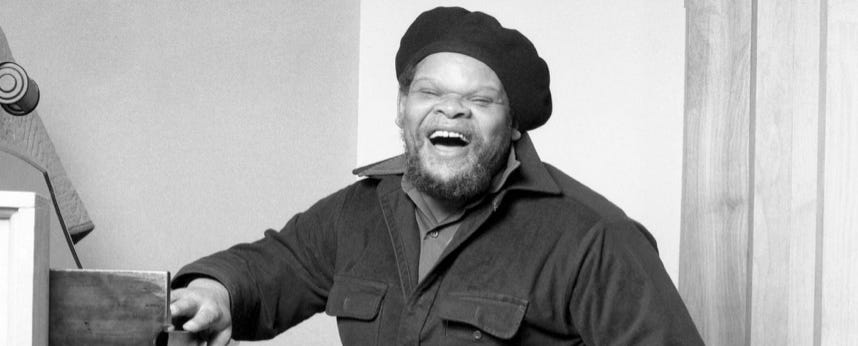
There are musicians whose fingerprints are all over the jazz we love, whose names surface in the liner notes of essential albums and in the memories of the men who made bebop what it is, and yet who never quite made it into the mainstream narrative. Walter Davis Jr. is one of those musicians -- a pianist and composer of uncommon depth, a keeper of the bebop flame, a man who taught the tradition to the next generation while the spotlight tracked others. His story is one of extraordinary talent, interrupted momentum, and a body of work that rewards serious attention more than three decades after his death.
Davis was born in Richmond, Virginia in 1932 and raised in East Orange, New Jersey, in a family saturated with music. His mother sang gospel. His father and uncles played piano in church. The young Walter studied classical piano, showed promise as a visual artist, and seemed headed in several directions at once -- until the night he heard Charlie Parker and Dizzy Gillespie perform with the Billy Eckstine band. That concert rewired him permanently. Bebop was not just music he wanted to play; it was the only music he could imagine playing.
What followed was one of the more remarkable apprenticeships in jazz history. As a teenager, Davis fell into the orbit of Thelonious Monk and Bud Powell, two of the architects of modern jazz, and both men took him seriously. Powell, in particular, used Davis as a sounding board for new compositions, running him through pieces and barking out specific chord changes while Davis absorbed everything. He was Powell’s musical guinea pig -- the trusted set of hands that new material passed through before it reached the public. Davis was so deeply embedded in Powell’s world that when Powell couldn’t make a gig, Davis held down the piano chair. Wayne Shorter remembered it years later, using the nickname the scene had given the young Davis: Humphrey. To be called Humphrey at that age, in those rooms, was a form of benediction.
His professional career began in earnest in the early 1950s. His first major engagement was with Charlie Parker at the Apollo Bar, and by 1953 he was making his first recordings with drummer Max Roach. His world had become 52nd Street, the Newark jam sessions, the cutting-edge conversations happening every night in the clubs and after-hours rooms of New York. He was exactly where he needed to be.
In 1956, Davis joined Dizzy Gillespie’s Big Band, and what he described as a period of “making history” began. The band toured the Middle East, South America, and Europe -- a State Department-backed cultural diplomacy effort that put American jazz in front of international audiences hungry for it. Davis, committed to the music in the most practical possible sense, memorized the entire piano book so he wouldn’t have to carry it on the road. From 1958 to 1959 he was based in Paris, performing with Donald Byrd and Bobby Jaspar, and forming a close bond with bassist Oscar Pettiford, who would visit Davis regularly to talk and play.
When he returned to the United States, he recorded his debut as a leader: Davis Cup, released on Blue Note in 1959. The album was composed entirely of his own material, featuring trumpeter Donald Byrd and saxophonist Jackie McLean, two musicians who understood his language completely. It announced a compositional voice that was serious, blues-rooted, and harmonically sophisticated. The hard bop scene had plenty of technically accomplished pianists; Davis was something more particular. Jazz historian Marc Myers compared his touch to Horace Silver -- commanding and percussive -- but Davis brought something harder to name: a gothic weight, a brooding harmonic seriousness that gave his playing its own unmistakable character. He favored dense voicings and dissonant harmonies. He was not interested in flash.
His association with Art Blakey and the Jazz Messengers defined another chapter. Davis joined in 1959 and returned for another stint in 1975, and during those years he contributed something lasting: a set of compositions that became Messengers repertoire staples. Scorpio Rising, Backgammon, and Uranus were not filler. They were the kind of pieces a band returns to because they hold up, because they have something in them worth excavating night after night. Davis was a sideman who left fingerprints on the music that outlasted his tenure.
And then, more than once, he stepped away. Personal difficulties interrupted his momentum. At one point he left the music industry entirely to run his own tailor shop. In 1969 he spent time studying Indian classical music, following his curiosity into unfamiliar territory the way a musician of genuine intellectual seriousness would. These departures cost him in terms of visibility and the kind of career continuity that builds public profiles. But they did not diminish what he brought back each time he returned.
He came back to recording in the late 1970s and produced some of his finest work. His composition “Blue Minor” had by then become a signature piece covered by other musicians, a quiet marker of influence. And in 1987, he recorded In Walked Thelonious for the Mapleshade label -- a solo piano tribute to Monk that stands as one of the more moving homages in the jazz discography. It was the work of a man who had studied the tradition from the inside, who had sat with Monk himself, and who understood what he was paying tribute to at a cellular level.
In 1990, Davis recorded a Piano Jazz session with Marian McPartland, one of the finest platforms the music had for presenting its practitioners in a thoughtful, unhurried way. Shortly after, he fell ill. He died in June 1990, at 57, from complications of untreated diabetes. His obituary in the Philadelphia Tribune called him one of the great bebop stylists of his time.
Drummer Ralph Peterson Jr., who learned the tradition directly from Davis, put it plainly: “Walter taught me the tradition of Bud and Monk.” That line contains a full education. To transmit Bud Powell and Thelonious Monk to the next generation is not a small thing. It is the work of someone who understood what the music was and what was at stake in passing it forward.
The mainstream jazz conversation has largely left Davis out, which is the kind of historical accident that happens to certain musicians for reasons that have more to do with timing, circumstance, and luck than with the quality of the work. The work is there. Davis Cup and In Walked Thelonious are not historical curiosities -- they are records that hold up under serious listening, that give back something new each time. There is a particular pleasure in discovering a musician of this quality, in understanding what he contributed and why it mattered. Walter Davis Jr. lived completely inside the bebop tradition, passed it forward faithfully, and left behind a legacy that is still waiting for the wider audience it deserves.
Listen to “Pranayama,” a Walter Davis, Jr. composition featuring Walter on piano, Santi Debriano on bass and Ralph Peterson on drums.
Listen to “Splendid,” another Davis composition, with the Art Blakey and the Jazz Messengers. This edition of the Messengers includes Blakey on drums, Davis on piano, Jymie Merritt on bass, Wayne Shorter on tenor saxophone and Lee Morgan on trumpet.
WKCR-FM Interview with Walter Davis, Jr. February, 1986, Interviewer uncredited, where he discusses Dizzy and Monk and Bud and Jackie, a whole lot more. The interview is unedited, for now. But perhaps someone can create subjects and timings and add it to the comments.
Brett, thank you for a long overdue tribute to a bebop master of understatement in his group’s foundational rhythm section. He sort of reminds me of Jackie Bayard’s approach to forcefully shaping the unique background atmosphere and timing of the piece he was playing. It’s fitting that he be celebrated for his contributions to the music we love.
Thanks for remembering Walter Davis Jr. I saw him one night in a tiny Paris club with Pierre Michelot on bass and Kenny Clarke on drums. What a blast! They made a record out of it, Live at the Dreher, which never made it to CD or streaming, alas.