

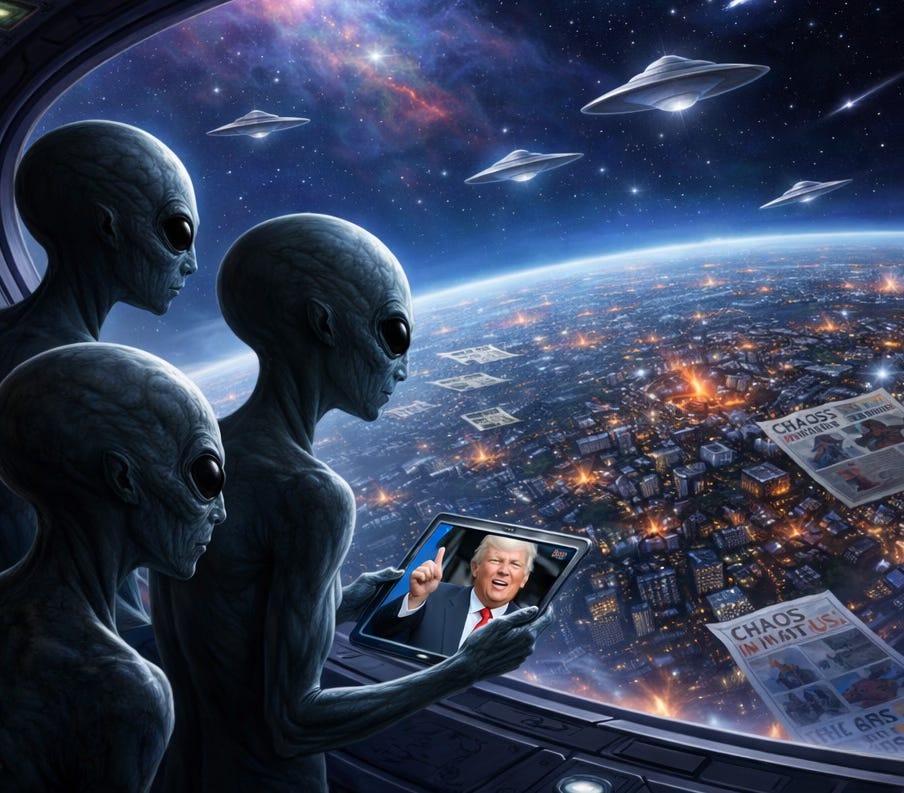
Let’s assume the unthinkable has already happened. The universe got bored and sent its best tourists.
They are out there right now. Not your grainy Navy footage. Not your congressional slideshow. I mean the real operators. A civilization so far ahead they treat faster-than-light travel the way you treat an Uber. Protein folding. Solved. War. Ancient history. Scarcity. A bad joke they tell at dinner.
And for reasons no sane species could justify, they pick Earth.
April 2026. Perfect timing. The place is buzzing. Donald Trump is on his own platform promising to crack open the government’s UFO files like a piñata. This comes after Barack Obama went on a podcast and shrugged, more or less, “Yeah, they’re probably out there, I just never saw them.” That was enough to send the natives into a frenzy. Now we are waiting for disclosure the way people wait for a delayed flight that keeps getting pushed back another hour with no explanation.
The aliens arrive. They do a slow pass over the atmosphere. They scan the data.
And then they hesitate.
Because what they see is not encouraging.
They see a species that cracked the atom and used it as a threat. Built networks that connect the entire planet and filled them with arguments about whether reality exists. Heated its own biosphere to a rolling boil while holding committee meetings about whether the thermometer is broken. They see a dominant power structure where volume beats wisdom and money beats both.
They check the timestamp. Yes. This is the current version.
Down below, the big reveal is stuck in bureaucratic molasses. No clear files. No dates. No urgency. The truth about the cosmos is being processed with the same efficiency as a lost form at the DMV. Somewhere, Harvard’s Avi Loeb is already on record saying if you looked at Earth from a distance, you would be disappointed. Most of our resources go into figuring out how not to kill each other, or how to do it faster when we fail.
That is one of our smartest people talking.
Now imagine a species that retired from war before your ancestors figured out agriculture.
They would not need a translator to understand what they are looking at. They would need a polite word for it. They would not have one.
We spend all our time asking what they look like. Eyes. Skin. Ships. Smell. We sketch them like suspects in a cosmic lineup. Meanwhile, we have never seriously asked the only question that matters.
What do we look like to them.
From orbit, the résumé is schizophrenic. Moon landing. Genome mapping. John Coltrane blowing a hole through the known emotional spectrum. Hospitals. Libraries. Acts of quiet grace that never make the news.
Also. Efficient killing machines. Endless conflict. A climate problem we argue about like drunk men debating a bar tab while the building burns.
They would circle. They would observe. They would take notes.
If they have a classification system, we are in a category with a warning label.
Back on Earth, officials like Sean Kirkpatrick are preparing everyone for disappointment. No new revelations. Nothing to see. Either the cupboard is empty or someone hid the food so well even the cooks cannot find it.
Then you get a more optimistic voice. Edwin Bergin says if a species traveled this far, they would show themselves. Otherwise why bother.
That assumes curiosity beats caution.
You watch a slow-motion car crash. You do not jump into it.
So maybe they sit. They watch. They treat Earth like a long-running series with uneven writing and moments of accidental brilliance. A civilization that swings between genius and self-sabotage with no stable middle.
Will they fix the climate? Will they stop shooting each other? Will they grow up before they burn the set down?
And here is the uncomfortable part. We are not just the chaos. We are also the signal buried under it. The same species launched Voyager into interstellar space. The same species wrote “A Love Supreme.” The same species pulls strangers out of floods and builds something again after every collapse.
From a distance, though, the worst clips run on a loop.
If they are watching, and I suspect they are, the message is simple.
Some of us see the problem. Some of us are trying.
The rest are still arguing about weather balloons.
Cosmically speaking, we are newborns with access to matches. About 300,000 years old as a species. Roughly 10,000 years into anything you would call civilization. No rehearsal. No supervision. Just a young band on stage, still arguing about the key while the audience waits.
The only real question is duration. Do we last long enough to get good?
Or this.
They never left.
Not ships over cities. Nothing so theatrical. Something quieter. Embedded. Watching from angles we trained ourselves to ignore. Pilots track objects that move like physics is optional. Instruments pick up things that behave like they read the radar instead of reacting to it.
And long before radar, you had stories. Persia. Vedic texts. The Dogon people. The Hopi. No contact. Same reports. Beings from the sky handing down knowledge like contraband.
We called them gods because we had no better word.
Maybe “visitation” is the wrong idea. Maybe presence is closer. Something that predates our arguments, our borders, our brief, noisy run at dominance.
Something that has been here long enough to know how this usually ends.
And is still watching to see if this time is different.
Bret
Awesome essay. Just discovered this side of you after all that jazz!
This is an amazing essay, Bret. It's simply out of this world. Here is my version of very similar ideas:
I can imagine a better kind of human being.
More brave. More insightful. More compassionate.
I can imagine and wish
that I was that better human being but
this isn’t my time. Only a few are ready.
Our minds can be
more effective
more conscious
some time to come. I can imagine
being a better kind of human
and maybe some day I will live
that destiny but trouble always makes a place
and the human race goes off
on a tangent
goes nuts for nothing
kills without provocation.
We must do better or vanish.
The human race? The universe teems
with life, is filled
with species, races, creatures beyond
every horizon, every direction
intelligent, inventive, kind creatures, dexterous
and wise.
Today I will become a better kind of human being.
They are out there, but No one is coming to save us. Ten thousand races of vibrant creatures
avoid this planet, know to avoid humanity for a while yet to come.